A renovation permit does not clear the way for construction by itself. In New York City, you must determine whether the planned work will disturb asbestos-containing material before demolition, alteration, renovation, modification, or plumbing work begins.
That means arranging an asbestos inspection in NYC early enough to support design, filing, bidding, and construction scheduling. The survey must be performed by properly credentialed professionals, and the results must support the correct NYC Department of Environmental Protection filing, such as an ACP-5 or ACP-7.
A missed material or incomplete filing can delay a DOB permit, force redesign, or create avoidable exposure during construction.
When do you need an asbestos survey in NYC?
Under New York State Industrial Code Rule 56, an asbestos survey is generally required before work that may disturb building materials during:
- Renovation or remodeling
- Interior or exterior demolition
- Repair work
- Alterations and modifications
- Plumbing work
- Roof, façade, window, or mechanical work
- Cutting, drilling, sanding, scraping, or removing suspect materials
The New York State Department of Labor states that the survey must cover the entire area affected by the project. If the survey is not completed, the building or affected area may need to be treated as containing asbestos.
NYC adds its own requirements. The building owner or authorized agent must arrange for a survey by a NYC DEP Certified Asbestos Investigator, or CAI, as early as possible before work begins. The investigator determines whether asbestos-containing material, or ACM, may be disturbed.
The practical rule is simple: if your scope touches existing building materials, address asbestos before the architect finalizes the permit set and before contractors price the work.
Learn more about Envicon’s environmental assessment services.
Industrial Code Rule 56 and the certified inspector
New York State Industrial Code Rule 56, found in 12 NYCRR Part 56, establishes the requirements for asbestos surveys, project classification, abatement, worker protection, and documentation.
A compliant survey must be performed by a New York State-certified asbestos inspector. In many project circumstances, the inspector works through or in coordination with a firm holding the required New York State asbestos handling credentials.
For NYC work, there is an additional distinction. A NYSDOL-certified inspector and a NYC DEP Certified Asbestos Investigator are not necessarily the same credential. An ACP-5 must be completed, signed, and sealed by a DEP-certified investigator.
For a NYC renovation, confirm that the firm you hire can satisfy both sides of the process:
- NYSDOL requirements under Industrial Code Rule 56
- NYC DEP requirements under Title 15 of the Rules of the City of New York
- DOB documentation and filing requirements
- Laboratory sampling and chain-of-custody procedures
- Coordination with the architect, filing representative, general contractor, and abatement contractor
This is one reason a low-cost visual inspection often creates problems later. A permit-ready survey must connect field conditions to the actual construction scope.
What the survey must evaluate
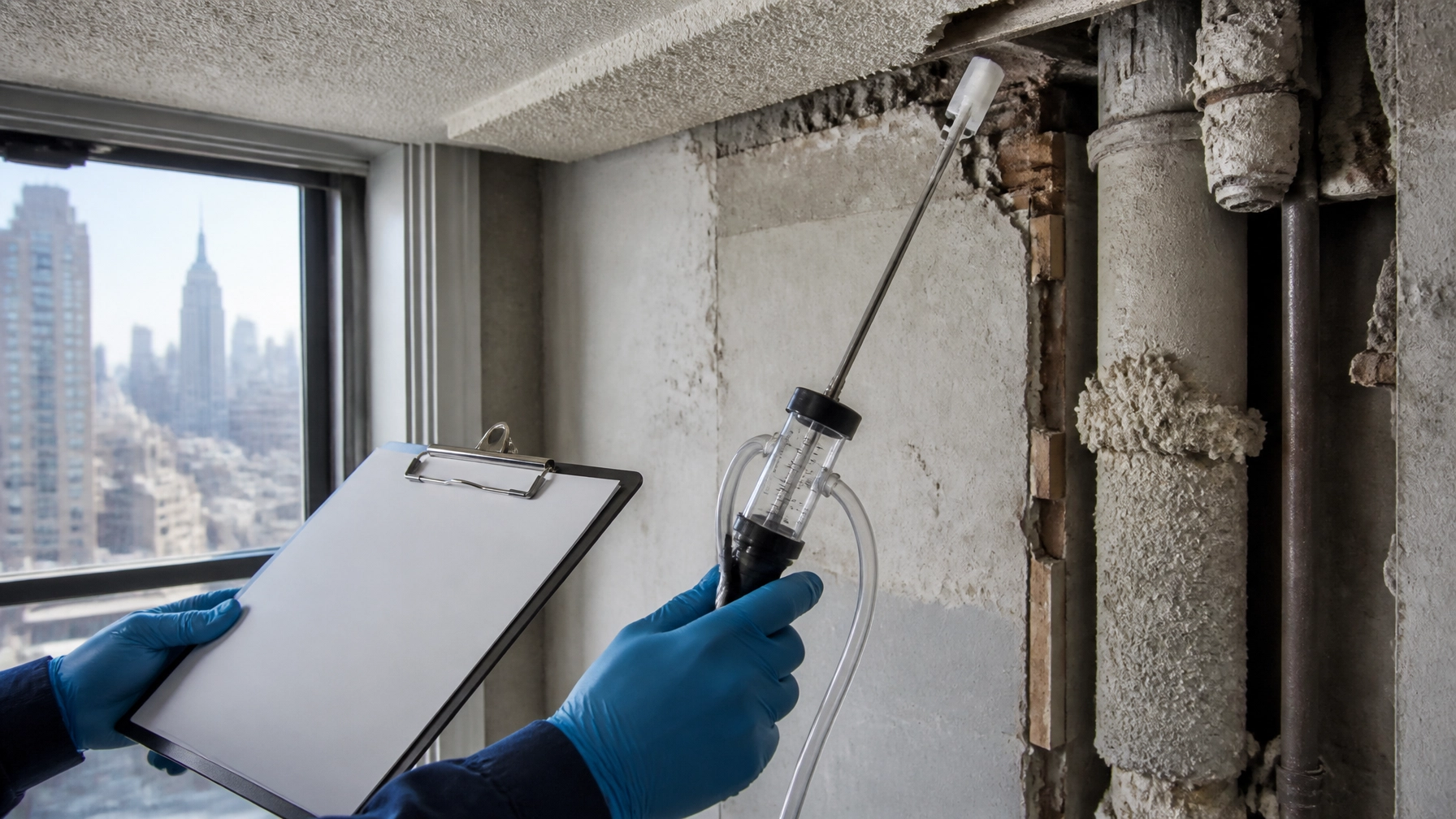
A qualified asbestos survey is not just a walkthrough. The inspector evaluates building materials by location, material type, appearance, application, condition, and relationship to the proposed work.
Homogeneous areas
A homogeneous area is a space or group of materials that appears uniform in composition, installation, age, color, and use. Examples can include:
- Similar floor tile and adhesive installed throughout a floor
- A consistent plaster ceiling system
- Pipe insulation installed on the same mechanical system
- Matching window caulk on one building elevation
- A common roofing or flashing material
The inspector develops a sampling strategy for each homogeneous area. One sample does not automatically represent every material in a building. Changes in color, texture, installation date, substrate, or repair history may require separate sampling.
Bulk sampling
Bulk samples are small portions of suspect material collected for laboratory analysis. Depending on the material, the inspector may sample:
- Floor tile and mastic
- Plaster and joint compound
- Ceiling tile
- Thermal system insulation
- Roofing materials
- Fireproofing
- Window and door caulk
- Transite panels
- Adhesives and sealants
Sampling should use controlled methods that limit the release of dust and prevent cross-contamination. Each sample needs a clear location, material description, and chain-of-custody record.
Laboratory results must then be tied back to the floor plan and construction scope. A report that lists results without showing where the materials occur is difficult for a contractor and filing team to use.
Inaccessible spaces
Some materials cannot be fully accessed during an initial inspection. Examples include:
- Wall cavities
- Chases and pipe risers
- Concealed ceiling spaces
- Areas behind fixed millwork
- Mechanical shafts
- Roofing or façade assemblies
- Materials covered by finishes that will remain in place
The inspector should document the limitation rather than imply that the area is asbestos-free. If the planned work will expose the space, the project team may need additional destructive inspection before construction or must manage the material as suspect until it is properly characterized.
This is where coordination matters. Your architect and contractor need to know what was inspected, what was not accessible, and what additional work may be required before disturbance.

ACP-5, ACP-7, and DOB filing requirements
The survey determines which filing path applies.
ACP-5 asbestos inspection report
An ACP-5, or Asbestos Assessment Report, is generally used when:
- No ACM is present in the affected area
- ACM is present but will not be disturbed
- The work qualifies as a minor project under applicable NYC requirements
NYC DEP explains that the ACP-5 must be completed, signed, and sealed by a DEP-certified asbestos investigator. The form is submitted through the required DEP process and supports the DOB application.
For full demolition, NYC DOB has a specific requirement. An ACP-5 with the appropriate certification that the entire building is free of ACM is required for the full demolition permit pathway. An ACP-21 is not a substitute for that requirement in a full demolition application.
ACP-7 asbestos project notification
If the work will disturb more than 10 square feet or 25 linear feet of ACM, it generally meets the NYC definition of an asbestos project. The owner or authorized agent must file an ACP-7 Asbestos Project Notification through DEP’s Asbestos Reporting and Tracking System, or ARTS.
DEP states that the ACP-7 must be filed at least one week before asbestos project work begins. Larger, complex, occupied, phased, or life-safety-sensitive projects may also require review by the Asbestos Technical Review Unit, or A-TRU.
Do not treat the ACP-5 and ACP-7 as interchangeable forms. The correct filing depends on the survey findings and the actual scope of disturbance.
Coordinate the survey with the abatement contractor
The asbestos inspector identifies and classifies suspect materials. The abatement contractor performs the regulated removal, enclosure, or other abatement work. The air-monitoring firm must remain independent of the abatement contractor.
Early coordination helps prevent three common problems:
-
The survey misses the construction scope.
The contractor later finds suspect material behind a wall or above a ceiling. -
The filing does not match the field conditions.
A different floor, quantity, material, or work area appears during construction. -
The abatement plan conflicts with the construction sequence.
The project requires a revised ACP-7, ACP-8, A-TRU review, or new phasing plan.
A survey should be reviewed against the drawings before the permit package is submitted. If the scope changes, the asbestos documentation must be reassessed.

Asbestos inspection by NYC borough
NYC asbestos requirements apply citywide, but existing building conditions and project types vary by borough.
Manhattan
Asbestos inspections are common in prewar apartment buildings, office towers, institutional properties, retail spaces, and interior build-outs. Dense occupancy makes phasing, tenant protection, egress, and mechanical risers especially important.
Brooklyn
Renovations often involve mixed-use buildings, converted industrial properties, brownstones, and larger residential developments. Do not limit the survey to the interior. Façade materials, roofing, service areas, and old mechanical systems may also fall within the disturbance scope.
Queens
Commercial and industrial properties may have multiple additions, repairs, and material generations. A commercial asbestos survey in Queens should account for inconsistent finishes, warehouse components, pipe insulation, roofing, and phased construction areas.
The Bronx
Older multifamily, institutional, and commercial buildings may contain layered finishes and concealed building systems. Coordinate the survey with demolition drawings and identify inaccessible spaces before the contractor mobilizes.
Staten Island
Residential, public, and commercial properties can include detached structures, additions, garages, and outbuildings. Confirm that the survey boundary covers every structure and exterior component included in the DOB scope.
The rules do not change by borough. The risk of an incomplete scope does.
NYC permit-readiness checklist
Before submitting your DOB application, confirm that you have:
- Defined the complete renovation, demolition, or plumbing scope
- Identified all areas where building materials will be disturbed
- Hired a properly credentialed asbestos inspection firm
- Surveyed each relevant homogeneous area
- Collected representative bulk samples
- Documented inaccessible spaces and limitations
- Received laboratory results and a mapped report
- Determined whether the work is non-project, minor project, or asbestos project
- Completed and filed the appropriate ACP-5 or ACP-7
- Coordinated with the abatement contractor and independent air monitor
- Reviewed A-TRU triggers, occupied areas, egress, and fire protection impacts
- Matched the asbestos filing to the PW1 and construction drawings
- Reassessed the survey if the scope or phasing changes
Frequently asked questions
Is an asbestos survey required before every NYC renovation?
A survey is required when work may disturb building materials and is part of the NYC permit and asbestos compliance process. The narrow exceptions depend on the activity and applicable regulation. Confirm the project-specific pathway before filing.
Can my architect perform the asbestos inspection?
An architect may coordinate the work, but the asbestos survey and ACP-5 must be completed by professionals with the required NYSDOL and NYC DEP credentials.
Does a newer building need an asbestos survey?
Do not rely on construction date alone. NYSDOL guidance addresses surveys for renovation, repair, remodeling, and demolition broadly. NYC DOB and DEP requirements may also require documentation for permitted work.
How long does an asbestos inspection take?
Timing depends on building size, access, number of materials, laboratory turnaround, and whether the project involves demolition or A-TRU review. Schedule the inspection before the permit package is complete.
What happens if asbestos is found?
The project may require abatement by a licensed asbestos contractor, an ACP-7 filing, independent air monitoring, and additional DEP or DOB documentation before construction can proceed.
Keep the project moving
An asbestos inspection is not a paperwork exercise. It is an early construction decision that protects your schedule, your workers, your tenants, and your investment.
Envicon Group helps owners, developers, architects, attorneys, and contractors connect field investigation with permit readiness and construction planning. We focus on clear documentation, direct coordination, and practical next steps.
A compliant site is not just safer. It is a site that can move.
Take the next step
- Call Envicon Group now at (917) 764-2171
- Get a free quote today
- View our complete list of environmental and engineering services
Official sources
- New York State Department of Labor: New York State Asbestos Survey Requirements
- New York State Department of Labor: Industrial Code Rule 56 information
- NYC DEP: Asbestos Abatement Forms and Filing Instructions
- NYC DOB: Asbestos and Abatement Permit Requirements
- NYC DEP: Title 15 Asbestos Rules and Regulations