September 2026 update for building owners, property managers, developers, and real estate investors across Manhattan, Brooklyn, Queens, the Bronx, and Staten Island.
The August 29, 2026 extended filing deadline has passed.
For owners of covered NYC buildings, the immediate question is no longer whether the deadline is approaching. It is whether the building filed a complete Article 320 report, whether the filing accurately reflects 2025 emissions, and what happens next if the report was late, incomplete, or shows an emissions exceedance.
The answer requires more than an energy spreadsheet. NYC LL97 compliance 2026 often depends on coordinated work involving building systems, environmental conditions, structural capacity, electrical service, hazardous materials, excavation, and construction oversight.
What the 2026 LL97 deadlines required
For most privately owned buildings covered under Article 320, the annual building emissions report for calendar year 2025 followed this schedule:
- May 1, 2026: Standard LL97 reporting deadline.
- June 30, 2026: Last day of the applicable grace period and the deadline to apply for a filing extension.
- August 29, 2026: Extended filing deadline for owners who submitted the required extension request by June 30.
The August 29 extension was not automatic. Owners needed to complete the DOB NOW payment process and submit the required extension ticket through the BEAM reporting portal. The extension guide required building information such as the BBL, BIN, owner or representative information, and the DOB NOW payment confirmation number.
Owners who did not apply by June 30 generally could not treat August 29 as an available filing date.
Review the NYC Department of Buildings LL97 requirements and reporting guidance and the DOB extension request guide for the agency’s filing procedures.
What happens after August 29?
If your building filed by the applicable deadline, the next step is quality control. A filing can still create problems if the utility data, floor area, BIN assignment, emissions factors, or compliance pathway do not match the building’s actual condition.
If your building did not file, filed late, or submitted inaccurate information, do not wait for a violation notice before reviewing the file.
DOB reports two separate Article 320 penalty formulas:
-
Late filing penalty:
Gross floor area × $0.50 per month -
Emissions exceedance penalty:
(Actual emissions - annual emissions limit) × $268 per metric ton of CO2e
These penalties address different failures. A building can file on time and still face an emissions penalty. A building can remain below its emissions limit and still face a late filing penalty. Both may apply in the same reporting year.
For example, a 100,000-square-foot building could face a reported late filing penalty of $50,000 per month if the filing is late. If the building also exceeds its annual limit by 150 metric tons of CO2e, the reported emissions penalty would be $40,200.
See DOB’s LL97 violation and penalty information for the official formulas and Article 320 filing guidance.
The 2026 REC option requires careful reading
Renewable energy credits, or RECs, may help address qualifying electricity-related emissions under LL97. They do not function as a substitute for every form of building decarbonization.
Under the DOB-published REC framework:
- Eligible RECs must be associated with renewable energy resources located in, or whose output directly sinks into, NYC Zone J.
- LL97 RECs may address emissions attributed to utility-supplied electricity.
- RECs do not offset onsite fossil-fuel combustion from boilers, furnaces, domestic hot water systems, or other equipment.
- RECs cannot eliminate the need to evaluate physical building improvements.
- Building owners using the good-faith-effort decarbonization plan pathway face additional restrictions.
The DOB FAQ identifies Tier 4 projects including the Champlain Hudson Power Express and Clean Path New York. The FAQ anticipated Tier 4 REC availability beginning with CHPE in 2026 and CPNY in 2027.
There is an important current-versus-proposed distinction.
The DOB REC policy document published in September 2023 describes portions of the REC framework as a proposed policy. Building owners should not treat older proposed language as a complete statement of current filing requirements. At the same time, DOB’s current LL97 materials and REC FAQ state that the latest amendments restrict REC use for buildings choosing the decarbonization plan pathway during the first compliance period.
In practical terms, an owner should confirm all of the following before relying on a 2026 REC strategy:
- The REC source qualifies under the current DOB and LL97 rules.
- The REC applies to the correct reporting calendar year.
- The REC addresses utility electricity emissions, not onsite combustion.
- The building’s selected compliance pathway permits the purchase.
- The REC documentation will support the professional’s filing and any later DOB review.
Read the DOB LL97 REC policy and REC FAQ before making a procurement or penalty-mitigation decision.
LL97 retrofit environmental review is not just an energy exercise
A building owner may begin with a carbon calculation and discover that the required work affects nearly every major building system.
A serious retrofit plan should coordinate:
Asbestos and lead surveys
Mechanical-room work, pipe insulation replacement, electrical upgrades, roof work, and wall penetrations can disturb asbestos-containing materials or lead-based coatings, particularly in older Manhattan, Brooklyn, Bronx, and Staten Island buildings.
A hazardous materials survey should precede demolition or intrusive work. The findings should inform specifications, worker protection, waste handling, and contractor pricing.
Roof and structural review
Heat pumps, cooling equipment, rooftop solar, condensers, screening, and new electrical equipment add weight and wind loads. Roof penetrations can also affect waterproofing and existing structural members.
A structural engineer should review the proposed equipment layout before procurement. This avoids discovering after award that the roof needs reinforcement or that the selected equipment cannot be installed as designed.
Electrical service and utility coordination
Building electrification can increase electrical demand significantly. Service capacity, distribution equipment, panels, risers, transformers, emergency power, and utility coordination all matter.
In Queens and Brooklyn, a building may need electrical work sequenced with roof replacement, tenant protection, sidewalk access, or other capital projects. A retrofit that ignores the construction sequence can create avoidable outages, redesign, and delay.
Excavation and soil disturbance
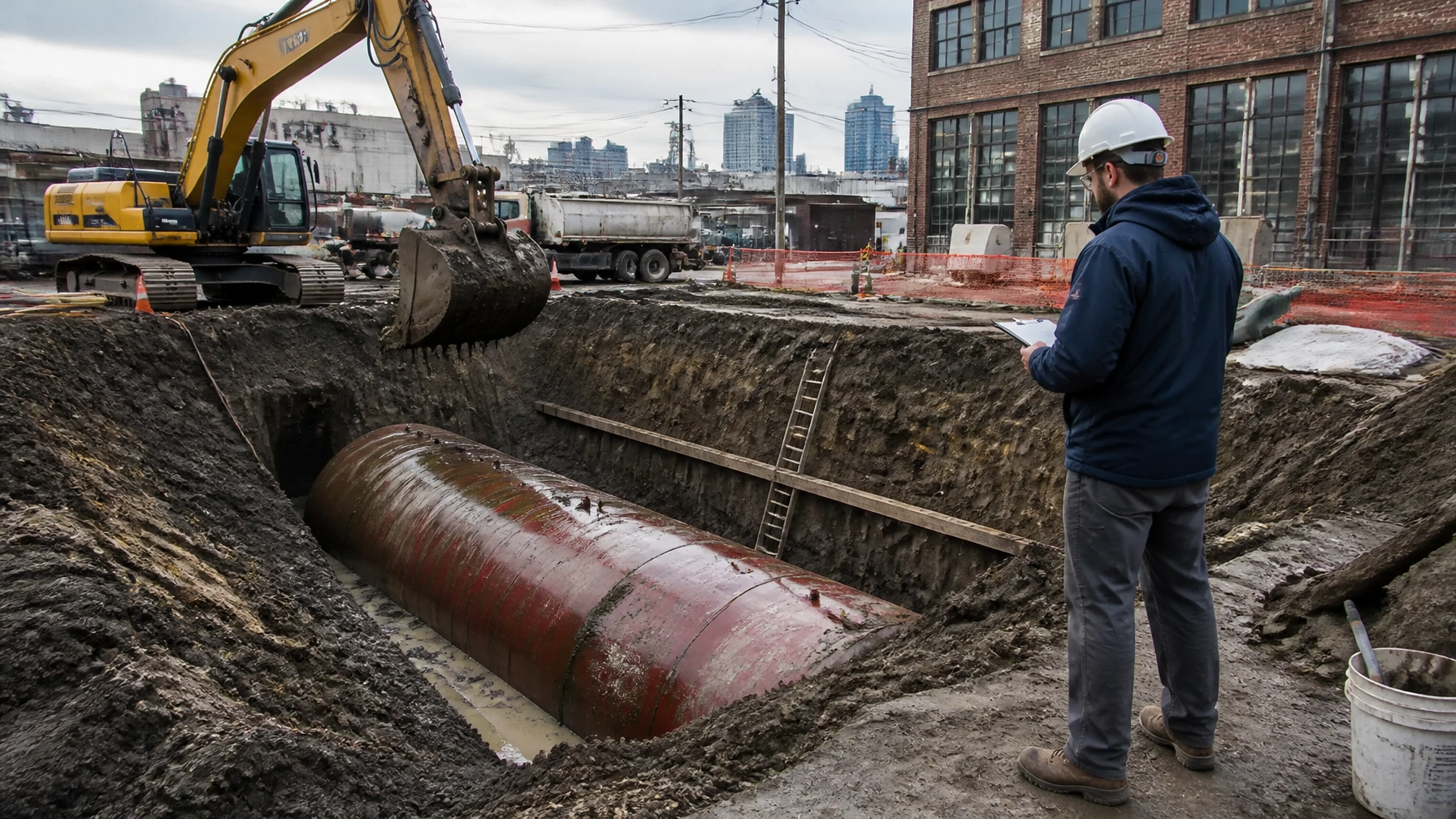
New electrical duct banks, geothermal systems, fuel conversions, drainage modifications, and service connections may require excavation.
Before soil disturbance, the project team should evaluate:
- Historic fill and prior industrial uses.
- Underground storage tanks and abandoned utilities.
- Soil disposal requirements.
- Potential vapor intrusion pathways.
- Required permits and documentation.
- Dust, odor, and community air monitoring needs.
This is where Local Law 97 retrofit environmental review becomes a project-control function, not a paperwork exercise.

Why environmental coordination belongs in the early retrofit scope
A building owner may use one firm for energy modeling, another for architectural design, and a contractor for construction. That structure can work, but only if someone owns the connections between disciplines.
Environmental coordination should begin before the final design package. The review should identify whether the retrofit will trigger:
- Asbestos or lead abatement.
- Soil or groundwater investigation.
- Vapor mitigation requirements.
- Construction air monitoring.
- Waste characterization and disposal profiling.
- NYC Department of Buildings filings.
- Utility or street-opening coordination.
- Roof, facade, or structural modifications.
- Tenant protection and occupied-building controls.
For a real estate owner, this coordination protects more than compliance. It protects the capital plan, financing assumptions, tenant relationships, and asset value.
A building with a credible LL97 plan is easier to explain to lenders, investors, buyers, and board members. A building with disconnected reports and no implementation schedule is harder to underwrite.
What owners should do in September 2026
If your building has not completed a post-filing review, start with a focused compliance consultation.
Gather:
- The submitted LL97 report, or proof that no report was filed.
- The building’s BIN, BBL, gross floor area, and compliance pathway.
- 2025 utility bills and fuel records.
- Current emissions calculations.
- Prior LL97, LL84, LL87, and LL88 filings.
- Existing energy audits, retro-commissioning reports, and capital plans.
- Boiler, HVAC, electrical, roof, and structural information.
- Any DOB notices, extension records, or BEAM correspondence.
Then ask your consultant to produce a short action memo that identifies:
- Filing status and potential exposure.
- Whether the reported data needs correction.
- Estimated emissions exceedance.
- Whether a penalty-mitigation pathway may apply.
- Physical upgrades required before the 2030 limit.
- Environmental and hazardous-material constraints.
- Permitting and construction sequencing.
- Near-term decisions for the next 30, 60, and 90 days.
Do not buy RECs or authorize major equipment based on a generic compliance estimate. The right strategy depends on the building’s actual fuel mix, utility profile, equipment condition, physical constraints, and selected LL97 pathway.

Why NYC owners work with Envicon
Envicon Group supports building owners across Manhattan, Brooklyn, Queens, the Bronx, and Staten Island with environmental assessment, regulatory compliance, civil engineering, and construction oversight.
We bring the environmental review into the retrofit conversation early. That means identifying hazardous materials before demolition, evaluating soil and utility risks before excavation, coordinating agency requirements, and staying involved when the contractor mobilizes.
Our team can support:
- LL97 compliance review and reporting coordination.
- Environmental assessment and due diligence.
- Asbestos and lead surveys.
- Soil, groundwater, and vapor assessment.
- Construction air monitoring.
- Compliance and permitting.
- Civil and site engineering.
- Roof and structural coordination.
- Field QA/QC and construction oversight.
You do not need another report that sits in a folder. You need a clear path from the emissions calculation to a fundable, permitted, buildable retrofit.
Environmental Consultant NYC services include direct coordination across all five boroughs. Our Compliance and Permitting team can help organize the regulatory path, while our Environmental Assessment services address the site and building conditions that may affect construction.
Takeaway
The August 29, 2026 LL97 filing deadline has passed, but the compliance work has not.
Review the filing. Confirm the emissions calculation. Separate electricity-related REC options from onsite combustion reductions. Then connect the building strategy to hazardous materials, structural capacity, electrical infrastructure, excavation, air monitoring, and construction oversight.
Compliance is not a single filing. It is a coordinated plan that keeps the building financeable, constructible, and moving toward the 2030 standard.
Request an LL97 Compliance Review
If you own or manage a covered building in Manhattan, Brooklyn, Queens, the Bronx, or Staten Island, contact Envicon for a focused review of your filing status, emissions exposure, and retrofit coordination needs.
- Request a compliance review and consultation
- Call Envicon at (917) 764-2171
- View Envicon’s complete list of services
This article is for general information and does not replace building-specific legal, engineering, energy, or regulatory advice. Confirm current requirements with NYC DOB and the qualified professionals responsible for your filing.
Sources
- NYC Department of Buildings: LL97 Greenhouse Gas Emissions Reduction
- NYC Department of Buildings: LL97 GHG Emissions Violations
- DOB User Guide: Local Law 97 Extension Requests
- DOB: Renewable Energy Certificate Policy for Local Law 97
- DOB: Renewable Energy Certificates Frequently Asked Questions
- DOB: Article 320 Information Guide