Published August 31, 2026 at 2:00 PM ET
Effective December 31, 2025, NYSDEC amended 6 NYCRR Part 375, the framework governing New York’s Environmental Remediation Programs.
Six months into implementation, the practical message for developers is straightforward:
A brownfield project now needs better field control, stronger documentation, and a QEP who can stand behind every major technical conclusion.
The revised framework affects how teams collect and certify environmental data, manage deviations from approved plans, document remedial work, and maintain the engineering and institutional controls tied to a Certificate of Completion.
For NYC developers pursuing a brownfield cleanup program NY COC, these are not paperwork issues. They directly affect schedule, budget, financing, tax credit strategy, and the ability to move from remediation to construction.
What changed under the NYSDEC Part 375 amendments?
The revised NYSDEC Part 375 amendments apply across the Brownfield Cleanup Program, State Superfund Program, and Environmental Restoration Program.
They also update soil cleanup objectives, clarify program requirements, and increase expectations around professional oversight and remedial documentation.
The most important operational changes for project teams are:
- QEP certification must address the completeness and accuracy of submitted environmental information.
- Remedial work must follow approved work plans, remedial designs, and agency-approved modifications.
- Field deviations must be identified, evaluated, documented, and justified in real time.
- Final documentation supporting a COC must be accurate, complete, and defensible.
- Engineering controls, institutional controls, and site management obligations require ongoing documentation after the COC is issued.
NYSDEC’s environmental remediation revisions page provides the adopted rulemaking materials. The final Part 375 text should be reviewed alongside the applicable program guidance and project-specific work plans.
QEP certification is now a project control, not a signature
A QEP certification is not simply an administrative step at the end of a report.
The QEP must be able to support the underlying environmental data and confirm that the work was completed in accordance with the approved remedial program. That includes the investigation, sampling, laboratory data, field observations, construction records, and closeout documentation that support the project’s path to a COC.
In practical terms, the QEP should be able to answer:
- Was the sampling program completed as approved?
- Are the data complete and representative?
- Were chain-of-custody and quality assurance procedures followed?
- Did the remedial contractor follow the approved RAWP or remedial design?
- Were field changes reviewed before implementation?
- Do the as-built conditions match the approved remedy?
- Does the final report accurately describe what happened in the field?
The QEP’s certification now carries more weight because NYSDEC can evaluate not only the final report, but also the quality and reliability of the project record supporting it.
This raises the bar on who you hire. A consultant who prepares reports remotely and relies on contractor notes may not have enough direct knowledge to certify the work confidently.
A strong team needs field presence, technical judgment, and a defined chain of responsibility from the first boring through the Final Engineering Report.
QEP certification also does not replace a New York-licensed Professional Engineer where engineering documents require PE certification under New York law. The right project team understands the distinction and coordinates both responsibilities instead of treating them as interchangeable.
Field deviations must be managed when they happen
Field conditions rarely follow the plan perfectly.
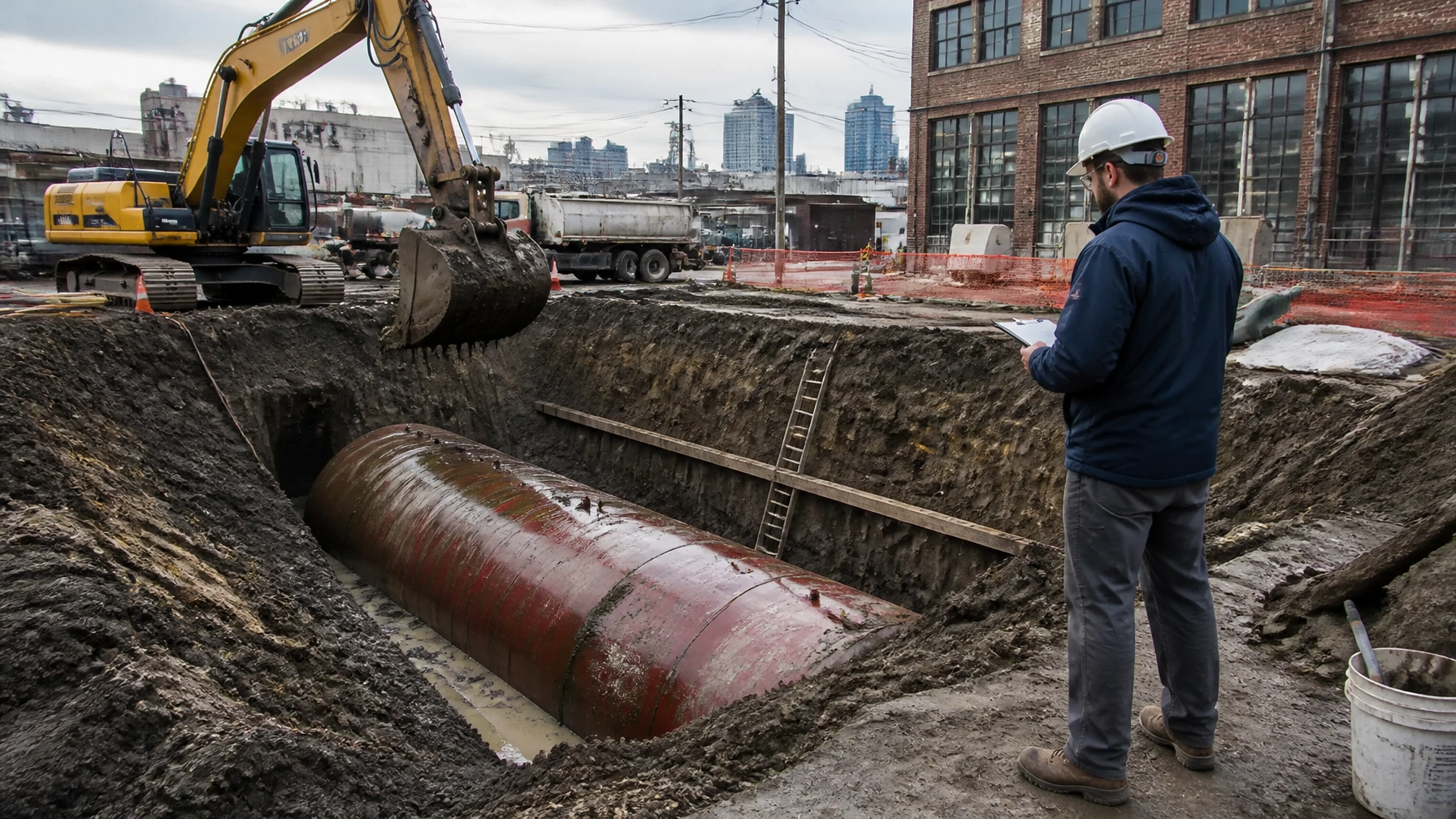
An excavation may encounter a different soil layer. A utility may limit the planned boring location. Groundwater may enter an excavation earlier than expected. A vapor barrier detail may need to change because of actual foundation conditions.
These situations are manageable. Undocumented changes are not.
The amended expectations require project teams to treat a deviation as a controlled technical decision, not a field footnote. When conditions change, the team should:
- Stop and identify the difference from the approved plan.
- Evaluate whether the change affects the remedy, exposure pathways, cleanup objectives, or engineering controls.
- Document the condition with photographs, field notes, survey data, drawings, and sampling results.
- Obtain QEP or PE review, as applicable, before proceeding.
- Notify NYSDEC when the change is material or requires agency approval.
- Incorporate the approved change into the daily reports, as-built drawings, and final report.
The NYSDEC Final Engineering Report template includes a section for describing deviations from the approved Remedial Action Work Plan. That closeout requirement reinforces the correct approach: the project team should not wait until the FER to reconstruct what happened.
A deviation documented six months later is weaker than a deviation evaluated and approved six hours after it occurred.

How the new standard affects schedule and budget
The revised requirements may add steps to the project schedule. They can also reduce avoidable delays when the team uses them correctly.
Schedule impact
Developers should account for additional review points during:
- Pre-construction planning
- Contractor submittal review
- Daily field reporting
- Confirmation sampling
- Engineering control installation
- As-built documentation
- FER preparation and agency review
- Site management plan updates
The goal is not to create unnecessary meetings. The goal is to identify problems before they become a rejected submittal, failed confirmation sample, or incomplete FER.
An undocumented field change discovered during closeout can trigger additional sampling, contractor remobilization, design revisions, and another round of agency comments. That delay is usually more expensive than resolving the issue in the field.
Budget impact
A realistic budget should include:
- Senior QEP or PE oversight
- Daily field reporting and quality control
- Survey and as-built documentation
- Additional confirmation samples where conditions warrant them
- Engineering control inspection and testing
- Site management plan updates
- Agency coordination and comment responses
- A reasonable contingency for changed subsurface conditions
This is where low-fee consulting scopes can become expensive. A narrow proposal may exclude the field coordination and documentation needed to secure closure. The cost then returns later as a change order, re-mobilization, or delayed construction start.
Envicon’s approach is to define the closure path before field work begins. Our brownfield redevelopment and remediation team coordinates investigation, remedial design, construction oversight, soil management, confirmation sampling, and regulatory closeout around the actual project objective.
We do not sell a report. We sell a cleared path.
What it takes to obtain and maintain a COC
Under Part 375, NYSDEC issues a COC after approving the applicable Final Engineering Report and determining that the remedial requirements have been satisfied or will be satisfied within the approved timeframes.
That makes the FER the bridge between completed field work and regulatory closure.
A defensible FER should clearly show:
- What the approved remedy required
- What work the contractor completed
- Where conditions differed from the approved plan
- Why each deviation occurred
- How each deviation affected the remedy
- What sampling and laboratory data demonstrate
- How engineering controls were installed and verified
- What institutional controls and site management obligations remain
- Who reviewed and certified the supporting information
The COC is not the end of the project. It creates continuing obligations.
Owners must maintain required engineering controls, follow institutional controls, perform inspections and monitoring, preserve records, and submit required periodic documentation. A change in ownership, site use, building footprint, utility work, or subsurface disturbance may require advance notice and technical review.
NYSDEC’s guidance on initial notice and transfer of a Certificate of Completion should be part of every owner’s post-COC compliance file.
A COC protects value only when the controls supporting it remain effective.

Why the consultant you hire matters more now
The new requirements expose the weakness in a common consulting model.
A large firm may present a senior partner during the proposal stage, assign junior staff to the field, and route regulatory questions through several layers of project management. That structure creates distance between the person signing the report and the conditions that actually occurred on site.
For a New York brownfield project, you need a team that can:
- Put qualified technical leadership in the field
- Coordinate directly with NYSDEC, NYC OER, attorneys, architects, contractors, and lenders
- Identify deviations before they become closeout problems
- Keep data, field records, drawings, and reports aligned
- Explain technical decisions in clear business terms
- Track schedule, budget, deliverables, and open issues in real time
- Take responsibility for the outcome
Envicon is a New York and New Jersey firm with 20 years of field-first environmental and engineering experience. Our NYC environmental consulting team works across Manhattan, Brooklyn, Queens, the Bronx, and Staten Island.
Collaboration is not a buzzword. It is how the work gets done.
A six-month action plan for NYC brownfield teams
If your site is active under Part 375, review the following now:
- Confirm that the responsible QEP and PE roles are clearly assigned.
- Reconcile the approved RAWP, remedial design, SMP, and construction documents.
- Create a written field deviation protocol.
- Require daily reports that capture work completed, conditions observed, samples collected, and decisions made.
- Review contractor submittals before materials or methods are installed.
- Maintain a live register of open technical decisions and agency communications.
- Verify that as-built drawings reflect actual field conditions.
- Recalculate schedule and budget assumptions for confirmation sampling and closeout.
- Review engineering and institutional control obligations with the property owner.
- Confirm that future construction or changes in use will not conflict with the COC or SMP.
The NYSDEC BCP document certification guidance is a useful reference for project teams and counsel.
Additional industry context is available through NYREJ’s brownfield coverage and archives and the FBT Gibbons Part 375 regulatory update materials.
The takeaway
The NYSDEC Part 375 amendments make one point clear: regulatory closure depends on the quality of the entire project record.
QEP certification, field deviation documentation, remedial design oversight, and long-term control management all connect to the same outcome. A defensible COC requires a defensible process.
For developers in New York City, the best time to strengthen that process is before the next field change, sampling event, agency comment, or construction decision.
We solve environmental and engineering challenges with precision, speed, and trust. If your project needs a clearer path to a COC, start with the team that will own the work from the field through closeout.
Talk to Envicon