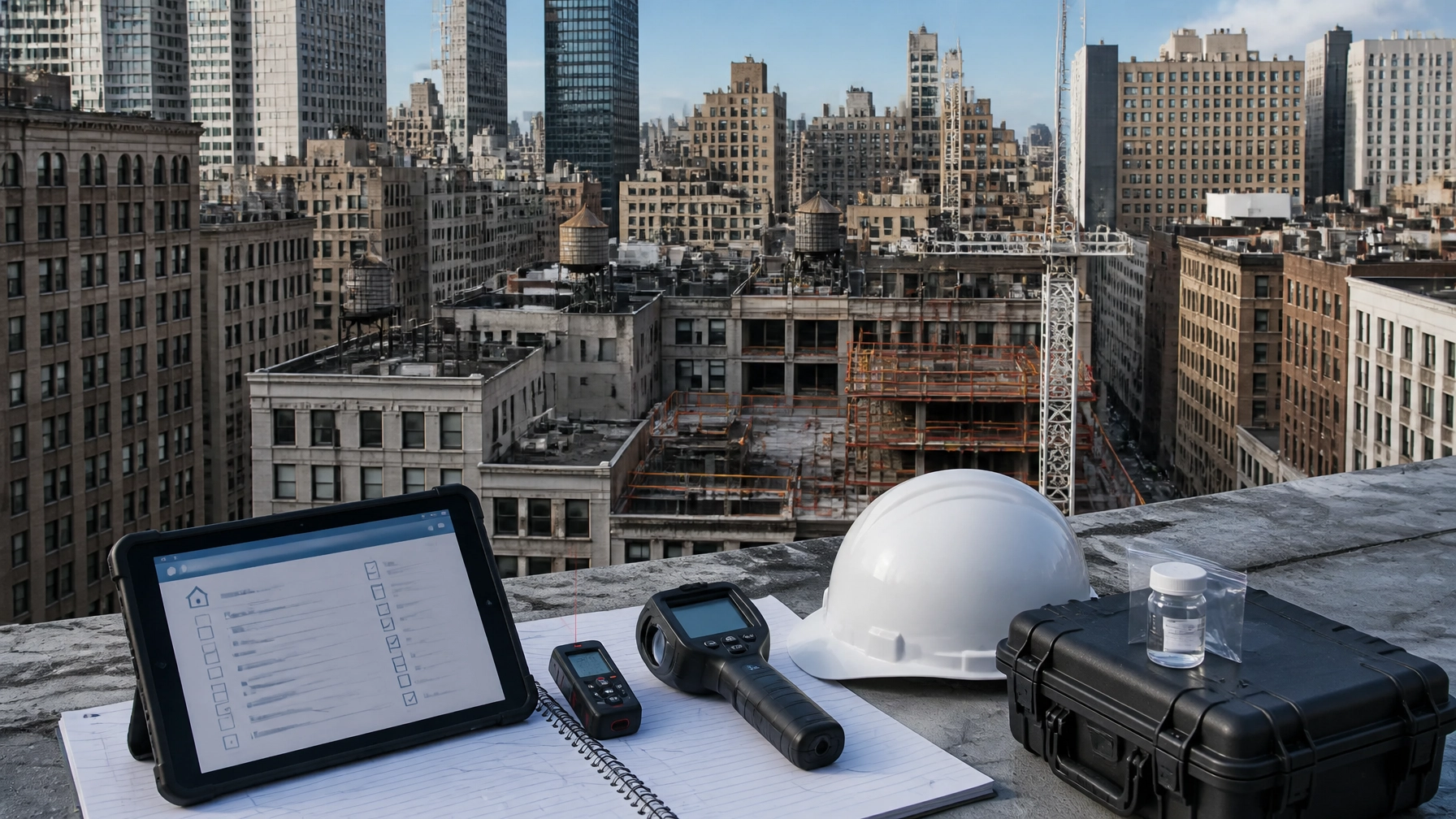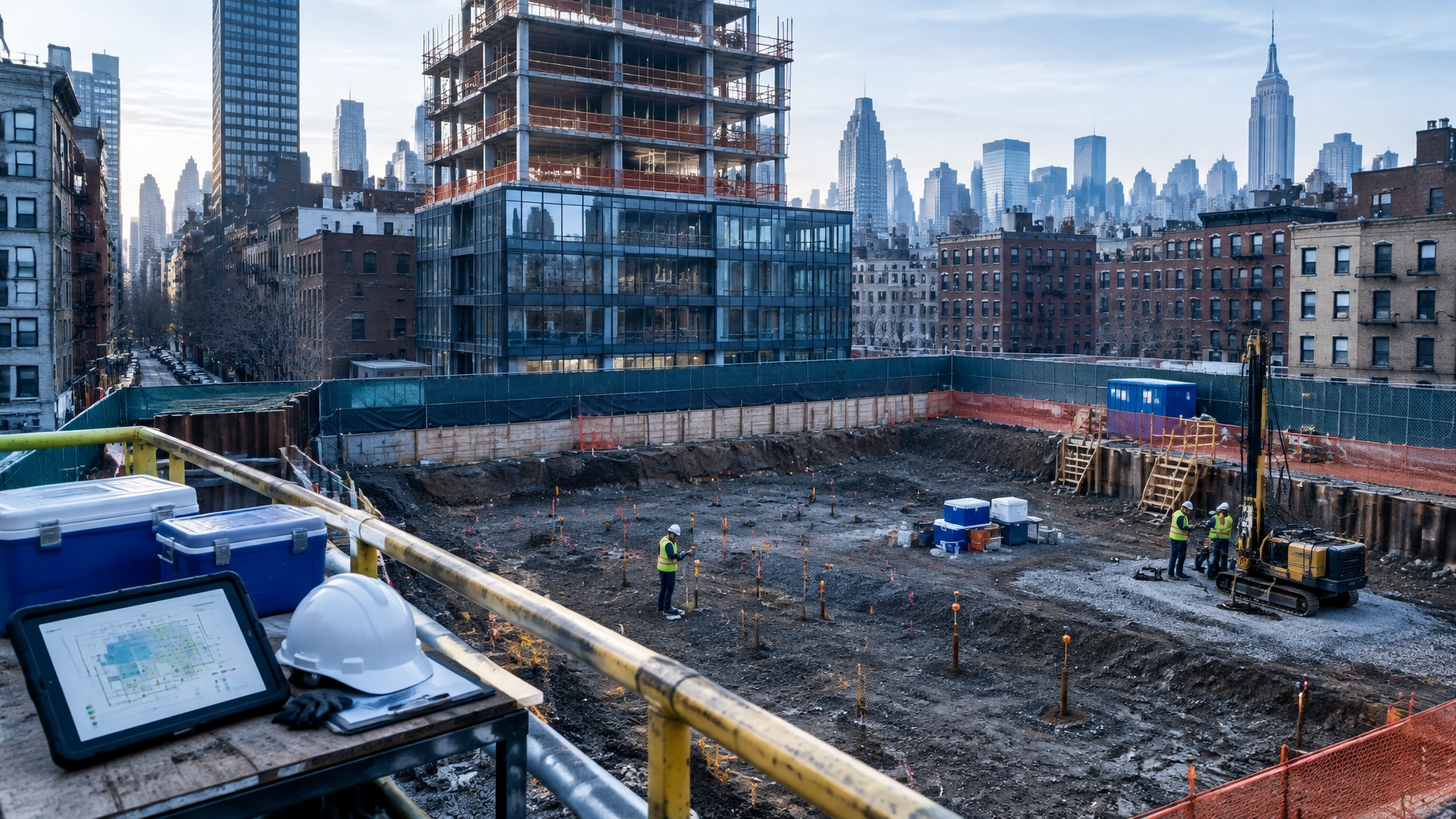
A commercial property transaction can close on time and still leave the buyer with an immediate compliance problem. The issue often appears when renovation plans reach the architect, contractor, or NYC Department of Buildings filing process.
An asbestos inspection for an NYC commercial property is not the same as a Phase I Environmental Site Assessment or a Property Condition Assessment. It answers a different question:
Will planned demolition, renovation, remodeling, repair, or maintenance disturb asbestos-containing material?
For buyers acquiring commercial buildings in Manhattan, Brooklyn, Queens, the Bronx, Staten Island, and Westchester, that answer belongs in the transaction file before closing. It affects construction cost, permit timing, tenant coordination, abatement scope, and lender confidence.
An asbestos survey is not a Phase I ESA or PCA
Transaction teams often assume that one environmental report covers every building risk. It doesn't.
ASTM E1527-21 Phase I ESA
An ASTM E1527-21 Phase I Environmental Site Assessment evaluates potential environmental conditions associated with the property and surrounding land. It typically includes:
- Historical records and regulatory database review
- Site reconnaissance
- Interviews with owners, occupants, and other knowledgeable parties
- Identification of recognized environmental conditions
- Recommendations for additional investigation
A Phase I ESA does not, by itself, provide a complete asbestos survey. It may identify the age, condition, or historic use of a building, but it does not satisfy the sampling and reporting requirements that apply when construction work may disturb suspect materials.
ASTM E2018 Property Condition Assessment
An ASTM E2018 Property Condition Assessment focuses on the physical condition of a building and its major systems. The PCA may note visible concerns such as damaged insulation, aging floor tile, or deteriorated ceiling materials.
It generally does not establish the laboratory-confirmed presence or absence of asbestos-containing material throughout the planned work area.
Rule 56 asbestos inspection
A Rule 56 survey is narrower and more intrusive. It identifies suspect asbestos-containing materials, or PACM, that could be disturbed by the defined scope of work. The survey may include bulk sampling and laboratory analysis.
For a transaction, the practical approach is to treat the Phase I ESA, PCA, and asbestos survey as separate but coordinated workstreams. Our environmental assessment team can help align those scopes before the buyer commits to a renovation budget.
What NYSDOL Industrial Code Rule 56 requires
New York State Industrial Code Rule 56, codified at 12 NYCRR Part 56, requires an asbestos survey before demolition, renovation, remodeling, or repair work on a building or portion of a building.
The New York State Department of Labor's current survey guidance states that the survey must be completed before the owner or contractor proceeds with activities such as:
- Advertising for bids
- Contracting for the work
- Starting the work
See the NYSDOL 2026 asbestos survey guidance and the full Industrial Code Rule 56 text.
Do not rely on a building's construction date as a shortcut. Limited exemptions may apply under the regulation, but an exempt building may still need to be treated as containing asbestos unless an appropriate survey establishes otherwise. OSHA, EPA, NYC DEP, and project-specific requirements can also create independent obligations.
For buyers, that means the question is not simply whether the building was constructed before a certain year. The question is what work you intend to perform and whether the survey covers the areas that work will affect.
NYC DEP and DOB coordination: ACP-5 versus ACP-7
NYC commercial properties have an additional city-level process. Asbestos documentation must coordinate with the NYC Department of Environmental Protection and the NYC Department of Buildings.
A qualified NYC asbestos investigator evaluates the proposed work area and determines which filing applies.
ACP-5
An ACP-5 Asbestos Assessment Report generally applies when:
- No asbestos-containing material is present in the affected work area
- ACM is present but will not be disturbed
- The anticipated disturbance falls within the applicable minor project threshold
Under NYC DEP rules, work that disturbs no more than 10 square feet or 25 linear feet of ACM may qualify as a minor project or non-project, depending on the specific conditions and filing requirements.
The ACP-5 control number is used in the DOB permit process. For full demolition, the documentation must address the entire structure, not just a convenient sample of rooms.
ACP-7
An ACP-7 Asbestos Project Notification applies when the proposed work will disturb more than 10 square feet or more than 25 linear feet of ACM, or otherwise meets the definition of an asbestos project.
The owner or authorized agent generally submits the ACP-7 through NYC DEP's asbestos reporting process before the abatement begins. Plan for at least one week of advance notification, and confirm current filing procedures, fees, and project-specific requirements with the agency.
The NYC DEP asbestos abatement forms page provides current forms and instructions. NYC DOB also explains how asbestos documentation affects demolition and alteration permits in its official asbestos permit guidance.
The important transaction point is simple. An ACP-5 or ACP-7 is not a paperwork detail to resolve after closing. It can control whether the project receives a permit and when the contractor can mobilize.

What a commercial asbestos inspection should cover
A useful survey is based on the proposed construction scope, not just a walk-through of publicly accessible rooms.
For a Manhattan office conversion, that may include:
- Suspended ceiling systems
- Floor tile, sheet flooring, and associated mastics
- Pipe, duct, and boiler insulation
- Fireproofing and sprayed materials
- Roofing materials
- Exterior facade and window caulking
- Plaster, joint compound, and textured coatings
- Electrical equipment and fire doors
- Mechanical rooms and vertical chases
- Basement, cellar, and utility areas
Bulk sampling should represent each homogeneous material that could be disturbed. Samples require documented chain of custody and laboratory analysis using appropriate methods.
Inaccessible areas are a transaction risk
Some materials cannot be sampled during an occupied-building inspection. Walls may remain closed. Mechanical chases may be inaccessible. Tenants may restrict access. Roof areas may require separate coordination.
Those limitations should appear clearly in the report. A statement that an area was inaccessible is not the same as a finding that the area is asbestos-free.
If the buyer plans a gut renovation, the survey should be designed around the actual demolition plans. A limited survey of visible office finishes may not be adequate for a full-floor alteration, facade project, or building-wide demolition.
Abatement, air monitoring, and clearance
If the survey identifies ACM that the project will disturb, the next step is not automatically to remove every asbestos-containing material in the building.
The abatement scope should match the planned disturbance. A licensed asbestos abatement contractor may need to establish containment, use negative air and HEPA filtration, follow worker protection procedures, and package waste for compliant disposal.
Air monitoring helps evaluate conditions during the work. Depending on the project, monitoring may include personal, perimeter, work-area, or clearance sampling.
Clearance testing occurs after abatement and cleanup. The project team should not treat visual completion as regulatory clearance. The required documentation and testing must support the applicable NYC DEP and NYSDOL process before the area returns to construction or occupancy.

How asbestos findings affect the purchase and closing
An asbestos inspection cost for an NYC commercial property is only one part of the financial analysis. The larger exposure is the cost of delayed decisions.
A finding may affect:
- Purchase price negotiations
- Escrow or seller credit discussions
- Construction loan underwriting
- Tenant relocation and access planning
- Demolition and renovation sequencing
- Contractor pricing and bid validity
- Permit submission dates
- Temporary occupancy plans
- Air monitoring and clearance requirements
- Waste handling and disposal costs
A report delivered after closing may confirm a problem without leaving enough time to price it. A report delivered during diligence gives counsel, the lender, architect, and contractor a chance to decide who carries the risk.
This is where a regional, senior-led team matters. Envicon does not treat an asbestos survey as a disconnected report. We coordinate the findings with the broader environmental and transaction picture, then explain what must happen next.
That approach is especially important when the property also requires a Phase I ESA, PCA, vapor assessment, UST review, or NYC permit coordination.
Local considerations across the New York market
The same core NYC requirements apply across the five boroughs, but access, building type, tenant conditions, and project logistics vary.
- Manhattan commercial properties often involve occupied office buildings, prewar construction, vertical mechanical systems, and compressed closing schedules.
- Brooklyn commercial buildings may involve warehouse conversions, mixed-use adaptive reuse, industrial corridors, and partial demolition.
- Queens properties frequently combine industrial, commercial, and residential uses with complex access and phasing requirements.
- Bronx properties may require coordination around older mixed-use buildings, institutional facilities, and redevelopment sites.
- Staten Island properties can involve larger sites, detached structures, and redevelopment work outside the dense Manhattan pattern.
- Westchester County properties fall under different local permitting channels, but New York State Rule 56 requirements still matter when regulated work is planned.
Closing-readiness review for your property
If you are buying, refinancing, renovating, or repositioning an NYC commercial property, complete the asbestos review before the construction budget becomes fixed.
Envicon can review the purchase timeline, proposed plans, existing reports, access limitations, and lender requirements. We will identify whether you need a targeted survey, a broader building inspection, ACP-5 coordination, ACP-7 planning, or additional environmental due diligence.
Start with Envicon
- Request a closing-readiness review
- Call Envicon at (917) 764-2171
- Review asbestos and lead survey services
- Review NYC environmental consulting services
The takeaway is straightforward: a Phase I ESA identifies environmental transaction risk. A PCA evaluates building condition. A Rule 56 asbestos survey determines whether your planned work can proceed without an avoidable compliance and cost problem.
Know the building before you close. Plan the work before you bid. Move forward with precision, speed, and trust.