As of September 3, 2026, the New Jersey Economic Development Authority’s Brownfields Redevelopment Incentive Program is not accepting applications.
The closure follows legislation signed on September 4, 2024. NJEDA is developing new rules to implement the statutory changes and expects to release them in 2026. Until those rules are issued, there is no active application deadline to advertise and no open portal for new Brownfield Redevelopment Incentive Program applications.
That does not mean your project should wait.
For developers pursuing brownfield redevelopment in Newark, Jersey City, Camden, Paterson, and the Northern New Jersey industrial corridors, this is the time to prepare the property, records, cost model, and regulatory pathway. When NJEDA reopens the program, the projects with organized documentation and a defensible remediation plan will be in the strongest position to move.
“The new application will be posted here after the rules are issued. The program is not currently accepting applications.”
NJEDA Brownfields Redevelopment Incentive Program
What NJ Brownfield Tax Credit 2026 applicants need to know
The Brownfields Redevelopment Incentive Program provides a one-time, transferable tax credit intended to support eligible environmental remediation, abatement, demolition, and related structural remedial activities at qualifying brownfield sites.
The 2024 legislation expanded the potential value of the incentive. NJEDA’s current program materials describe the following published framework:
- For qualifying non-landfill projects in a Government-Restricted Municipality or Qualified Incentive Tract, credits may reach up to 80% of eligible remediation costs, subject to a maximum award of $12 million.
- For other qualifying brownfield projects, credits may reach up to 60% of eligible remediation costs, subject to a maximum award of $8 million.
- Solar projects on closed sanitary landfills may qualify for a credit equal to 100% of eligible remediation costs, subject to location-based caps.
- The program requires a redevelopment agreement, municipal support, reasonable and appropriate remediation costs, site access, environmental standards, and other conditions.
- Prevailing wage, good-standing, ownership, timing, and responsible-party requirements may apply.
These are not committed proceeds. They are published program terms that remain subject to the new rules, the application process, NJEDA review, and project-specific eligibility determinations.
Do not put an NJEDA tax credit into your acquisition underwriting as guaranteed revenue. Treat it as a potential source of project support that requires documentation and formal approval.
NJEDA brownfield tax credit applications closed, but preparation can start now
The most common mistake is treating the program closure as a reason to pause all brownfield work. The better approach is to separate incentive preparation from cleanup compliance.
NJEDA controls the tax incentive. NJDEP controls environmental remediation requirements through programs such as the Site Remediation Reform Act, the Licensed Site Remediation Professional program, ISRA, and the Technical Requirements for Site Remediation.
You may need to continue environmental investigation, obtain regulatory approvals, address an ISRA trigger, manage a discharge, or protect construction activities even while the NJEDA application portal remains closed.
An NJEDA tax credit does not replace:
- NJDEP remediation obligations.
- An NJDEP-approved or LSRP-managed cleanup strategy.
- ISRA compliance for an industrial establishment transaction.
- A remedial investigation or remedial action work plan.
- Required permits, engineering controls, deed notices, or site management plans.
- Documentation needed for an LSRP Response Action Outcome.
The tax incentive may help pay for eligible remediation. It does not make contamination disappear from the regulatory record.
A practical NJ Brownfield Tax Credit 2026 readiness plan
1. Establish whether the property is a brownfield
Start with the site history and current condition.
NJEDA defines a brownfield as property that is vacant or underutilized and has experienced, or is suspected to have experienced, a discharge of a contaminant or contains contaminated building materials.
For a property in the Ironbound, Newark industrial districts, Hudson County, Camden’s former manufacturing areas, Paterson’s mill corridors, or other Northern New Jersey industrial markets, gather:
- Historical Sanborn maps and aerial photographs.
- Prior industrial and manufacturing uses.
- Former dry-cleaning, metalworking, petroleum, chemical, rail, or waste operations.
- Existing NJDEP case numbers and regulatory correspondence.
- Prior Phase I and Phase II Environmental Site Assessments.
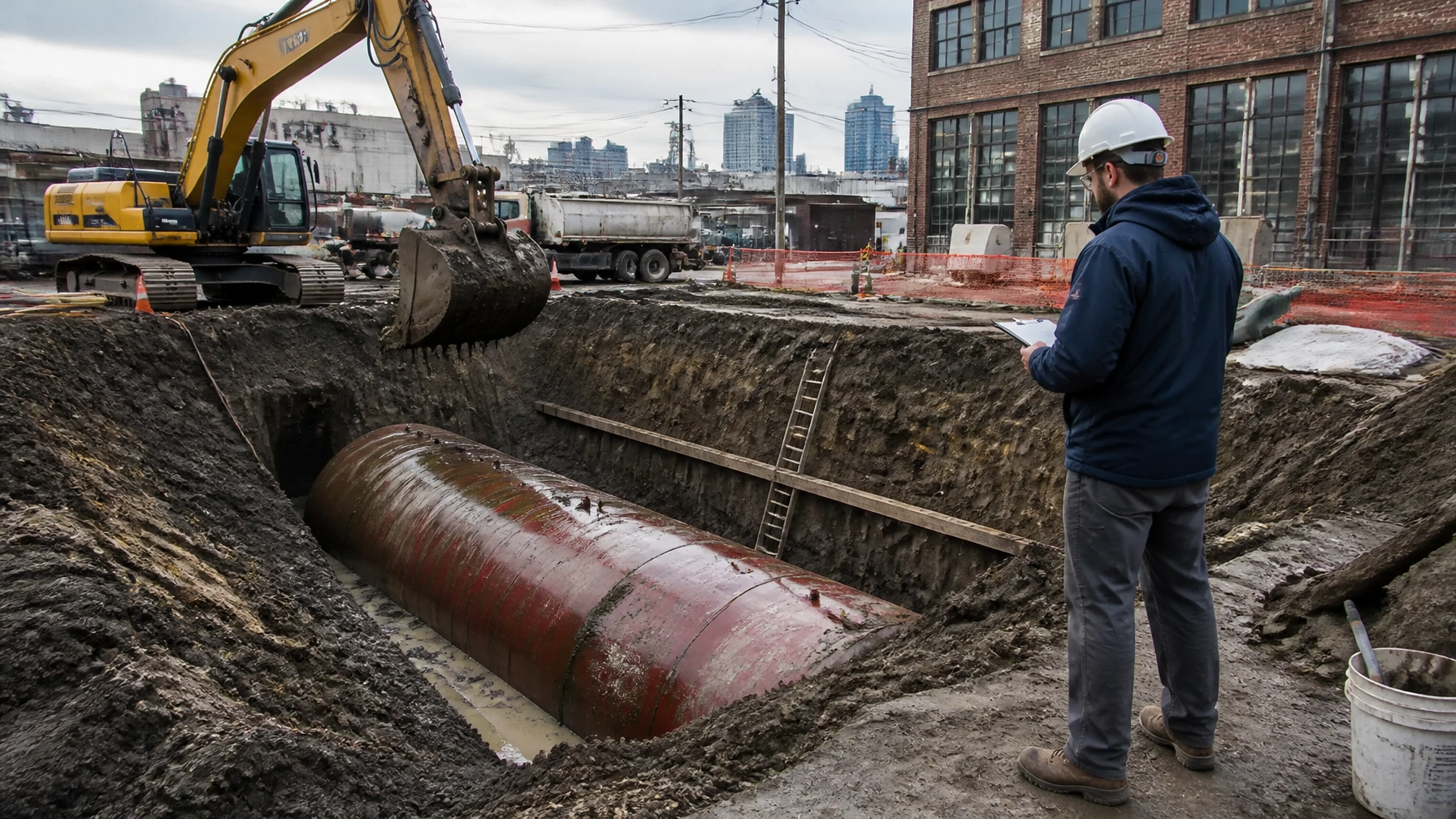
- UST, tank, discharge, spill, and demolition records.
- Building material surveys for asbestos, lead, PCBs, and other hazardous materials.
A brownfield determination is not the same as proving tax credit eligibility. It is the starting point for a defensible review.
2. Retain an NJDEP LSRP early
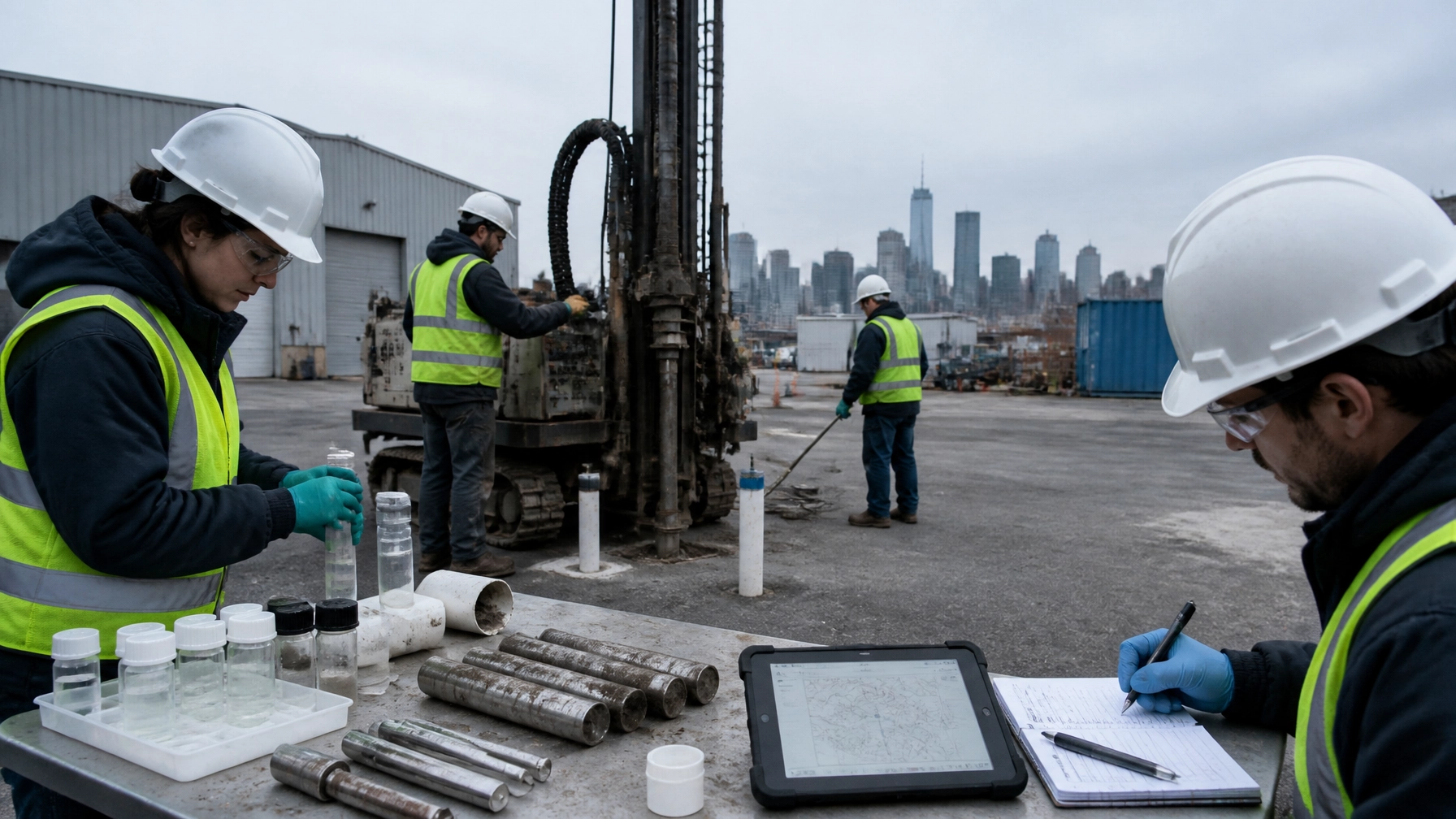
If the property has known contamination, an active case, a discharge, an ISRA trigger, or a redevelopment plan that will disturb impacted soil, bring in a New Jersey Licensed Site Remediation Professional early.
An LSRP can help establish the regulatory path, identify data gaps, coordinate NJDEP communications, and connect the cleanup scope to the proposed end use.
Envicon’s NJ LSRP Services include preliminary assessment, site investigation, remedial investigation, RAWP preparation, remedial action oversight, engineering and institutional controls, NJDEP coordination, and RAO support.
This matters during a transaction. A buyer, lender, attorney, and municipality need to understand not only what contamination exists, but who owns the regulatory obligation, what work remains, and whether the redevelopment plan is compatible with the cleanup strategy.
3. Build NJ brownfield remediation cost documentation
NJEDA will need a clear basis for determining whether remediation costs are reasonable and appropriate. A single high-level construction estimate will not be enough.
Create a cost structure that separates eligible remediation activities from ordinary development costs.
Potentially relevant categories may include:
- Environmental investigation and delineation.
- Soil excavation, treatment, transport, and disposal.
- Groundwater treatment and monitoring.
- Vapor mitigation systems.
- Engineering controls and clean cover systems.
- Hazardous building material abatement.
- Structural demolition or modifications required to perform remediation.
- Dewatering and treatment tied to contaminated excavation.
- Confirmation sampling and remedial documentation.
- Construction oversight and environmental monitoring.
Keep ordinary acquisition costs, vertical construction, tenant improvements, general landscaping, and unrelated site improvements in separate categories unless NJEDA’s final rules specifically address them.
For every cost, maintain:
- Executed contracts and purchase orders.
- Invoices and payment records.
- Field tickets and disposal receipts.
- Laboratory reports and chain-of-custody records.
- Daily reports and construction photographs.
- Change-order explanations.
- Quantity tracking for soil, groundwater, waste, and clean fill.
- A connection between the cost and the approved remediation scope.
This is the foundation of NJ brownfield remediation cost documentation. It also gives your lender, equity partner, and tax advisor a better basis for underwriting.

4. Organize ISRA and NJDEP case records
If the property is an industrial establishment, determine whether a sale, cessation, transfer, or operational change triggers ISRA.
Collect the relevant ISRA notices, NJDEP correspondence, prior submissions, regulatory filings, LSRP certifications, discharge reports, permits, and case status information. If a prior owner or operator initiated remediation, verify whether the case remains active and whether the current ownership structure has accepted specific obligations.
A transaction should not depend on a vague statement that “the site is under remediation.” Your team should know:
- The current person responsible for conducting remediation.
- The retained LSRP.
- The active NJDEP case number.
- Open Areas of Concern.
- Remaining investigation or remediation milestones.
- Engineering or institutional controls.
- Sampling and monitoring requirements.
- The likely path to an RAO or other regulatory endpoint.
5. Confirm ownership and redevelopment milestones
NJEDA incentives are tied to a specific applicant, property, and redevelopment project. Before the program reopens, confirm:
- Who owns the property today.
- Whether the applicant will own or control the site.
- Whether affiliates or prior owners could affect eligibility.
- Whether remediation has already started beyond permitted exceptions.
- Whether the municipality supports the redevelopment.
- Whether the project has site access for investigation and remediation.
- Whether the proposed use is commercial, retail, mixed-use, industrial, residential, or another permitted category.
- Which approvals control the redevelopment schedule.
Create a milestone map from acquisition through remediation, financing, construction, and completion. Tax credit timing can matter because NJEDA describes the credit as issued in the year remediation is completed.
6. Prepare location and community documentation
Project location can affect potential award levels and application requirements. Review whether the site is located in a Qualified Incentive Tract or Government-Restricted Municipality using current NJEDA mapping resources.
Also prepare documentation that may become relevant under the eventual rules or application materials:
- Municipal support and redevelopment resolutions.
- Transit access and transit-oriented development characteristics.
- Community benefits.
- Affordable housing components.
- Job creation and local hiring.
- Environmental justice considerations.
- Green remediation and green building measures.
- Public access, open space, or infrastructure benefits.
This is particularly important for urban redevelopment in Newark, Jersey City, Camden, and Paterson, where environmental cleanup, housing, transit, and community outcomes often intersect.
For projects in Hudson County, our Jersey City environmental consulting team works with developers on industrial property history, NJDEP coordination, brownfield remediation, Phase I and Phase II assessments, and transaction-driven schedules.

What developers should not do while the program is closed
Avoid these errors:
- Do not advertise an active NJEDA application deadline.
- Do not represent that your project has been approved for a tax credit.
- Do not use future credit proceeds as a substitute for equity without confirming lender acceptance.
- Do not begin major remediation solely to preserve a future incentive claim.
- Do not combine eligible remediation costs with general construction costs.
- Do not assume an NJDEP RAO automatically creates NJEDA eligibility.
- Do not rely on outdated 2023 application materials as the final 2026 requirements.
- Do not let a transaction close without assigning environmental and ISRA responsibilities in writing.
Monitor the official NJEDA program page and sign up for program updates. NJEDA also directs program questions to bftaxcredit@njeda.gov.
Build the file before the portal opens
The strongest response to a closed program is not speculation. It is readiness.
A developer with a complete site history, an engaged NJDEP LSRP, a defensible remedial design, organized cost records, municipal support, and a realistic redevelopment schedule can act quickly when the program reopens.
Envicon supports brownfield developers with remediation and brownfield redevelopment services, LSRP oversight, remedial cost modeling, soil and groundwater management, regulatory coordination, and construction-phase documentation.
We work with developers, investors, attorneys, contractors, and municipalities across Newark, Jersey City, Camden, Paterson, Hudson County, Essex County, Passaic County, and the broader Northern New Jersey industrial market.
The objective is not to produce another report. It is to remove the uncertainty between a contaminated property and a financeable, buildable asset.
Summary
The NJ Brownfield Tax Credit 2026 program is not accepting applications while NJEDA develops new implementing rules following the 2024 legislation. There is no active deadline to advertise.
Use this period to:
- Confirm brownfield and transaction status.
- Retain an NJDEP LSRP.
- Organize ISRA and NJDEP case records.
- Separate eligible remediation costs from general development costs.
- Build complete NJ brownfield remediation cost documentation.
- Confirm ownership, access, municipal support, and redevelopment milestones.
- Prepare community, affordability, transit, and green remediation information.
- Monitor NJEDA and avoid claiming eligibility before the program reopens.
A closed application portal does not have to mean a stalled project. Prepare now so your property can move when the rules and application process are ready.
Sources
- NJEDA Brownfields Redevelopment Incentive Program
- NJEDA BRIP Program Legislation, signed September 4, 2024
- NJEDA BRIP Overview 2026
- NJDEP Office of Brownfield and Community Revitalization
- NJDEP Site Remediation Program
- NJDEP ISRA Information
- NJDEP Brownfield and Contaminated Site Remediation Act
Brownfield Readiness and Risk Review
Before you underwrite a future incentive, let Envicon review the property, regulatory file, redevelopment schedule, and anticipated remediation costs.
- Call now: (917) 764-2171
- Get a free brownfield readiness quote
- Use our proprietary cost estimator tool