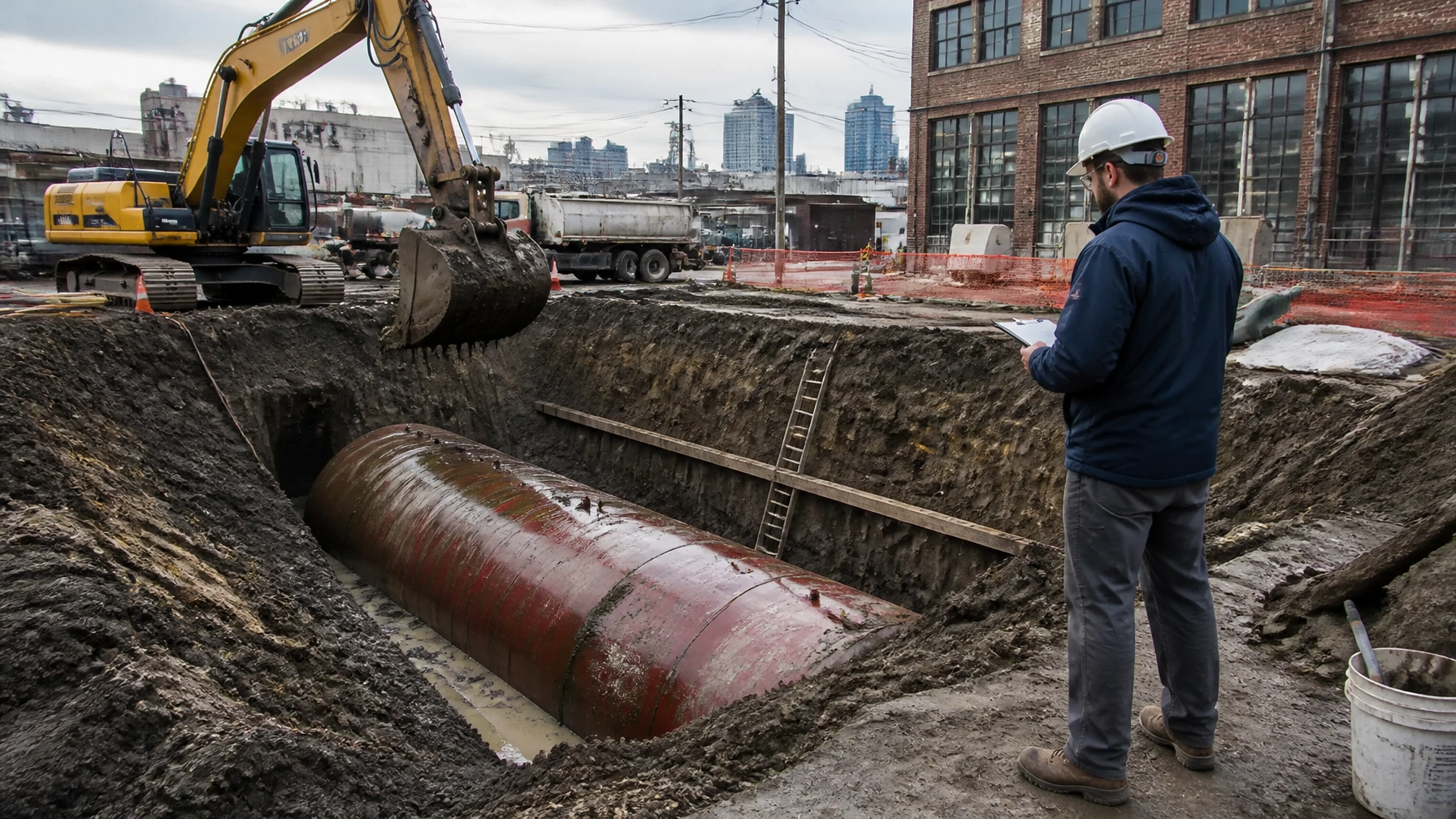
A suspected historic fill layer can change the cost, schedule, and regulatory path for a development project in Jersey City, Newark, Hudson County, Bergen County, or elsewhere in Northern New Jersey.
The issue is not simply whether fill is present. You need to know what it contains, where it ends, how it may affect groundwater, and whether the material can remain in place, move within the site, or leave the property.
This guide explains the current NJDEP framework for a historic fill investigation in Jersey City, historic fill soil management in Newark, NJ, and related redevelopment projects across the region.
“Historic fill material is generally deposited to raise the topographic elevation of the site, which was contaminated prior to emplacement.”
Source: NJDEP Historic Fill Material Technical Guidance
What is historic fill?
Under N.J.A.C. 7:26E-1.8, historic fill means non-indigenous material placed to raise site elevation. The material was contaminated before placement and was not connected to operations at the location where it was placed.
Examples can include:
- Construction and demolition debris
- Brick, concrete, and cinders
- Dredge spoils
- Incinerator residue
- Fly ash
- Non-hazardous solid waste
- Imported soil mixed with ash or rubble
Historic fill is not the same as a municipal solid waste landfill. It also does not include material substantially composed of chromate chemical production waste, other chemical production waste, or waste from processing metal or mineral ores, residues, slag, or tailings. Those materials require separate investigation as distinct areas of concern.
NJDEP identifies historic fill as an area of concern, or AOC. If the fill is contaminated, it must be addressed under the applicable Site Remediation Program requirements.
Why urban fill can contain metals, PAHs, VOCs, and PFAS
Historic fill was often placed before modern material controls, analytical testing, and environmental regulations existed. Industrial waterfronts and low-lying urban properties were frequently raised with whatever material was available.
Typical contaminants include:
- Metals: arsenic, lead, mercury, chromium, copper, and zinc
- PAHs: compounds associated with coal, ash, asphalt, petroleum, and combustion
- Petroleum hydrocarbons: including extractable petroleum hydrocarbons, or EPH
- VOCs: such as benzene, toluene, ethylbenzene, xylenes, chlorinated solvents, or other compounds associated with a separate historical release
- PCBs, pesticides, and other SVOCs: where site history or fill composition supports the concern
- Emerging contaminants: including PFOS, PFOA, PFNA, and GenX chemicals when required by current NJDEP rules or supported by the site history
Metals and PAHs are common historic fill indicators. VOCs and PFAS are more site-specific. Their detection may indicate that another AOC, an operational release, or a migration pathway exists in addition to the historic fill.
Under current N.J.A.C. 7:26E-2.1, when contaminants are unknown or poorly documented, the analytical program may need to address broader contaminant lists, including TCL plus tentatively identified compounds, TAL metals, hexavalent chromium, EPH, and specified PFAS compounds.
The current NJDEP rules were amended on June 15, 2026. Always verify the applicable rule, standards, and guidance before relying on a sampling or reuse pathway.
How to distinguish historic fill from native soil
A focused field investigation starts with the physical profile. Fill often has an abrupt contact with native material and may contain visible foreign material, inconsistent textures, or multiple layers.
Field indicators include:
- Brick, glass, ash, cinders, concrete, metal, or demolition debris
- Dark gray, black, reddish, or mottled soil inconsistent with surrounding native deposits
- Abrupt changes in texture or color
- Mixed sand, silt, gravel, and debris in a poorly sorted layer
- Strong odors, staining, or elevated PID or FID readings
- A fill layer that does not follow natural geologic bedding
- A transition to relatively uniform native soil, meadow mat, glacial deposits, or bedrock
NJDEP’s Historic Fill Material Technical Guidance recommends advancing borings, test pits, or trenches through the suspected fill and approximately two feet into the underlying material to establish the vertical contact. Field teams should document soil type, debris, odors, instrument readings, groundwater depth, and evidence of product.
The investigation must also remain alert for materials that do not qualify as historic fill. For example, a discrete solvent source, underground storage tank release, or chemical production waste must be investigated independently.

NJDEP historic fill guidance and sampling requirements in New Jersey
NJDEP provides two basic approaches when historic fill is confirmed under N.J.A.C. 7:26E-3.12.
Option 1: Assume the fill is contaminated
The responsible party may assume that historic fill exceeds applicable soil remediation standards and that associated groundwater is contaminated above applicable groundwater standards.
This approach avoids analytical sampling of the historic fill itself, but it does not eliminate the need to:
- Determine the horizontal and vertical extent of the fill
- Characterize the physical material
- Evaluate groundwater and receptors
- Investigate other AOCs independently
- Design and document a protective remedy
Option 2: Sample the fill and groundwater
The responsible party may collect samples to determine whether the material exceeds applicable standards.
The 2013 NJDEP guidance recommends:
- At least two historic fill sample locations per acre, with a minimum of two locations per site
- One discrete sample from a six-inch interval in each homogeneous fill type
- One discrete sample from a six-inch interval within each recognizable fill stratum
- Analysis for TCL PAHs and TAL metals
- EPH analysis on 25 percent of samples, with at least one sample per stratum or fill type
- Complete TCL/TAL and EPH analysis for a representative portion of the dataset
For remedial investigation purposes, the guidance recommends at least four borings, test pits, or trenches per acre, with a minimum of four locations per site. The current rule requires sufficient investigation to determine the horizontal and vertical extent and physical characteristics of the fill. The exact number and placement of locations must reflect site conditions and professional judgment.
Groundwater evaluation
If groundwater is encountered, the investigation should determine whether the fill is affecting groundwater quality.
The 2013 guidance recommends at least one groundwater sample within the fill area. If that is not practical, the sample may be collected downgradient and within approximately 10 feet of the fill area, based on the site’s hydrogeology.
Current requirements may differ based on the site, contamination, and applicable regulatory pathway. Groundwater flow direction, nearby surface water, wetlands, utility corridors, and potential potable wells must be considered.
Field sampling workflow
A defensible historic fill sampling investigation in NJ generally follows this sequence:
-
Review historical records
Examine aerial photographs, Sanborn maps, topographic maps, prior reports, municipal records, NJGS historic fill mapping, and available facility records. -
Develop a conceptual site model
Identify suspected fill areas, potential sources, groundwater flow, planned excavations, building footprints, utilities, and receptors. -
Prepare the sampling plan
Establish boring or test pit locations, sample intervals, analytes, field screening methods, laboratory requirements, quality controls, and health and safety procedures. -
Complete the field investigation
Advance borings or test pits through the fill and into native material. Log the stratigraphy and document visible debris, odors, staining, PID/FID readings, and groundwater conditions. -
Collect discrete samples
Do not use composite samples for a standard site investigation under N.J.A.C. 7:26E-3.4. Collect representative discrete intervals based on fill type and stratigraphy. -
Analyze and validate the data
Use appropriate NJDEP-certified laboratory methods, chain-of-custody procedures, data deliverables, and data usability review. -
Update the site model
Compare results to current NJDEP standards and determine whether additional AOCs, groundwater impacts, vapor concerns, or ecological receptors require evaluation. -
Prepare an action-based report
The report should connect the data to excavation limits, soil handling, caps, disposal, reuse, deed notices, permits, and construction sequencing.
Historic fill soil management in Newark, NJ and Northern New Jersey
Historic fill can affect a project long before remediation begins. Excavation for foundations, utilities, garages, stormwater systems, and elevators can generate large volumes of regulated material.
A soil management plan should address:
- Expected fill thickness and excavation limits
- On-site stockpile locations and cover requirements
- Dust, odor, runoff, and tracking controls
- Soil segregation by material type and analytical profile
- Trucking, manifests, bills of lading, and disposal facilities
- Clean fill specifications for backfill and caps
- Dewatering and groundwater treatment
- Confirmation sampling and as-built documentation
Soil containing debris may be regulated as solid waste under N.J.A.C. 7:26-1.6(a)6. NJDEP’s Understanding Regulatory Requirements for Soil and Fill Recyclable Materials explains that soil and fill with debris generally cannot be repurposed or redeposited without an authorized pathway.
NJDEP alternate fill approval and reuse
Historic fill reuse is not automatic.
For an SRP site, the current fill requirements are found in N.J.A.C. 7:26E-5.2 and the NJDEP Fill Material Guidance for SRP Sites.
Off-site alternative fill may be used without prior written NJDEP approval only when the material:
- Does not introduce a contaminant that is not already present above the applicable standard at the receiving AOC.
- Does not contain an individual contaminant above the 75th percentile of concentrations at the receiving AOC.
- Does not exceed the volume needed to restore the receiving area to its pre-remediation topography and elevation.
If any condition is not met, the responsible party must obtain prior written NJDEP approval of the fill use plan before bringing the material to the site.
Additional review may apply when:
- The receiving area is otherwise uncontaminated
- The fill would raise site elevation above original grade
- The material contains non-soil debris
- The material is being used outside an SRP remedial action
- A beneficial use determination or Certificate of Authority to Operate is required
A licensed site remediation professional should compare the donor and receiving areas, evaluate groundwater impact, confirm the material does not undermine the remedy, and document the decision.

Decision tree for historic fill projects
Use this as a planning framework, not a substitute for site-specific regulatory review.
-
Is fill suspected?
- No: document the basis and continue the standard PA or SI.
- Yes: review records and complete physical delineation.
-
Does the material meet the NJDEP definition of historic fill?
- No: investigate the material as a separate AOC.
- Yes: proceed under N.J.A.C. 7:26E-3.12 and 4.7.
-
Will you assume contamination or collect samples?
- Assume: proceed to RI, groundwater evaluation, and remedy design.
- Sample: use discrete sampling and current NJDEP standards.
-
Are soil or groundwater standards exceeded?
- No: document the results and evaluate other AOCs.
- Yes: delineate, evaluate receptors, and select a remedy.
-
Will the fill remain in place?
- Yes: evaluate caps, deed notices, soil remediation permits, CEAs, and long-term inspection requirements.
- No: prepare excavation, disposal, treatment, or approved reuse plans.
-
Will the material be reused?
- On-site or at an SRP receiving AOC: complete the required fill use evaluation.
- Off-site or non-soil reuse: determine whether prior NJDEP approval, CAO, BUD, or a permitted facility is required.

Historic fill remediation in Jersey City, Newark, and Hudson County
Waterfront and urban redevelopment projects often have tight construction schedules. The right investigation can prevent two costly mistakes:
- Removing material that could have remained safely under an engineered cap
- Moving contaminated material without the approvals, documentation, or receiving-site compatibility analysis required by NJDEP
Envicon combines field investigation, soil management, remediation design, LSRP oversight, and construction coordination. Our brownfield remediation and redevelopment team develops practical paths from characterization through closure.
For projects requiring NJDEP oversight, our NJ LSRP services include PA/SI, RI, RAWP preparation, deed notices, CEAs, fill use planning, regulatory coordination, and RAO strategy.
Our Jersey City environmental consulting team supports waterfront, Journal Square, Downtown, Bergen-Lafayette, Newark-adjacent, and broader Hudson County projects with local field access and direct senior-level coordination.
Key takeaway
Historic fill is manageable when it is investigated early and connected directly to the construction plan.
The goal is not to produce another report. The goal is to establish a defensible path for:
- What stays
- What moves
- What gets capped
- What requires disposal
- What may qualify for approved reuse
- What must be documented for NJDEP and future property owners
NJDEP guidance and standards change. Before relying on a historic fill, alternate fill, or reuse pathway, verify the current rules and obtain project-specific advice from a qualified LSRP.
Take the next step
If your Jersey City, Newark, Hudson County, Bergen County, or Northern New Jersey project may contain historic fill:
Official NJDEP sources:
- Historic Fill Material Technical Guidance, Version 2.0
- N.J.A.C. 7:26E Technical Requirements for Site Remediation
- NJDEP Fill Material Guidance for SRP Sites
- Understanding Regulatory Requirements for Soil and Fill Recyclable Materials
- NJDEP Remediation Standards and Criteria