For NYC developers, property owners, and project teams, environmental justice is no longer a policy discussion that sits outside the cleanup plan. It now affects how you screen a site, evaluate future land use, design construction protections, communicate with nearby residents, and document the remedy.
The technical cleanup standards have not been replaced with a separate “environmental justice cleanup track.” Instead, NYC’s Office of Environmental Remediation (OER), the City Environmental Quality Review process, and New York State environmental requirements now create a higher expectation for how projects address existing community burdens.
That matters in Brooklyn, Queens, the Bronx, Manhattan, and Staten Island: especially where a contaminated or underutilized property sits near homes, schools, child-care facilities, hospitals, public housing, community gardens, or other sensitive receptors.
What environmental justice means for an NYC cleanup
New York’s environmental justice framework focuses on whether a proposed action could cause or increase a disproportionate pollution burden in a disadvantaged community.
The City’s 2025 CEQR Technical Manual, Chapter 23, applies to environmental reviews commenced on or after December 30, 2025. It directs lead agencies and applicants to evaluate potential effects on disadvantaged communities, or DACs.
The standard DAC study area generally extends one-half mile from the project area and includes project components located within, or within one-half mile of, a DAC.
That screening step can affect more than the environmental review document. It can influence:
- The scope of environmental and health impact analysis
- Construction-phase controls
- Community air monitoring
- Public outreach and document access
- Evaluation of cumulative pollution burdens
- Selection of remedial alternatives
- The proposed future use of the property
- Agency coordination and project schedule
The first practical question is simple: Is your project in or near a New York State-designated disadvantaged community, and what existing burdens are already present there?
Do not rely on a general neighborhood description. Use current state and City mapping resources, then document the basis for the screening decision.
OER’s cleanup process already includes public protection
For projects entering NYC’s Voluntary Cleanup Program (VCP), public participation is a formal part of the remedial process.
OER states that:
“Citizen Participation is a critical component of the NYC VCP.”
The requirements include a document repository, a site contact list, public notices, fact sheets, and prescribed public comment periods. OER’s public participation guidance explains that the site contact list may include:
- Adjacent property owners and residents
- Nearby schools, hospitals, and day-care facilities
- The local Community Board
- Elected officials
- Community-based organizations
- Other interested parties
For a Remedial Action Work Plan (RAWP), the public receives an opportunity to review the proposed remedy and submit comments. OER’s public-facing guidance identifies a 30-day public comment period for the RAWP. The City’s regulations also provide mechanisms for extensions and public meetings upon request.
The RAWP must also include a Community Protection Statement. That statement summarizes, in concise and non-technical language, the measures the project will use to protect people near the site during construction.
This is important in an environmental justice community. A technically complete plan that residents cannot understand, access, or comment on is not a strong community protection strategy.
The 2025 CEQR changes raise the front-end stakes
The 2025 CEQR Technical Manual makes disadvantaged community analysis more explicit than prior City guidance.
Under the updated framework, the lead agency must consider whether a project may cause or increase a disproportionate pollution burden when making a significance determination. If an Environmental Impact Statement is required, the analysis must address those effects in the environmental review.
The review should connect the project’s potential effects to existing conditions. That may include:
- Air emissions and construction dust
- Traffic and truck activity
- Noise and vibration
- Soil disturbance and off-site tracking
- Soil vapor and indoor air pathways
- Groundwater or surface-water impacts
- Flooding and climate vulnerability
- Loss or creation of open space
- Proximity to sensitive populations
- Existing industrial or infrastructure burdens
The analysis is not simply a demographic appendix. It should inform project decisions.
For example, if a site is near a school and sits in a community already affected by industrial traffic, the project team may need to consider truck routing, work-hour restrictions, enhanced dust controls, perimeter monitoring, and clearer public notice procedures.
The question is not only whether the project complies with a numerical standard. The question is whether the project adds another burden to a community that is already carrying several.
Community Air Monitoring must be designed for the actual work
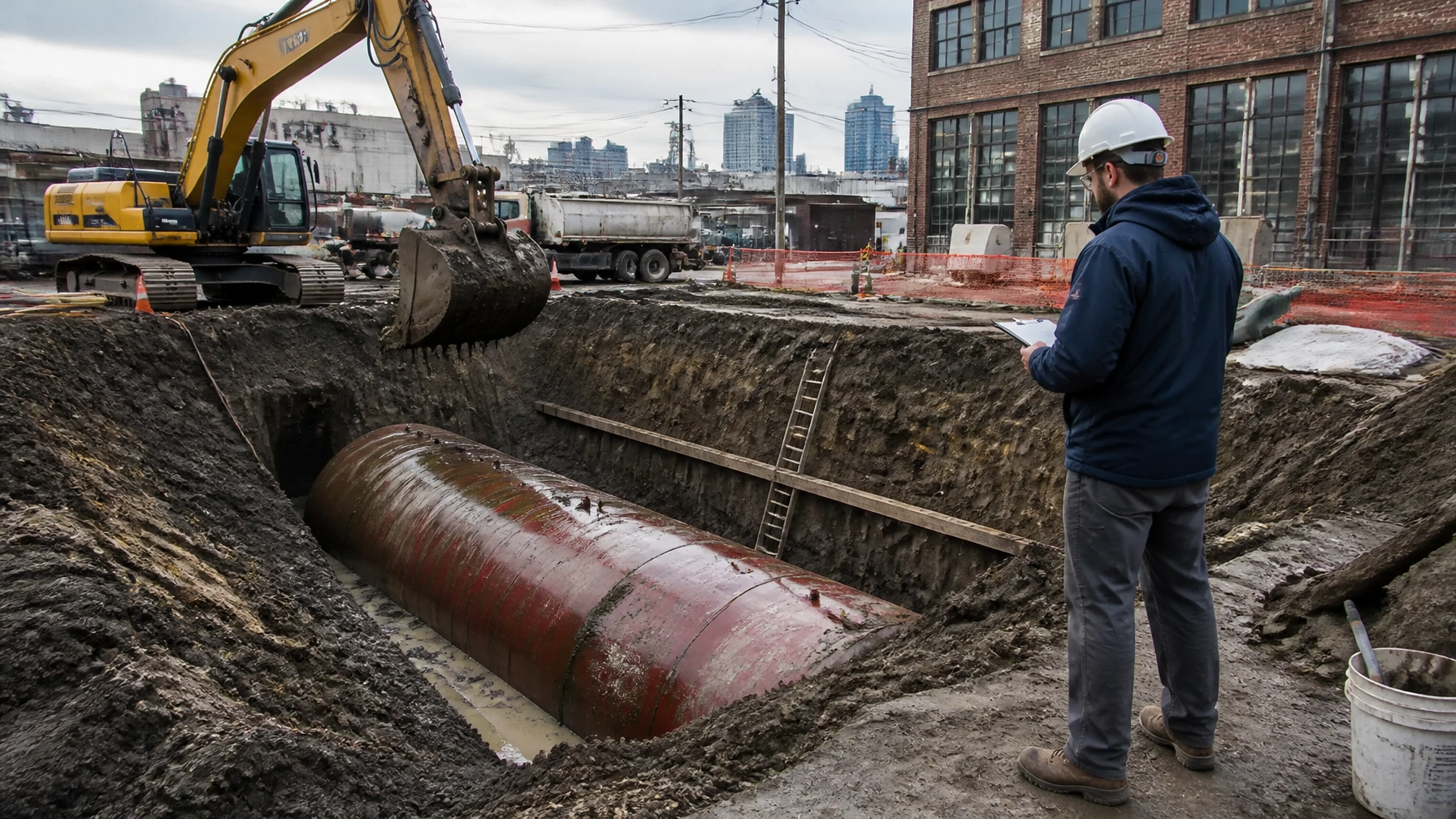
Intrusive remediation creates short-term risks that nearby communities experience in real time. Excavation, soil stockpiling, truck loading, dewatering, utility work, and subsurface demolition can generate dust, odors, and volatile organic compounds.
Under NYC’s Brownfield Cleanup Program requirements, the RAWP must include a Community Air Monitoring Plan (CAMP). The plan should be specific to the contaminants, work activities, site layout, wind conditions, nearby receptors, and planned controls.

A field-ready CAMP typically addresses:
- Monitoring locations and perimeter coverage
- Particulate monitoring
- Volatile organic compound monitoring
- Instrument calibration and response procedures
- Background readings
- Action levels and notification requirements
- Dust suppression and work-practice changes
- Data logging and reporting
- Procedures for exceedances or instrument alarms
- Coordination with the project health and safety plan
Monitoring is not a substitute for good construction controls. If readings increase, the team must be able to act. That may mean wetting exposed soil, covering stockpiles, adjusting excavation methods, stopping work temporarily, cleaning tracked soil from paved areas, or changing truck handling procedures.
In a community that has experienced years of environmental burdens, “we monitored it” is not enough. The project must show what the monitoring measured and what the team did with the information.
Remedy selection now requires a broader site and community view
NYC OER regulations require the remedial program to protect public health and the environment, including soil, groundwater, surface water, air, indoor air, sensitive populations, and ecological resources.
The regulations also identify environmental justice impacts as a factor in evaluating future land use. That includes considering whether the proposed use may cause or increase a disproportionate burden on the community, including low-income minority communities, or contribute to a concentration of commercial or industrial uses in a historically mixed-use or residential area.
That affects the alternatives analysis.
A remedy should not be selected only because it is the least expensive construction option. The project team should evaluate:
- Short-term construction impacts
- Long-term exposure pathways
- Reliability of engineering controls
- Operation and maintenance requirements
- Future building and utility work
- Access for monitoring and repairs
- Community acceptance
- Compatibility with reasonably anticipated land use
- Long-term costs and financial assurance
- The risk of disturbing the remedy during future redevelopment
Potential remedies may include source removal, treatment, containment, vapor barriers, sub-slab depressurization, groundwater controls, soil management plans, and institutional controls. The right combination depends on site data: not a template.
A restricted-use remedy can be protective, but it creates ongoing obligations. The owner may need to maintain caps, inspect controls, submit annual certifications, follow a site management plan, and notify OER before a change in use.
Public participation is a project control, not a public-relations exercise
A strong citizen participation plan helps identify issues before they become schedule problems.
Residents may know about recurring odors, flooding, informal site access, community gardens, nearby basement conditions, or sensitive uses that do not appear in a standard desktop review. Community Boards and local organizations may also identify practical concerns about truck traffic, construction hours, or access routes.
The project team should engage early enough to use that information.

At a minimum, the team should:
- Identify DAC status and nearby sensitive receptors during early due diligence.
- Build a complete site contact list.
- Prepare plain-language summaries of contamination and the proposed remedy.
- Confirm where the public can access technical documents.
- Coordinate notices with OER before major milestones.
- Explain CAMP procedures before intrusive work begins.
- Track public comments and document how they were addressed.
- Keep communication active through construction and closure.
The NYC Brownfield Cleanup Regulations require meaningful participation principles, including early involvement, representation of diverse community perspectives, and full, timely, accessible disclosure of reports, technical data, and analytical assumptions.
That is a clear standard for project communication.
What developers should do now
If you own, finance, or plan to redevelop a potentially contaminated NYC property, do not wait until the RAWP is drafted to consider environmental justice.
Start with a project-specific screening that connects regulatory status to field conditions and community context.
Your early action list should include:
- Review zoning, CEQR documents, E-Designations, and prior environmental reports.
- Screen the project against current New York State DAC mapping.
- Define the one-half-mile study area where applicable.
- Identify schools, hospitals, day-care facilities, residences, gardens, and public spaces.
- Review historic fill, petroleum, chlorinated solvents, metals, and vapor conditions.
- Determine whether OER VCP enrollment is appropriate.
- Build the CAMP around actual contaminants and construction activities.
- Budget for public participation, monitoring, reporting, and long-term controls.
- Coordinate OER, NYC Department of Health and Mental Hygiene, NYSDEC, design professionals, contractors, and counsel early.
This is where an experienced local environmental consultant makes a measurable difference. Envicon Group works directly with developers, attorneys, architects, contractors, and agency stakeholders across New York and New Jersey. We connect Phase I and Phase II investigations, remedial design, CAMP, soil management, regulatory coordination, and construction oversight into one practical path forward.
We do not just deliver a report. We help you move from environmental uncertainty to a buildable, defensible project.
The takeaway
NYC OER’s environmental justice expectations are not limited to one new permit or one additional form. They change the standard for responsible project delivery.
A successful cleanup must be technically protective, regulator-ready, understandable to the surrounding community, and durable through construction and future use.
The best time to identify environmental justice concerns is before they become agency comments, public objections, redesigns, or construction delays.
Precision gets the remedy approved. Transparency helps the project earn trust.
Ready to assess your NYC cleanup strategy?
- Visit the Envicon Group main website
- Call Envicon Group at (917) 764-2171
- Request a free consultation