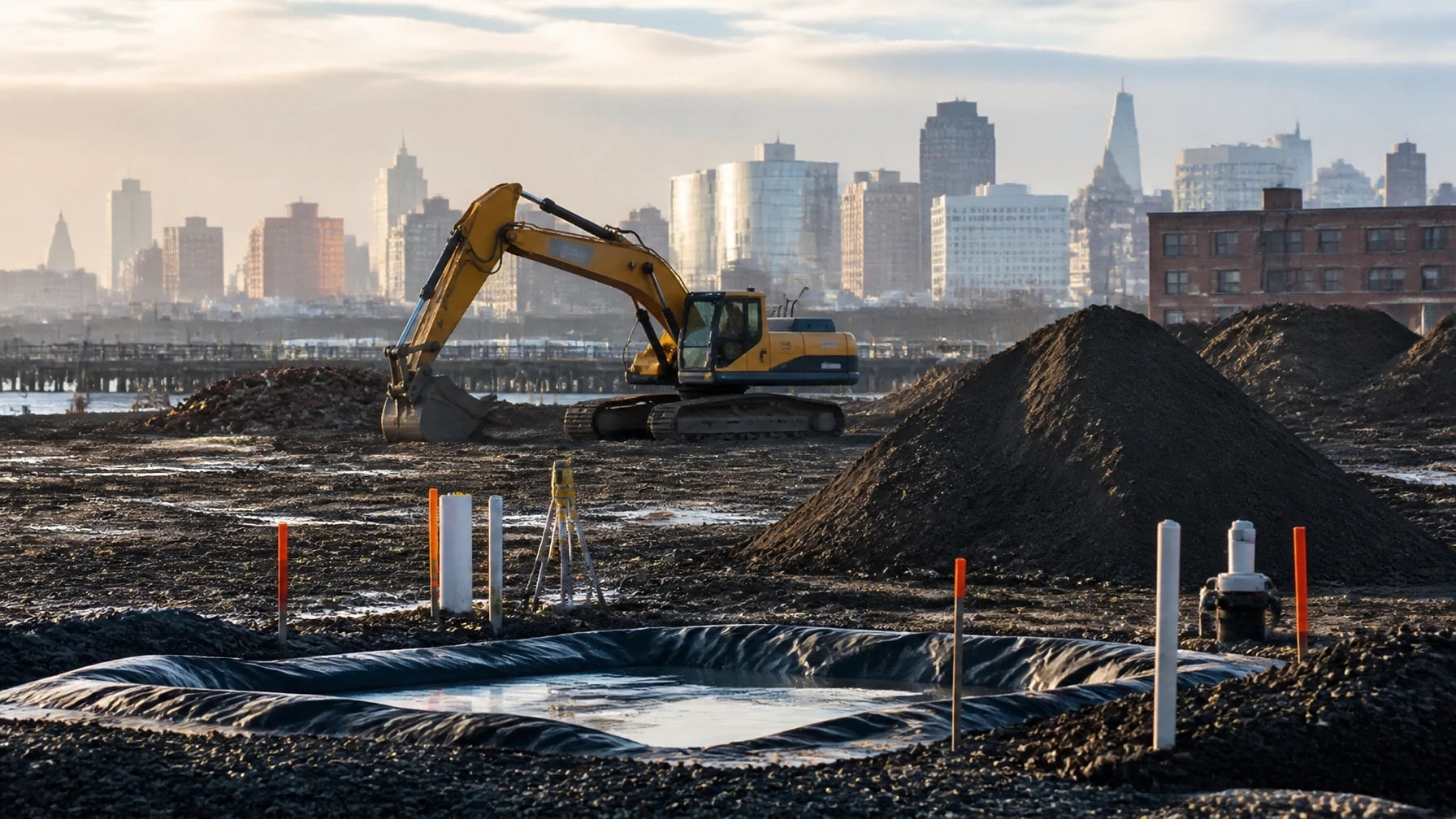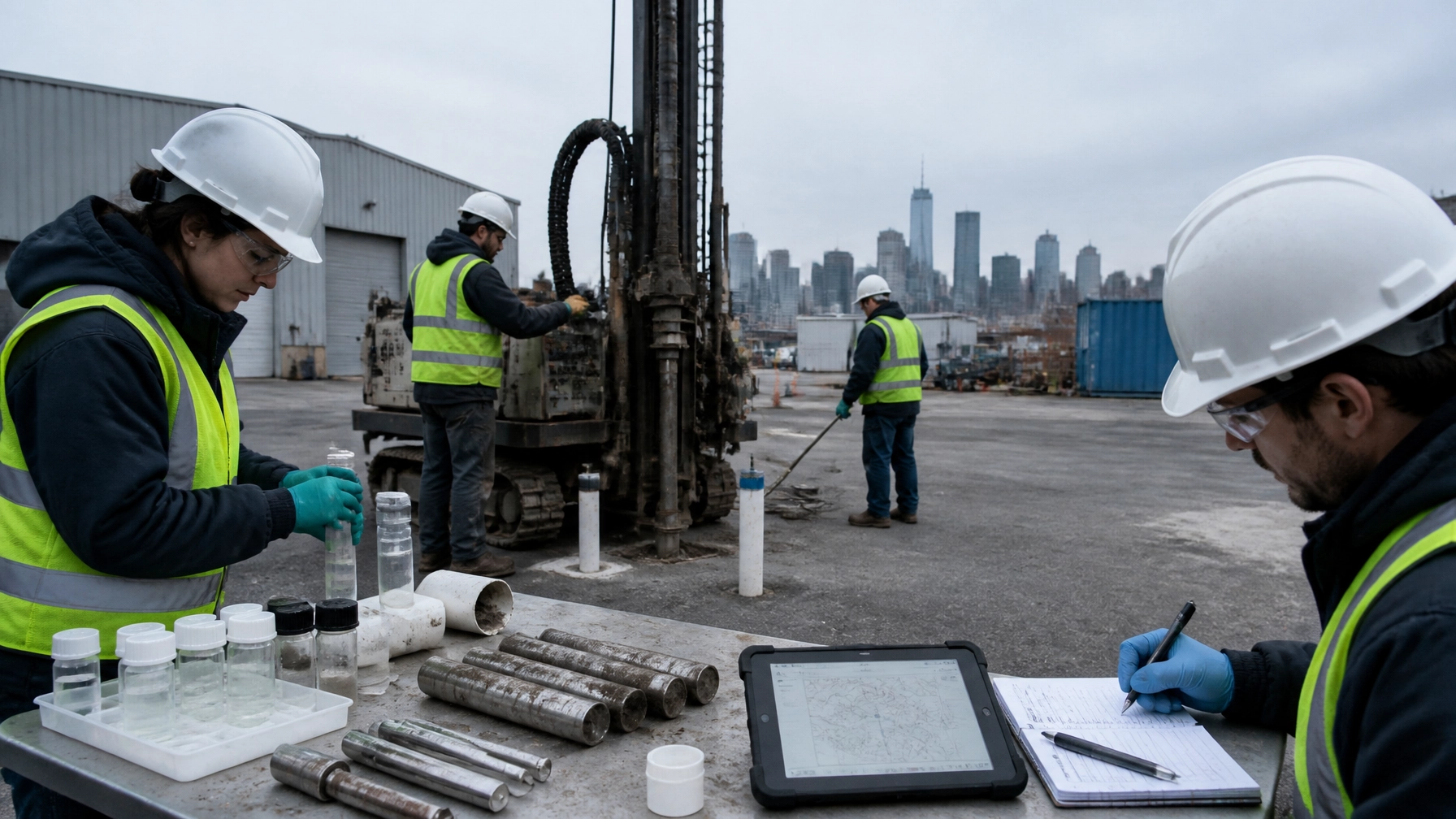
An NYC OER E-designation can affect your building permit, construction sequence, certificate of occupancy, and real estate closing. It does not disappear simply because remediation is complete or a new building is occupied.
The required environmental work must be documented, submitted through the NYC Office of Environmental Remediation’s EPIC Environment system, and certified by OER. The Department of City Planning then handles the administrative zoning record change.
This distinction matters for developers, lenders, attorneys, and owners pursuing E-designation removal in Manhattan, E-designation removal in Brooklyn, or closeout anywhere across Queens, the Bronx, and Staten Island.
“OER can remove all E-Designations from a property that achieves a high level of cleanup and fully meets air quality and noise requirements.”
Source: NYC Office of Environmental Remediation
What an NYC E-designation means
An E-designation is a zoning notation created through a City Environmental Quality Review action. It identifies environmental requirements related to one or more of the following:
- Hazardous materials
- Air quality
- Noise
The designation attaches requirements to a specific tax lot or group of tax lots. Before redevelopment, the owner generally must address the requirements through OER review.
The applicable requirements depend on the designation language, the proposed development, prior environmental conditions, and the technical records available for the property.
A Phase I ESA alone does not remove an E-designation. It may identify recognized environmental conditions and guide the next investigation, but OER typically requires a project-specific compliance pathway.
The three types of E-designations
Hazardous materials E-designation
A hazardous materials designation generally requires environmental investigation before development proceeds. The scope may include:
- Review of historical site use and prior environmental reports
- Soil borings and laboratory analysis
- Groundwater sampling
- Soil vapor investigation
- Supplemental Phase II work
- Remedial Action Plan preparation
- Soil and groundwater management during construction
- Confirmation sampling and final documentation
OER uses the investigation results to determine whether remediation is necessary and what cleanup measures will satisfy the designation.
The remedy may involve excavation and off-site disposal, treatment, clean fill placement, vapor controls, protective barriers, or other measures. However, final removal of the hazardous materials designation requires careful review of whether engineering or institutional controls remain necessary.
A property that continues to rely on an active soil vapor management system or an institutional restriction may receive project-specific approval while remaining subject to ongoing obligations. That is different from full NYC OER E-designation removal.
Air quality E-designation
An air quality E-designation may restrict fuel type, boiler location, stack placement, or other building-system features identified during environmental review.
The project team must confirm the requirements in the applicable zoning record and OER documentation. Typical closeout evidence can include:
- Mechanical equipment schedules
- Fuel specifications
- Boiler and stack locations
- Approved design drawings
- Equipment cut sheets
- Photographs of installed systems
- Professional certification
- Installation or construction reports
Depending on the designation, OER may require the source of concern to be permanently eliminated or the required air-quality measures to be fully implemented.
Noise E-designation
A noise designation commonly involves building-envelope and ventilation requirements. These may include:
- Window and wall attenuation
- Sound-rated assemblies
- Alternate means of ventilation
- Mechanical system documentation
- Installation verification
- Acoustical or construction closeout reports
The final package must demonstrate that the approved measures were installed as required. Design intent is not enough. OER needs records showing what was actually constructed.

Step 1: Confirm the designation and applicable requirements
Start with the property’s block and lot, zoning history, CEQR documentation, environmental restrictive declarations, and any prior OER correspondence.
Do not rely only on a title report or an outdated zoning summary. Confirm the current record through official City resources and project files.
For a Manhattan or Brooklyn development site, the review should address:
- Current tax block and lot numbers
- Existing E-designation type or types
- CEQR number and related zoning action
- Environmental Restrictive Declaration, if applicable
- Prior OER project numbers
- DOB filing type
- Proposed building use and below-grade construction
- Prior environmental reports and closure documents
Envicon’s NYC environmental consulting team can organize this review before field work begins. That prevents the common problem of collecting data that does not answer the agency’s actual requirements.
Step 2: Build the EPIC submission record
OER manages E-designation submissions through EPIC Environment. Project teams typically create or request access to the applicable project, enter the property information, and upload the technical documents required for review.
Depending on the designation and project stage, the record may include:
- Phase I Environmental Site Assessment
- Sampling and Analysis Plan or sampling protocol
- Phase II investigation report
- Soil, groundwater, soil vapor, or indoor-air data
- Remedial Action Plan
- Vapor mitigation design
- Air-quality or noise plans
- Construction monitoring records
- Waste characterization and disposal records
- Confirmation sampling results
- Installation reports
- Professional certifications
- Final completion documentation
OER’s E-designation guidance and EPIC submission instructions should control the current process.
A saved EPIC project is not the same as a submitted project. The applicant must complete the required submission step and retain confirmation of the filing.
Step 3: Investigate and remediate the site
For hazardous materials requirements, Envicon may use Phase I findings, historical research, geophysical data, soil borings, groundwater wells, and soil vapor sampling to define the site condition.
The right remedy depends on the contaminant, concentration, depth, building design, groundwater conditions, and intended use. Possible measures include:
- Targeted excavation
- Soil disposal and clean fill placement
- Groundwater treatment
- Vapor barriers
- Sub-slab depressurization systems
- Passive venting systems
- Utility and foundation sealing
- Construction-phase soil management
- Indoor-air monitoring
Soil vapor and indoor-air controls deserve particular attention. A building may appear complete while vapor pathways remain at slab joints, utility penetrations, elevator pits, sumps, or foundation cracks.
For new construction, vapor barriers and sub-slab systems should be coordinated with structural, architectural, and MEP drawings before concrete placement. For existing buildings, the design must account for occupied conditions, access limitations, HVAC operation, and system maintenance.
See Envicon’s technical guide on vapor intrusion mitigation systems for additional background.

Step 4: Document construction and installation
OER closeout depends on reliable field documentation. Construction records should show that the approved remedy and building controls were installed correctly.
A project closeout file may include:
- Daily field reports
- Community Air Monitoring Program records, when applicable
- Photographs before concealment
- Vapor barrier inspection forms
- Sub-slab system pressure readings
- Fan and alarm testing
- Indoor-air sampling results
- Window and wall assembly records
- Mechanical equipment records
- Noise-control installation reports
- Soil export and disposal documentation
- Imported fill certifications
- As-built drawings
- Contractor affidavits
- Engineer or architect certifications
- Responses to OER comments
This is where field oversight matters. A report assembled months after construction cannot replace photographs, readings, chain-of-custody records, and installation verification collected at the correct stage.
Step 5: Obtain OER certification
After the environmental requirements are complete, the applicant submits the closeout package through EPIC.
OER reviews the record and determines whether the applicable hazardous materials, air quality, and noise requirements have been satisfied. In qualifying cases, OER issues a final notice of satisfaction or equivalent completion determination.
The standard for full removal is important. Under 43 RCNY § 43-1475, the final determination concerns complete satisfaction of the environmental requirements for the affected tax lot or lots.
For hazardous materials, full removal generally requires a cleanup that does not depend on engineering or institutional controls and is protective for allowable uses. For air and noise, the source must be permanently eliminated or the required measures must be completed and documented.
OER may also issue a project-level notice that supports DOB sign-off while ongoing controls remain. That document should not automatically be treated as final zoning removal.
OER certification is not the same as final zoning record removal
This is the most important closeout distinction.
- OER reviews the technical work and certifies that the environmental requirements have been satisfied.
- DCP updates the official zoning record, including Appendix C, after receiving the required OER notice.
- DOB may rely on OER documentation for permit or occupancy-related actions, depending on the project and filing.
A closing attorney or lender may ask for proof that the designation has been removed from the zoning record, not merely proof that construction controls were installed.
DCP’s administrative action may remove affected tax lots first. If all lots associated with the designation receive final notices of satisfaction, DCP can administratively remove the full E-designation from the applicable zoning record.

NYC E-designation closeout checklist for a real estate closing
Before representing that the property is clear, confirm that you have:
- Current block and lot information
- The applicable E-designation language
- CEQR and zoning documentation
- OER project number and EPIC access
- Phase I and Phase II reports
- Approved sampling or remedial plans
- Remedial completion records
- Soil vapor and indoor-air documentation, if applicable
- Air-quality installation records, if applicable
- Noise-control installation records, if applicable
- Construction monitoring and waste records
- OER final notice or certification
- Evidence of DCP administrative record update
- Confirmation that all tax lots are addressed
- Closing counsel review of any remaining restrictive declaration or control
The checklist applies across Manhattan, Brooklyn, Queens, the Bronx, and Staten Island. The technical details change by site, but the closeout logic remains the same: identify, investigate, implement, document, certify, and verify the zoning record.
Frequently asked questions
How do I remove an E-designation from a property?
First identify the designation type and applicable tax lots. Then complete the required investigation or building measures, submit documentation through EPIC, obtain OER certification, and verify DCP’s administrative update to the zoning record.
How long does E-designation removal take in Manhattan or Brooklyn?
The timeline depends on the designation, the condition of the site, the project schedule, OER review, construction sequencing, and the quality of the submission. Early review usually reduces delays because it identifies missing records before permit or closing deadlines.
Can a vapor mitigation system be used for final E-designation removal?
A vapor mitigation system may support development and occupancy, but full removal can require a cleanup that does not rely on an active soil vapor management system. The answer depends on OER’s determination and the applicable rule.
Does an OER notice automatically change the zoning record?
No. OER certification and DCP administrative removal are related but separate steps. Confirm both the environmental determination and the final Appendix C or zoning record update.
Can an E-designation be closed before the building is fully constructed?
Some project-level approvals and notices may support construction or occupancy steps before complete zoning removal. Full removal may depend on construction reaching the required development potential and submission of final installation records.
Move from designation to cleared path
E-designation removal is not just a paperwork exercise. It is a coordinated environmental, construction, regulatory, and real estate process.
Envicon Group brings Phase I and Phase II investigation, remediation, vapor controls, construction oversight, and NYC agency coordination into one accountable workflow. We give developers and counsel a clear record of what is required, what has been completed, and what remains before closing.
Start your NYC E-designation closeout
- Call Envicon now at (917) 764-2171
- Get a free quote today
- View our complete list of environmental and engineering services
Official NYC sources
- NYC OER E-designation overview
- NYC OER guidance on removing E-designations
- NYC OER new development and EPIC submission guidance
- 43 RCNY § 43-1475 and E-designation rules
- NYC Department of City Planning E-designation datasets
A designation is an obstacle only when no one owns the path through it. We do the technical work, manage the record, and keep your project moving toward a buildable, compliant asset.