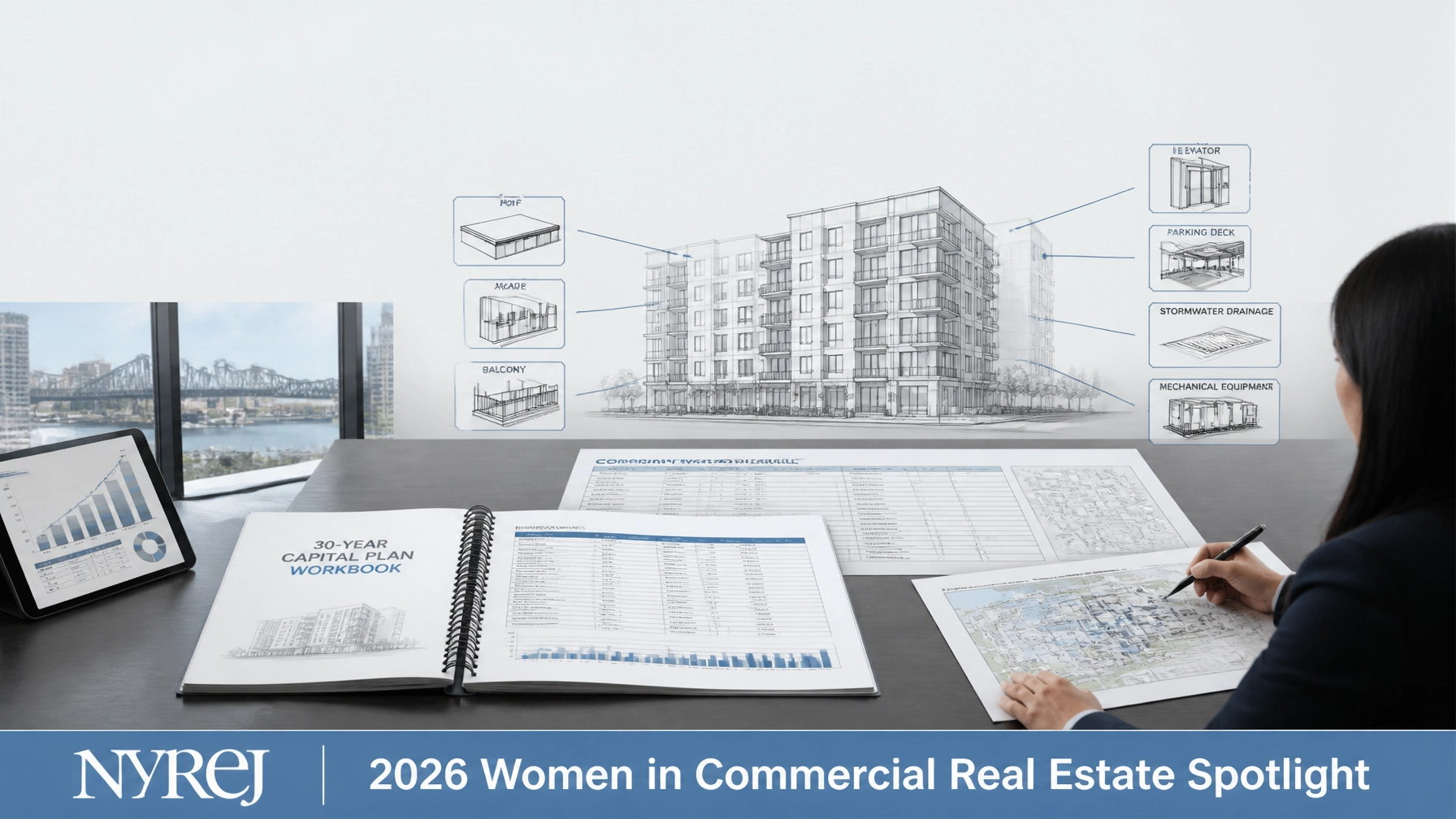
For condo and HOA boards across Jersey City, Newark, Hoboken, Bayonne, Bergen County, Hudson County, and Essex County, reserve planning is no longer something to revisit only after a major roof leak or façade repair.
New Jersey’s capital reserve requirements now place greater responsibility on associations to understand their common-area assets, anticipate repair costs, and maintain a defensible funding plan. In September 2026, boards should be asking a direct question:
Can our current reserve plan support the building we actually own and maintain?
A proper reserve study HOA New Jersey engagement connects engineering conditions to financial decisions. It gives the board a practical 30-year view of upcoming capital work, funding needs, and special-assessment exposure.
What a New Jersey reserve study should include
A reserve study has two connected parts.
1. The physical analysis
The physical component documents the common-area assets the association must maintain. That usually includes:
- Roofing systems and waterproofing
- Exterior façades and masonry
- Balconies, terraces, and decks
- Windows and doors maintained by the association
- Elevators and major mechanical systems
- Parking garages, podium decks, and paved areas
- Drainage, site utilities, and stormwater infrastructure
- Domestic water, sanitary, and fire protection systems
- Heating, ventilation, and air-conditioning equipment
- Pool, clubhouse, fitness, and recreation facilities
- Site lighting, fencing, retaining walls, and landscaping systems
The engineer evaluates current condition, estimated remaining useful life, maintenance needs, and replacement timing. A component inventory that misses a major asset produces a funding plan that looks precise but is incomplete.
2. The financial analysis
The financial component uses the physical findings to model future reserve needs. It typically considers:
- Current reserve fund balance
- Annual reserve contributions
- Anticipated capital expenditures
- Inflation and construction-cost escalation
- Interest earned on reserve funds
- Replacement timing
- Funding levels over a 30-year period
- Percent-funded or cash-flow results
- Alternative contribution scenarios
- Potential special assessments or loans
A board should not receive only one number labeled “recommended annual contribution.” It should see how the plan performs under realistic conditions.
For example, a funding plan may compare:
- A stable annual contribution
- Gradual increases tied to inflation
- A front-loaded funding strategy
- A lower contribution plan with a projected special assessment
- A phased capital program that coordinates multiple projects
That information gives owners context. It also gives the board a better basis for budgeting, communicating, and making decisions before a capital project becomes urgent.

What P.L. 2023, c. 214 means for associations
New Jersey’s Structural Integrity Law, enacted as P.L. 2023, c. 214, amended the Planned Real Estate Development Full Disclosure Act and created related structural inspection requirements for certain residential condominium and cooperative buildings.
The New Jersey Department of Community Affairs explains that the capital reserve provisions apply to planned real estate development associations, including associations that may not qualify as “covered buildings” for structural inspection purposes. The DCA’s official FAQ is available here.
Under N.J.S.A. 45:22A-44.2, a qualifying association must undertake and fund a capital reserve study. The study must be prepared in accordance with the latest National Reserve Study Standards of the Community Associations Institute, or similar recognized standards, and must be performed or overseen by a credentialed reserve specialist or a New Jersey-licensed engineer or architect.
The statute identifies a 30-year funding plan as a required part of the reserve study.
Associations that did not complete a reserve study within the five years before the law’s effective date generally faced an initial study deadline of January 8, 2025. The study must then be conducted and reviewed at least once every five years. Associations with less than $25,000 in total common-area capital assets may fall within the statutory exemption, but that determination depends on the association’s actual assets and governing facts.
The law is specific. The application is not always simple.
A Jersey City high-rise with a concrete podium, an older Newark condominium conversion, and a wood-frame community in Bergen County may have different obligations. Legal compliance depends on the association’s structure, asset inventory, governing documents, building history, and current counsel guidance.
Reserve study Jersey City condo boards should coordinate with structural inspections
A reserve study Jersey City condo board commissions is not the same thing as a mandatory structural integrity inspection.
The two services can and should inform each other, but they answer different questions.
A reserve study asks:
- What common-area components does the association maintain?
- What condition are those components in?
- When will repair or replacement likely occur?
- What will that work cost?
- How much should the association contribute over 30 years?
A structural integrity inspection asks:
- Does the building’s primary load-bearing system show deterioration or deficiencies?
- Are columns, beams, slabs, bracing, foundations, balconies, or related structural elements performing as intended?
- Is corrective maintenance required?
- When must the next structural inspection occur?
The structural inspection requirement under P.L. 2023, c. 214 applies to certain “covered buildings.” These generally include residential condominium or cooperative buildings with primary load-bearing systems made of concrete, masonry, steel, or a hybrid structure. Podium-deck buildings may qualify. Some frame-built structures, primarily rental buildings, and single-family dwellings are excluded by the statutory definitions.
For older covered buildings, the first inspection deadline may already have passed. The law establishes age-based timing tied to the certificate of occupancy, including a two-year period for buildings that were at least 15 years old when the law took effect on January 8, 2024.
The structural inspector’s report must identify required maintenance or repairs and be provided to the applicable municipal officials and enforcing agency. The report must also be retained by the association and made available to residents upon request.
A structural inspection does not replace a reserve study. It does not create the financial model needed to fund roofing, paving, elevators, mechanical systems, drainage, or other common elements. Conversely, a reserve study does not replace an engineering evaluation of the primary load-bearing system.

How to reduce special-assessment risk
A reserve study cannot guarantee that an association will never need a special assessment. Building components can fail earlier than expected. Storm damage, hidden deterioration, supply-chain constraints, and changing construction costs can affect any 30-year projection.
A good plan reduces avoidable surprises by making assumptions visible.
Boards should review:
-
Component condition
Does the study reflect current site conditions, or does it rely on an outdated walkthrough? -
Useful-life assumptions
Is the roof listed for replacement based on actual age and condition? Are façade repairs timed realistically? -
Local construction costs
Does the model reflect current pricing in Jersey City, Newark, Hoboken, and the surrounding metro market? -
Inflation assumptions
Does the plan account for construction escalation without overstating certainty? -
Reserve balance
Is the current balance sufficient for near-term work already identified? -
Funding scenarios
Does the board understand the difference between the recommended plan and a reduced-contribution plan? -
Structural findings
Have inspection findings been incorporated into the component inventory and capital schedule? -
Maintenance responsibilities
Do the study and governing documents agree on who maintains balconies, windows, drainage, parking areas, and other shared or exclusive-use elements?
A lower annual contribution may appear attractive in the current budget. If it shifts a known capital need into a large future assessment, the association has not eliminated the cost. It has delayed it.
Under the current statutory framework, associations should review funding decisions with their community-association attorney, accountant, property manager, and qualified reserve professional or engineer. The board should document why it selected a particular funding scenario and how it plans to address identified deficiencies.
What boards should prepare before commissioning a study
A faster, more useful engagement starts with complete records. Before the site visit, gather:
- Prior reserve studies and updates
- Current operating and reserve budgets
- Recent financial statements
- Reserve account balance
- Master deed, bylaws, and maintenance responsibilities
- Certificate of occupancy information
- Structural inspection reports
- Façade, balcony, roof, or garage repair records
- Capital project contracts and warranties
- Preventive maintenance schedules
- Insurance inspection reports
- Open violation notices or municipal correspondence
This preparation helps the engineer distinguish known conditions from assumptions. It also reduces the risk of paying for a generic report that does not reflect the actual property.
For a reserve study Newark HOA, the same principle applies even when the community does not have a covered condominium building. The association still needs to identify its common-area capital assets and determine whether its funding plan supports long-term maintenance.
In Hoboken, Bayonne, and older parts of Bergen and Essex County, dense construction, coastal exposure, aging infrastructure, and high contractor pricing make local engineering judgment especially important. A capital reserve study Hudson County should not read like a national template with the property name changed on the cover.

How Envicon helps New Jersey boards make the numbers usable
Envicon prepares board-ready reserve studies for condos, co-ops, and HOAs across New York and New Jersey. Our reserve study service combines on-site component assessment, useful-life analysis, local replacement-cost research, and 30-year funding scenarios.
When structural concerns exist, we can coordinate the reserve study with NJ structural integrity inspections so the funding plan reflects the engineering findings. Our broader civil and geotechnical engineering team supports related site, drainage, paving, utility, and structural coordination needs.
We work directly with boards, property managers, attorneys, accountants, and contractors. You receive a clear explanation of what the study found, what the numbers mean, and what decisions come next.
That is the difference between receiving a report and having a plan.
Takeaway for New Jersey condo and HOA boards
A 30-year reserve study New Jersey association can defend should do more than satisfy a deadline. It should help the board understand the property’s physical condition, forecast capital work, communicate with owners, and reduce the chance of avoidable special assessments.
For boards in Jersey City, Newark, Hoboken, Bayonne, Hudson County, Bergen County, and Essex County, the right time to update the plan is before the next roof, façade, garage, balcony, or mechanical emergency forces the issue.
Start with a board consultation
Tell us your building type, location, current reserve balance, last study date, and any known structural concerns. We’ll help you determine whether you need a new study, a five-year update, a structural inspection, or coordinated support.
- Call Envicon now at (917) 764-2171
- Request a free board consultation
- Review Envicon’s reserve study services
- See Envicon’s Jersey City and Hudson County coverage
A clear reserve plan protects more than a balance sheet. It gives owners confidence that the association is managing the building before the building manages the board.