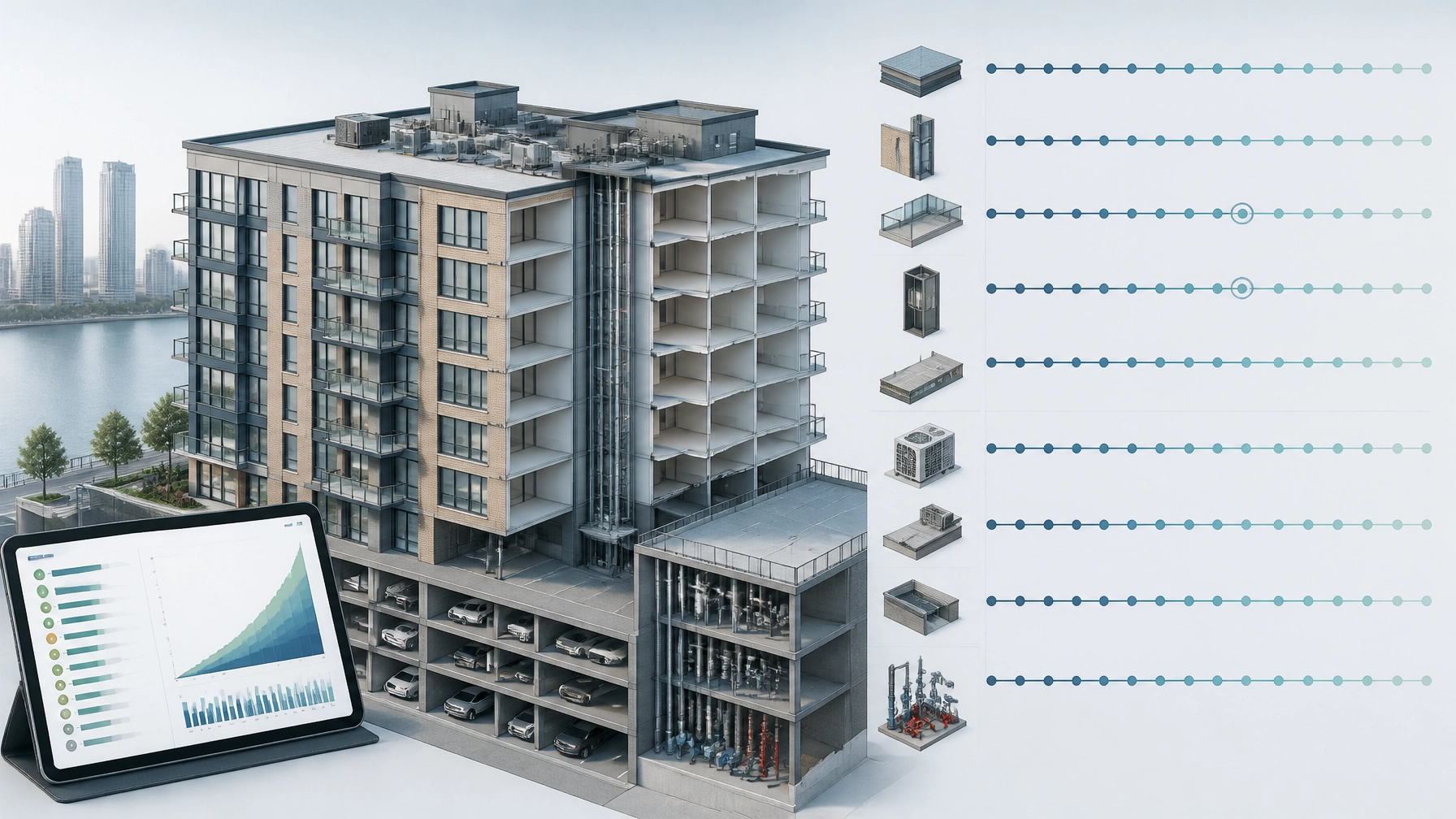
A reserve study HOA boards can defend is more than a spreadsheet. It connects the physical condition of shared property to the money required to repair or replace it.
For New Jersey condominium, cooperative, and HOA boards, that connection now carries statutory weight. Under N.J.S.A. 45:22A-44.2 and 45:22A-44.3, covered planned real estate developments must address capital reserves through a professional study and a 30-year funding plan. The goal is straightforward: maintain common assets without repeatedly turning predictable repairs into emergency special assessments or loans.
This guide explains the reserve study requirements for New Jersey condos and HOAs, what the study should contain, and how it works alongside structural integrity inspections.
“An association of a planned real estate development shall obtain a reserve study including a 30-year funding plan.”
N.J.S.A. 45:22A-44.3
What is a reserve study?
A capital reserve study condo board members can use has two connected parts:
- Physical analysis
- Financial analysis
The physical analysis identifies the common-area assets the association must maintain. It documents their current condition, estimated remaining useful life, and likely repair or replacement requirements.
The financial analysis converts those findings into a long-range funding plan. It considers current reserve balances, annual contributions, projected expenses, inflation, investment income, and the timing of major capital work.
The result should answer practical board questions:
- What assets will require major work?
- When will that work likely occur?
- What will it cost in today’s dollars and future dollars?
- Are current contributions adequate?
- Will the association face a funding gap?
- What action should the board take before the problem becomes urgent?
New Jersey reserve study requirements
New Jersey’s reserve study law applies to associations of planned real estate developments governed by the Planned Real Estate Development Full Disclosure Act, or PREDFDA. The statute requires a capital reserve study prepared in accordance with the latest Community Associations Institute National Reserve Study Standards or comparable recognized standards.
The study must be performed or overseen by one of the following:
- A Community Associations Institute credentialed Reserve Specialist
- A New Jersey-licensed professional engineer
- A New Jersey-licensed architect
The statute also identifies an exception for an association with less than $25,000 in total common-area capital assets. Coverage can depend on the association’s legal structure, governing documents, and asset portfolio. Boards should have association counsel confirm how the law applies to their specific community.
The New Jersey Department of Community Affairs explains that a community may still have a capital reserve study obligation even if its building is not subject to the separate structural inspection requirement. Read the New Jersey DCA Structural Integrity Law and Capital Reserve Study FAQ before relying on an exemption.
Associations that had not completed a reserve study within five years of January 8, 2024, were required to undertake one within one year of that effective date. New associations must complete a study as soon as practicable after a majority of the executive board is elected, and no later than two years after that election.
A reserve study should be reviewed and updated at least every five years. A board should not wait for the five-year mark if the property has experienced major damage, construction defects, severe weather, unexpected price escalation, or a significant capital project.
What belongs in the component inventory?
The component inventory is the foundation of the study. If an asset is missing from the inventory, its future cost may also be missing from the funding plan.
Typical components include:
- Roofing systems
- Exterior façades and masonry
- Balconies and decks
- Windows and doors
- Elevators
- Parking lots and parking structures
- Concrete walks and plazas
- Site drainage and stormwater systems
- Domestic water and plumbing systems
- Boilers, chillers, and HVAC equipment
- Electrical distribution equipment
- Fire protection systems
- Swimming pools and recreational facilities
- Retaining walls, fences, gates, and site lighting
- Clubhouses and other common buildings
The association’s master deed, bylaws, maintenance obligations, prior studies, repair records, warranties, and operating history should inform the inventory.

Physical analysis and useful-life assumptions
A reserve study site visit is not a substitute for a full forensic investigation. It is a disciplined condition assessment of the components included in the association’s maintenance responsibility.
The engineer or reserve specialist typically documents:
- Current condition
- Visible deterioration
- Prior repairs
- Maintenance history
- Remaining useful life
- Expected repair or replacement year
- Recommended next action
- Estimated cost
Useful-life assumptions must reflect actual site conditions. A roof exposed to coastal wind, ponding water, or repeated patching may not have the same remaining life as a well-maintained roof in a protected location.
The study should explain the assumptions behind each forecast. It should not simply apply a generic 20-year or 30-year life to every component.
For example, useful life may be affected by:
- Installation quality
- Material type
- Exposure to water, salt, freeze-thaw cycles, or ultraviolet radiation
- Maintenance frequency
- Prior repairs
- Design defects
- Occupancy and usage
- Current observed condition
The report should also separate routine maintenance from major capital work. Repainting a corridor is different from replacing a failed façade system. Both may affect the budget, but they belong in different planning categories.
Sample reserve study component table
A board-ready report should present information in a format that supports decisions. A simplified example appears below.
| Component | Current condition | Estimated remaining life | Planning action | Cost basis |
|---|---|---|---|---|
| Roof membrane | Fair | 6 years | Replacement planning | Local contractor pricing and current cost data |
| Façade masonry | Fair | 10 years | Targeted repairs and follow-up review | Engineer assessment and repair allowance |
| Parking deck coating | Poor | 3 years | Repair and recoating project | Quantity estimate and bid-level allowance |
| Elevator modernization | Fair | 12 years | Capital replacement reserve | Service records and vendor budget |
| Site drainage | Fair | 8 years | Repair, cleaning, and selective replacement | Field observations and civil design allowance |
These figures are examples only. A qualified professional must develop project-specific assumptions.
Financial analysis: inflation, funding, and timing
A 30-year reserve study New Jersey boards can rely on should show how projected costs change over time.
The financial model generally considers:
- Current reserve fund balance
- Annual reserve contributions
- Planned capital expenditures
- Inflation assumptions
- Interest or investment income assumptions
- Timing of repairs and replacements
- Future study and update costs
- Required structural inspection costs
- Corrective maintenance identified by structural inspections
Inflation matters because a component scheduled for replacement in 15 years will not cost the same as it costs today. The model should identify the inflation assumptions used and test whether the plan remains workable under different conditions.
Boards should review more than one funding scenario. Common approaches include:
- Gradual increases in annual reserve contributions
- A stable contribution schedule supported by a higher current contribution
- A phased capital program
- A combination of reserves and carefully documented financing
- A limited special assessment where permitted and unavoidable
The statutory objective is to maintain adequate reserves without needing a special assessment or loan obligation for predictable capital work. New Jersey law also provides an 85 percent funding option for certain existing associations, subject to specific notice, disclosure, and time-limit requirements. Because that option can create a future funding gap and affect unit sales, counsel should review the association’s eligibility and required notices before the board adopts it.

Special-assessment risk is a planning problem
A special assessment is not always avoidable. A storm event, premature failure, concealed defect, or unexpected structural condition can change the plan.
The avoidable problem is discovering a predictable capital expense after the reserve account is already underfunded.
A useful study helps the board see the funding gap early. It can show:
- The year the reserve balance becomes inadequate
- Which component creates the largest exposure
- Whether a modest annual contribution increase changes the outcome
- Whether project phasing reduces short-term pressure
- Whether the association’s current budget matches the adopted plan
That visibility gives owners a clearer explanation of why contributions may need to increase. It also gives the board a documented basis for its decisions.
Reserve studies do not replace structural integrity inspections
New Jersey’s reserve study requirement and structural integrity inspection requirement work together, but they are not the same service.
A reserve study focuses on capital planning. It evaluates the condition, useful life, and cost of common-area components and develops a funding plan.
A structural integrity inspection evaluates the primary load-bearing system of a covered residential condominium or cooperative building. Covered systems may include concrete, masonry, steel, hybrid construction, heavy timber, podium decks, foundations, beams, columns, bracing, and connected balconies, subject to statutory definitions and exclusions.
Under N.J.S.A. 52:27D-132.3 and 52:27D-132.4, covered buildings require inspections by a licensed New Jersey engineer on a statutory schedule. Older covered buildings had an initial deadline tied to January 8, 2024, while newer buildings generally follow the certificate of occupancy timeline. The inspection report establishes required maintenance and the timing of future inspections.
A reserve study should account for:
- The cost of required structural inspections
- Corrective maintenance identified by those inspections
- Repair design and construction support
- Follow-up monitoring where conditions warrant it
But the reserve study itself does not certify structural safety. If the board sees cracking, spalling concrete, water intrusion, corrosion, movement, or other distress, it should engage a qualified structural engineer promptly.
Envicon provides NJ structural integrity inspections and reserve studies with a coordinated handoff between the physical findings and the financial plan.
Board disclosure and governance
A reserve study is most useful when the board treats it as a working governance document, not a report that sits in a file cabinet.
Boards should:
- Present the key findings to unit owners
- Explain major assumptions in plain language
- Adopt an annual reserve contribution consistent with the selected plan
- Document any decision to deviate from the recommendation
- Track repairs and replacements against the study
- Update the model after major work or unexpected damage
- Have association counsel review statutory obligations and owner disclosures
For communities in Jersey City, Hoboken, Newark, and throughout Hudson County, local building conditions, waterfront exposure, aging infrastructure, and dense construction can materially affect capital planning. Envicon’s Jersey City engineering team works with boards, managers, attorneys, and property owners across the New York and New Jersey metro area.
How much does a reserve study cost for an HOA?
The cost depends on the size and complexity of the association, the number of buildings and components, the study level, site access, available records, and whether structural or property-condition work must be coordinated.
A full study with an on-site inspection generally requires more field time than a financial update based on a recent, reliable study. A large condominium with elevators, parking structures, façades, mechanical systems, and multiple buildings will require a broader scope than a small HOA with roads, drainage, and a clubhouse.
The right question is not only the fee. It is whether the study gives the board a defensible inventory, realistic useful-life assumptions, transparent cost basis, and a funding plan that owners can understand.
You can request a project-specific scope through Envicon’s reserve study service or review related civil and geotechnical engineering services.
Frequently asked questions
Is a reserve study required for every HOA in New Jersey?
Not necessarily. Coverage depends on the association’s status as a planned real estate development, its common-area capital assets, and applicable statutory requirements. Counsel should confirm whether an exemption applies.
How often should a New Jersey reserve study be updated?
The study should be reviewed and updated at least every five years under the applicable New Jersey requirements. Earlier updates may be appropriate after major repairs, damage, or changes in construction costs.
Does a reserve study include a structural inspection?
A reserve study includes a condition assessment of common-area components, but it does not replace a statutory structural integrity inspection. Covered condo and co-op buildings may need both services.
Who can prepare a reserve study?
The study must be performed or overseen by a credentialed Reserve Specialist, a New Jersey-licensed professional engineer, or a New Jersey-licensed architect, and it should follow recognized national reserve study standards.
What happens if the reserve study shows a funding shortfall?
The board should evaluate contribution increases, project timing, phasing, financing, or other lawful funding options. Counsel and the reserve professional should review any special assessment or alternative funding decision.
The takeaway for New Jersey boards
A reserve study HOA boards can defend begins with accurate field information. It ends with a funding plan that connects today’s decisions to tomorrow’s obligations.
For New Jersey associations, the practical sequence is clear:
- Confirm coverage and statutory obligations.
- Build a complete component inventory.
- Assess physical condition and useful life.
- Coordinate structural inspection findings where required.
- Model inflation, timing, and reserve contributions.
- Document the board’s funding decision.
- Review and update the plan before conditions change.
A strong reserve plan does more than reduce financial surprises. It gives owners confidence, supports responsible governance, and keeps the community’s shared assets moving toward long-term stability.
Ready to build a defensible 30-year capital plan?
- Call Envicon now at (917) 764-2171
- Get a free quote today
- Use Envicon’s proprietary reserve study cost estimator