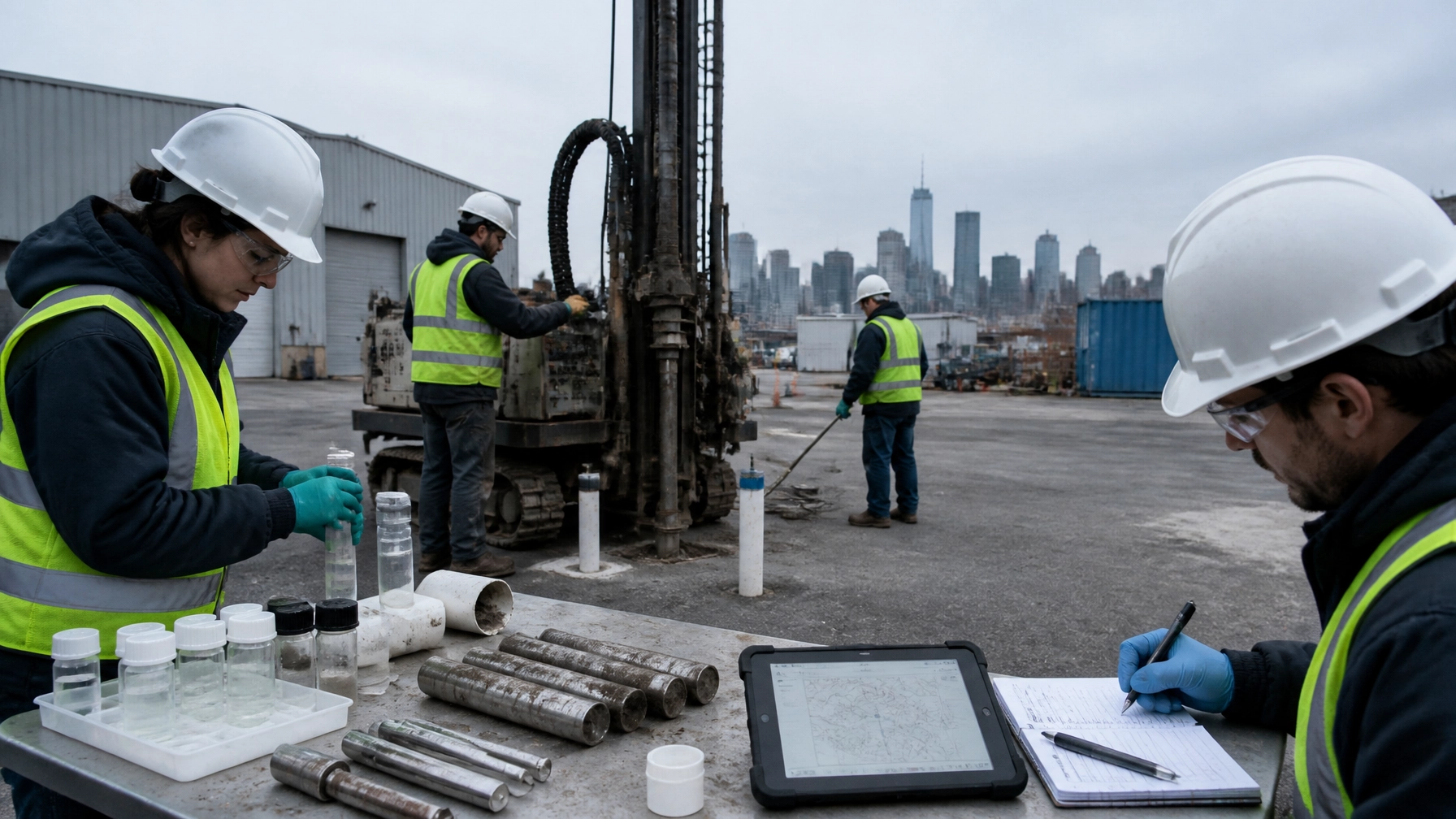
A Newark acquisition rarely turns on one report. A commercial property in the Ironbound, Downtown Newark, the North Ward, or near the Passaic River may require environmental due diligence, NJDEP coordination, building-material surveys, civil design, and construction oversight before the project is ready to close or build.
That is why choosing an environmental consultant Newark NJ developers can reach directly matters. The right team connects the findings, the regulatory path, and the construction plan before separate scopes create gaps.
Envicon Group supports Newark and Essex County projects with coordinated environmental consulting, NJDEP LSRP services, brownfield redevelopment support, civil and geotechnical engineering, permitting, and field oversight.
“Our mission” at New Jersey’s Contaminated Site Remediation & Redevelopment Program is “to reduce the number of contaminated sites in New Jersey to ensure the protection of public health and the environment and ready sites for redevelopment.” NJDEP CSRR
Why Newark environmental due diligence requires coordination
A Phase I ESA can identify historical and current environmental concerns. It does not, by itself, resolve subsurface contamination, confirm the condition of a UST, clear a vapor intrusion pathway, or determine whether a building contains asbestos or lead.
For Newark commercial property, the acquisition team may need to evaluate:
- Historic industrial and commercial uses
- Historic fill and urban redevelopment conditions
- Former dry cleaners, auto uses, rail operations, and manufacturing
- Underground storage tanks and petroleum releases
- Soil, groundwater, and soil vapor conditions
- NJDEP case status and potential ISRA obligations
- Asbestos and lead before renovation or demolition
- Grading, drainage, utilities, foundations, and dewatering
- Construction stormwater and SWPPP requirements
A report that identifies a concern without explaining the next action leaves the buyer, lender, attorney, and contractor to solve the problem separately. That creates delay.
Our approach is different. We define the transaction or redevelopment objective first, then build a scope that supports the closing date, permit date, and intended site use.

Environmental scope: Phase I ESA, Phase II, historic fill, and USTs
Phase I ESA Newark NJ
A Phase I Environmental Site Assessment generally reviews property history, regulatory databases, aerial photographs, Sanborn maps, interviews, and current site conditions under ASTM E1527-21.
The goal is to identify recognized environmental conditions, historical recognized environmental conditions, controlled recognized environmental conditions, and other areas that may require additional investigation.
For a Newark property, the review should consider the site’s relationship to surrounding industrial parcels, former petroleum uses, rail corridors, waterfront operations, and older commercial buildings. A Phase I ESA is also commonly required by lenders before acquisition or refinancing.
A Phase I ESA does not include soil, groundwater, or vapor sampling. If the assessment identifies a recognized environmental condition, a Phase II ESA may be appropriate.
New Jersey transactions may also require a Preliminary Assessment that follows NJDEP requirements. A Phase I ESA and an NJDEP-focused Preliminary Assessment serve related but distinct purposes. The correct scope depends on the property history, transaction structure, regulatory status, and intended use.
Phase II investigation and soil management
A Phase II ESA may include:
- Soil borings and laboratory analysis
- Groundwater monitoring wells and sampling
- Soil vapor or sub-slab vapor evaluation
- Petroleum hydrocarbon testing
- Metals and polycyclic aromatic hydrocarbon analysis
- Data validation and comparison to applicable NJDEP standards
Historic fill deserves special attention in Newark and throughout older urban areas of Essex County, Hudson County, and Bergen County. NJDEP defines historic fill as non-indigenous material placed to raise site elevation. It may include construction debris, ash, demolition material, dredge spoils, or other materials.
NJDEP’s Historic Fill Material Technical Guidance explains that historic fill can be addressed through investigation, sampling, assumption, engineering controls, institutional controls, or other approved remedial strategies depending on the site conditions.
The practical issue is not simply whether fill exists. The project team needs to know how it affects excavation, soil disposal, cap design, deed notices, groundwater, and the final site use.
UST closure and vapor intrusion
Former service stations, industrial facilities, and older commercial properties may contain current or abandoned underground storage tanks. A UST closure scope can include tank removal or closure-in-place, soil screening, confirmatory sampling, waste characterization, and NJDEP documentation.
Vapor intrusion also matters when volatile chemicals are present in soil or groundwater beneath occupied or proposed buildings. Depending on the pathway, the evaluation may include soil gas, sub-slab vapor, indoor air, or mitigation design. Envicon provides vapor intrusion assessment and related mitigation support.
Regulatory scope: NJDEP LSRP, ISRA, and case closure
NJDEP LSRP Newark
If contamination or a regulatory obligation requires formal remediation, an NJDEP LSRP in Newark can manage the case under New Jersey’s Site Remediation Reform Act framework.
The LSRP may coordinate:
- Preliminary Assessment and Site Investigation
- Remedial Investigation and Feasibility Study
- Remedial Action Work Plan preparation
- NJDEP correspondence and submissions
- Vapor intrusion investigation and mitigation
- Soil and groundwater management
- Engineering and institutional controls
- Deed notices and site management plans
- Response Action Outcome documentation
The LSRP should be involved early when the property has an active NJDEP case, a known discharge, an ISRA trigger, a prior deed notice, or contamination that may affect the proposed redevelopment.
ISRA review
The Industrial Site Recovery Act can affect certain industrial establishments when ownership, operations, or other triggering events change. ISRA applicability depends on the facility’s operations and regulatory facts. It should not be assumed based only on the property’s current appearance.
For an industrial acquisition in Newark or a nearby Hudson or Bergen County municipality, the due diligence team should review historical operations, applicable industrial classifications, NJDEP records, and the proposed transaction structure. Envicon’s complete services hub includes NJ ISRA compliance, LSRP oversight, and environmental assessment support.
Building scope: asbestos and lead before renovation
A Phase I ESA is not an asbestos survey. Older Newark commercial buildings, warehouses, multifamily properties, and mixed-use structures may require separate building-material evaluations before renovation or demolition.
An asbestos and lead survey can help identify suspect materials before contractors disturb walls, flooring, roofing, insulation, fireproofing, or mechanical systems.
For regulated facilities, federal Asbestos NESHAP requirements under 40 CFR Part 61, Subpart M may require a thorough inspection and advance notification. Renovation thresholds and demolition notification requirements depend on the facility and the quantity of regulated asbestos-containing material.
The survey should be completed before the renovation schedule is locked. Discovering asbestos after mobilization can create abatement costs, rework, and permit delays.

Engineering scope: civil, geotechnical, dewatering, and SWPPP
Environmental findings must connect to the design.
A Newark redevelopment may require:
- Geotechnical borings and foundation recommendations
- Grading and drainage design
- Utility coordination
- Excavation support and underpinning coordination
- Construction dewatering design
- Soil reuse, export, and disposal planning
- Erosion and sediment control
- Stormwater management
- Construction monitoring and field QA/QC
Envicon’s civil and geotechnical engineering team coordinates these needs with environmental data rather than treating them as separate files.
If construction disturbs one acre or more, or is part of a larger common plan of development, NJPDES construction stormwater requirements may apply. A project-specific SWPPP and stormwater scope should be developed before soil disturbance begins. NJDEP construction stormwater resources are available through the NJPDES stormwater program.

A practical Newark project decision workflow
1. Confirm the property and deadline
Provide the street address, municipality, current use, proposed use, closing date, permit date, and lender or agency requirements.
2. Complete the records and site review
Start with Phase I ESA and NJDEP records. Review historical uses, UST records, known contamination, historic fill indicators, and building age.
3. Decide whether sampling is needed
If the review identifies a REC, AOC, potential vapor pathway, UST concern, or other exposure risk, define a Phase II or targeted investigation.
4. Determine the regulatory path
Evaluate NJDEP case status, LSRP retention, ISRA applicability, deed notices, engineering controls, and potential RAO requirements.
5. Coordinate building surveys and design
Complete asbestos and lead surveys before renovation. Align environmental findings with geotechnical design, excavation, dewatering, soil disposal, grading, and stormwater plans.
6. Carry the scope into construction
Field oversight confirms that contractors follow the approved plans, soil handling procedures, air monitoring requirements, stormwater controls, and regulatory commitments.
This sequence gives the owner and project team a clear path from acquisition risk to buildable conditions.
FAQ: Environmental consultant Newark NJ
Do I need a Phase I ESA for a Newark commercial property?
Most commercial acquisitions and many refinancing transactions require environmental due diligence for lender, investor, or liability purposes. The exact scope depends on the property, lender, transaction, and intended use.
Is a Phase I ESA the same as an NJDEP Preliminary Assessment?
No. A Phase I ESA follows ASTM and federal All Appropriate Inquiries expectations. An NJDEP Preliminary Assessment follows New Jersey requirements. Some Newark transactions need one, while others require a coordinated scope that addresses both.
When should I retain an NJDEP LSRP in Newark?
Bring in an LSRP early if the property has known contamination, an active NJDEP case, an ISRA question, a discharge, a deed notice, or a remediation obligation connected to the transaction or redevelopment.
Does a Phase I ESA include asbestos or lead?
No. Asbestos and lead surveys are separate building-material scopes. They should be scheduled before renovation, demolition, or contractor mobilization.
Can the same consultant coordinate environmental and engineering work?
Yes. A coordinated team can connect sampling, regulatory requirements, soil management, dewatering, civil design, SWPPP preparation, and construction oversight under one project plan.
Move your Newark project forward
Tell our team the property address, current project stage, and closing or permit date. We’ll help identify the right environmental, regulatory, engineering, and construction scopes before the next deadline.
- Request a free consultation
- Call Envicon at (917) 764-2171
- View Envicon’s complete services
- Learn more about Newark environmental consulting
The objective is not another report. It is a cleared path from Newark property risk to a buildable, compliant asset.