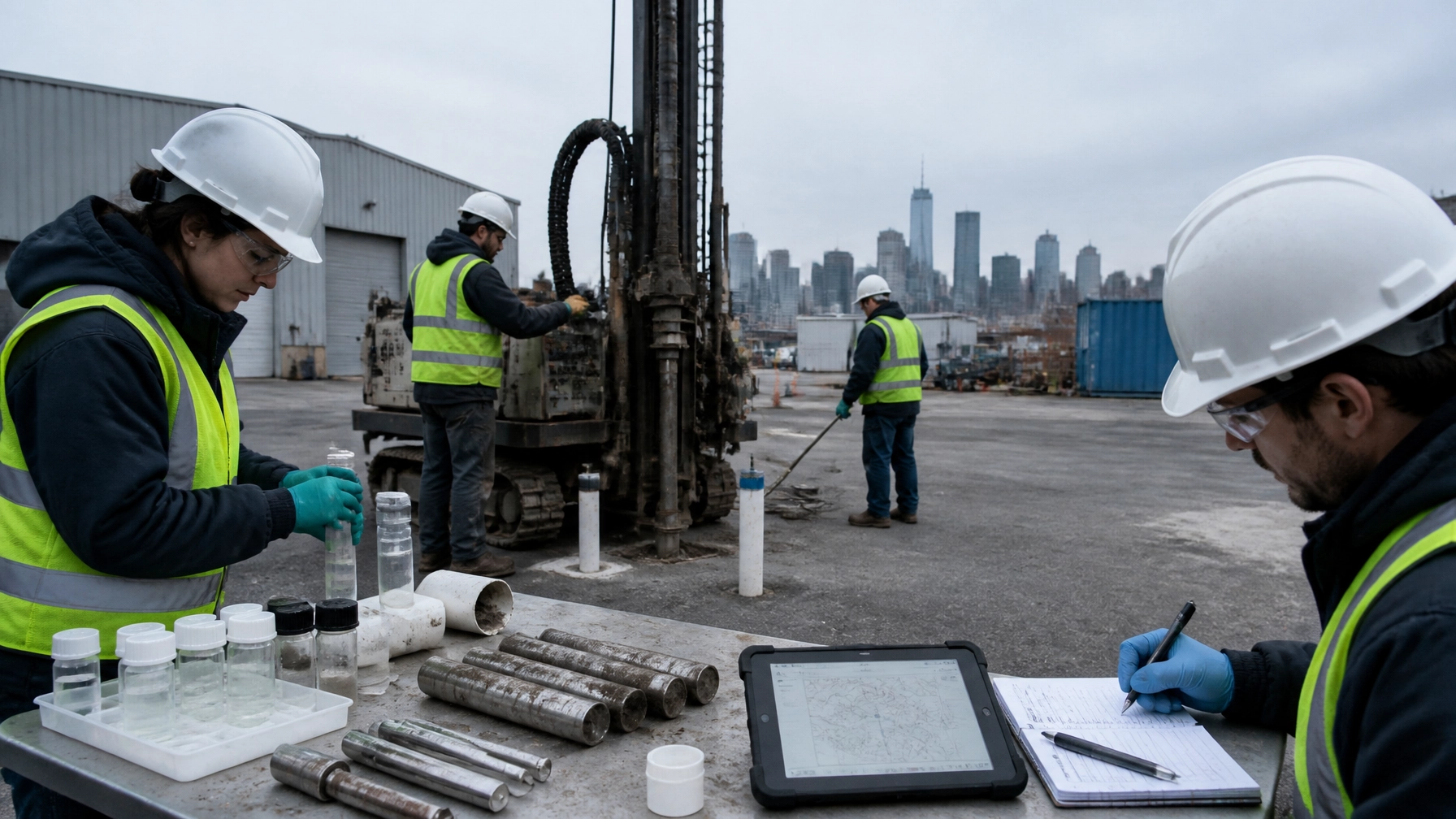
Published August 31, 2026 at 2:00 PM ET
On June 15, 2026, the New Jersey Department of Environmental Protection adopted final remediation standards for PFNA, PFOA, PFOS, and GenX. NJDEP also amended the Technical Requirements for Site Remediation at N.J.A.C. 7:26E-2.1(c)1ii.
The result is a new baseline for many New Jersey site investigations.
When contaminants at an Area of Concern are unknown or not well documented, analytical testing must now include:
- GenX
- PFNA
- PFOS
- PFOA
- 2,3,7,8-tetrachlorodibenzo-p-dioxin, commonly called 2,3,7,8-TCDD
This is the NJDEP PFAS testing requirement that developers, property owners, lenders, attorneys, contractors, and Licensed Site Remediation Professionals need to address before finalizing a Phase II scope or remediation budget.
The change affects more than laboratory analysis. It can influence transaction timing, ISRA obligations, soil handling, groundwater management, remedial design, and the final redevelopment plan.
What changed under N.J.A.C. 7:26E-2.1(c)1ii?
Before the amendment, the rule required testing for the Target Compound List and Target Analyte List, hexavalent chromium, extractable petroleum hydrocarbons, and pH when contaminants at an Area of Concern were unknown or poorly documented.
The June 2026 amendment adds PFAS compounds and 2,3,7,8-TCDD to that required analytical framework.
The language matters. This is not limited to properties with a known history of PFAS manufacturing, firefighting foam use, or chemical production. It applies when the contamination history for an Area of Concern is incomplete, uncertain, or not sufficiently documented.
NJDEP explained that the substances were added because they have been widely used or are prevalent throughout New Jersey. The Department’s June 15, 2026 news release describes the rule adoption and its purpose.
The rule does not eliminate professional judgment. An LSRP may evaluate documented lines of evidence showing why a specific analysis is not necessary. But that decision needs to be technically supportable and documented. “We did not see PFAS in the old file” is not the same as demonstrating that PFAS could not have been used, released, transported, or placed in the AOC.
That distinction will matter during NJDEP review, lender underwriting, and transaction negotiations.

PFAS is now a default consideration in uncertain site histories
PFAS are a broad family of manufactured chemicals used in products and processes that resist heat, oil, grease, and water. They have been associated with industrial operations, firefighting foams, waste handling, landfills, wastewater residuals, and certain manufacturing activities.
A New Jersey property does not need to have an obvious PFAS history to create an investigation issue. Many older industrial and commercial records are incomplete. Former tenants may be unknown. Waste streams may not have been documented. Historical site plans may show storage areas without identifying the materials that were stored.
That is exactly where the amended rule has practical force.
Under the revised requirement, an investigation team should not wait until the laboratory detects a related compound before considering the analytical suite. The question comes earlier:
Is the contamination profile for the AOC known and well documented?
If the answer is no, PFAS and 2,3,7,8-TCDD need to be addressed in the sampling and analysis plan.
Final PFAS standards create defined cleanup benchmarks
The June 2026 rulemaking also converted several interim standards into final regulatory standards under New Jersey’s remediation framework.
NJDEP’s PFAS Standards and Regulations page identifies the following standards:
| Contaminant | Groundwater standard | Residential soil, ingestion-dermal | Nonresidential soil, ingestion-dermal | Soil leachate |
|---|---|---|---|---|
| PFOA | 0.014 µg/L | 0.13 mg/kg | 1.8 mg/kg | 0.28 µg/L |
| PFOS | 0.013 µg/L | 0.11 mg/kg | 1.6 mg/kg | 0.26 µg/L |
| PFNA | 0.013 µg/L | 0.047 mg/kg | 0.67 mg/kg | 0.26 µg/L |
| GenX, or HFPO-DA | 0.020 µg/L | 0.23 mg/kg | 3.9 mg/kg | 0.40 µg/L |
The migration-to-groundwater soil evaluation remains site-specific. NJDEP indicates that the applicable standard should be calculated using the Area of Concern or site-specific conditions, including the synthetic precipitation leaching procedure where appropriate.
The significance is straightforward. PFAS results are no longer evaluated only against interim criteria or emerging-contaminant guidance. The final standards provide enforceable benchmarks that can affect remedial obligations and closure strategy.
The Day Pitney client alert describes the rule as both a formal adoption of interim PFAS standards and an expansion of analytical requirements.
What this means for Phase II scoping in New Jersey
A standard Phase II environmental site assessment typically responds to recognized environmental conditions identified during a Phase I. The scope should address the contaminants, media, and exposure pathways supported by the site history and current conditions.
The amended NJDEP requirement adds another question for New Jersey projects:
Does the AOC have a sufficiently documented contaminant profile to justify excluding the new default analytes?
If not, the Phase II or remedial investigation scope may need to include PFNA, PFOA, PFOS, GenX, and 2,3,7,8-TCDD in applicable media.
That can affect:
- Sampling and Analysis Plan preparation
- Laboratory method selection
- Reporting limits and data quality objectives
- Sample container and handling procedures
- Quality assurance and quality control requirements
- Laboratory turnaround time
- Investigation budgets
- Soil and groundwater disposal decisions
- Regulatory reporting and remedial design
PFAS analysis also requires careful field planning. Sampling equipment, personal protective equipment, tubing, containers, and field materials can introduce background contamination if the team does not follow appropriate PFAS sampling protocols.
The laboratory result is only as defensible as the sampling plan and chain of custody behind it.
Our Phase II ESA services in New Jersey are designed around the actual property history, planned redevelopment, regulatory pathway, and lender or counsel requirements. We do not add testing as a substitute for investigation logic. We build the scope so the data answers the questions the project must resolve.
ISRA transactions cannot treat PFAS as an afterthought
For an industrial property transfer subject to New Jersey’s Industrial Site Recovery Act, environmental obligations can become transaction conditions. A missing contaminant history can create a problem at the point when the parties are already negotiating price, closing conditions, and remedial responsibility.
The amended rule can affect an ISRA transaction in several ways:
- The initial investigation may require a broader analytical suite.
PFAS and dioxin testing may be necessary when the AOC history is incomplete. - The schedule may need additional laboratory and review time.
A rushed investigation that omits required analytes can lead to re-sampling and delayed submissions. - The purchase agreement may need clearer environmental protections.
Parties should understand who controls the investigation, who pays for additional work, and how newly identified contamination affects closing. - The remedial budget may need a PFAS contingency.
Detection can create additional delineation, soil handling, groundwater treatment, engineering controls, or long-term monitoring requirements. - The LSRP’s documentation becomes more important.
If an LSRP determines that a default analyte is not necessary, the technical rationale should be clear and defensible.
A report that simply lists historical operations without connecting them to the current AOC boundaries may not give the transaction team enough certainty.
Brownfield redevelopment: test early or pay later
Brownfield projects often involve the exact conditions that trigger this rule. Historical records may be fragmented. Fill may have been imported from unknown sources. Former industrial uses may overlap. Groundwater conditions may vary across a site. Multiple responsible parties may have handled different operations over time.
Testing for PFAS and dioxin early can be more efficient than discovering the issue after excavation, dewatering, or foundation work begins.
The investigation should connect the analytical program to the construction plan:
- Where will soil be excavated?
- Will groundwater need to be removed or treated?
- Can soil be reused on site?
- Will off-site disposal facilities accept the material?
- Will a cap, barrier, or institutional control be necessary?
- Could the redevelopment introduce a residential exposure scenario?
- Will the site require long-term groundwater monitoring?
These questions belong in the early planning process, not after a contractor is mobilized.

How to avoid a surprise PFAS testing change order
The most reliable approach is to address the amended requirement during scoping.
Before authorizing field work, ask your consultant to provide:
- A clear list of each Area of Concern
- The documented and undocumented portions of the site history
- The proposed analytes for each environmental medium
- The regulatory basis for including or excluding PFAS and dioxin
- The laboratory method and reporting limits
- The expected turnaround time
- The sampling and decontamination protocols
- The anticipated cost of additional rounds of sampling
- The relationship between results and the remedial decision tree
Your LSRP should also identify whether the investigation supports an ISRA transaction, NJDEP case closure, brownfield redevelopment, lender diligence, or construction soil management. Those objectives can require different levels of documentation and coordination.
At Envicon, our LSRPs, environmental engineers, and field teams work from one project scope. We coordinate sampling, laboratory review, regulatory communication, and soil and groundwater management without handing the client a report and leaving the next decision unresolved.
Our NJ LSRP services include site investigation, remedial investigation, RAWP preparation, remedial action oversight, NJDEP coordination, and case closure strategy. For projects in Hudson County, our Jersey City environmental consulting team provides local field response and direct access to senior professionals. You can also review our broader New Jersey environmental consultant hub.

The practical takeaway for New Jersey project teams
The June 15, 2026 NJDEP rulemaking changes the default conversation for uncertain site histories.
When contaminants at an Area of Concern are unknown or not well documented, PFNA, PFOA, PFOS, GenX, and 2,3,7,8-TCDD now belong in the analytical planning discussion. The final PFAS standards also provide regulatory benchmarks that can influence the response action once contamination is identified.
For developers, investors, attorneys, lenders, and contractors, the correct response is not to test everything without a plan. It is to build a documented, technically defensible investigation that accounts for the new default requirements before the project reaches closing or construction.
As NJDEP Acting Commissioner Ed Potosnak stated in the Department’s announcement, “New Jersey remains firm in its commitment to strong science, policies and regulations to address the legacy of PFAS pollution.”
That means your site investigation needs to be built for the current rules, not the rules your last consultant used several years ago.
Sources
- NJDEP News Release 26/P032, June 15, 2026
- NJDEP PFAS Standards and Regulations
- Day Pitney: NJDEP Formally Adopts Interim Standards and Expands Testing Requirements for Certain PFAS
- Cullen LLP: Revised Remediation Standards, New Baseline for PFAS Sampling Required in New Jersey
- N.J. Admin. Code § 7:26E-2.1
Talk with a New Jersey LSRP before you finalize your scope
If your property has incomplete records, an active ISRA transaction, a brownfield redevelopment plan, or an investigation already underway, let’s review the AOCs and analytical program before the field crew mobilizes.