As of August 31, 2026, New York City building owners are dealing with two separate Local Law 97 issues.
First, the extended filing deadline for the 2026 reporting cycle passed on August 29. That deadline applied to owners who requested an extension by June 30.
Second, NYC building owners can now access a new renewable energy credit option, commonly called the NYC LL97 REC option. The credits may help offset electricity-related emissions, but they don't eliminate the need for building upgrades, accurate reporting, or a long-term decarbonization plan.
For landlords, property investors, and asset managers, the distinction matters. A REC can address part of an emissions calculation. It doesn't fix an inefficient boiler, correct missing energy data, or protect a project from a poorly coordinated retrofit.
The 2026 Local Law 97 compliance timeline
Most buildings over 25,000 gross square feet must meet annual greenhouse gas emissions limits under Local Law 97. The law may also apply when multiple buildings on one tax lot exceed the applicable combined square footage threshold.
The 2026 reporting cycle covers emissions from calendar year 2025. The key dates were:
- May 1, 2026: Standard deadline for the annual LL97 report.
- June 30, 2026: Grace period deadline and last day to apply for an extension.
- August 29, 2026: Extended filing deadline for owners who applied by June 30 and received approval.
The August 29 deadline did not change a building's emissions limit. It only extended the time to file the report.
If your building had an approved extension, confirm that the report was submitted through the NYC Department of Buildings LL97 reporting system. If you did not apply for an extension by June 30, August 29 did not create a new filing window.
DOB's guidance is direct:
“Building owners are responsible for verifying the accuracy of all information used for compliance and reporting.”
That includes the building's Covered Buildings List status, gross floor area, BIN and BBL information, occupancy classification, energy use, and compliance pathway.
What happens when an Article 320 building misses the filing deadline?
For buildings covered under Article 320, the penalty structure has two separate parts.
Late filing
The late-filing penalty is:
$0.50 per square foot per month
The penalty can continue to accrue until the required report is filed. For a 100,000-square-foot building, that equals $50,000 per month before considering any other penalty exposure.
Exceeding the annual emissions limit
The overage penalty is:
$268 per metric ton of CO2e above the annual limit
These penalties are calculated separately. Filing a report does not automatically mean the building meets its emissions limit. Likewise, purchasing an eligible REC does not excuse a missed filing.
DOB lists the Article 320 penalty formula and related enforcement information on its LL97 GHG Emissions Violations page.
Owners should not wait for a Notice of Violation before reviewing their exposure. The practical first step is to determine:
- Whether the building filed on time or under an approved extension.
- Whether the reported energy data is complete.
- Whether the building exceeds its annual emissions limit.
- Which portion of the emissions comes from electricity.
- Which portion comes from onsite fossil fuel combustion.
- Whether the building has a viable compliance pathway beyond paying penalties.
How the new NYC LL97 REC option works
A renewable energy credit represents the environmental attributes of one megawatt-hour of renewable electricity.
Under current DOB policy, qualifying RECs may be used to deduct emissions associated with utility-supplied electricity. The eligible renewable resource must meet specific requirements, including delivery into or direct sinking into New York City's electrical grid, also known as Zone J.
As reported by Gothamist and The Real Deal, NYSERDA opened the first sale of LL97-eligible Tier 4 RECs on August 19, 2026.
The first sale included:
- Approximately 50,000 Tier 4 RECs.
- A price of $35.52 per REC.
- A minimum purchase of 1,000 RECs.
- A minimum purchase cost of approximately $35,520.
- A sale window running through September 2, 2026.
- Credits associated with renewable power delivered into NYC, including power connected to the Champlain Hudson Power Express.
These credits are intended for the 2027 compliance year. In practical terms, owners purchasing credits in this initial sale would use them in a future filing covering 2027 emissions, not to retroactively solve the 2025 emissions report due in 2026.
RECs must be properly documented, owned and retired by or on behalf of the building owner, and tied to the applicable reporting year. The building owner must also avoid double-counting the environmental attributes.
What RECs can and cannot offset
This is the most important point for NYC building owners.
RECs can address electricity-related emissions
A building with a significant electricity-related overage may be able to use qualifying RECs to reduce the emissions counted against its annual limit under the current standard compliance pathway.
This could be relevant for properties with:
- High electricity consumption.
- Efficient or recently upgraded heating systems.
- Limited short-term capital available for additional improvements.
- A modest overage driven primarily by grid electricity.
- A need for a bridge while larger capital work moves through design and permitting.
At the current price, RECs may appear less expensive than the $268 per metric ton LL97 penalty. But the comparison requires a proper emissions calculation. One REC equals one megawatt-hour, while the penalty is calculated by metric ton of CO2e. Those are different units.
RECs cannot offset onsite fossil fuel emissions
RECs cannot be used to erase emissions from onsite gas or oil combustion.
They do not replace:
- Boiler upgrades.
- Heat pump installation.
- Building envelope improvements.
- Steam distribution improvements.
- Domestic hot water conversion.
- Fuel switching.
- Controls and commissioning.
- Physical reductions in onsite emissions.
A building that exceeds its limit because of gas-fired boilers will not solve the problem by purchasing electricity-related RECs.
The DOB REC Frequently Asked Questions and LL97 REC Policy explain the electricity-only limitation and the Zone J requirements.

The current REC flexibility may not last
As of August 2026, current rules allow broader use of qualifying RECs for electricity emissions under the standard compliance pathway. That does not mean owners should build a long-term asset strategy around unlimited REC purchases.
The policy is under active debate.
City Council legislation, including Intro 0159-2026, would limit how much of an emissions overage a building could address through RECs. The NYC Comptroller has also recommended a cap.
Those proposals are not the same as current law. Owners should not treat a proposed 10% or 30% cap as an active requirement unless and until the applicable legislation or DOB rule takes effect.
The signal is still clear. NYC policymakers want RECs to support decarbonization, not replace it.
There is also a major restriction for owners using the Decarbonization Plan pathway. Under current DOB guidance, owners using that pathway cannot rely on RECs to achieve emissions reductions through 2029. The pathway requires building-level work and documented good-faith efforts.
That distinction makes compliance pathway selection a technical and financial decision. It should not be made by a broker, property manager, or energy vendor working without the full building record.
How LL97 decisions interact with construction and environmental work
Energy upgrades rarely happen in isolation.
A boiler replacement, heat pump installation, electrical service upgrade, rooftop equipment installation, or building envelope project may require:
- NYC Department of Buildings coordination.
- Electrical and mechanical design.
- Roof or structural review.
- Utility coordination.
- Construction sequencing.
- Tenant and occupant planning.
- Asbestos or lead review.
- Soil and groundwater assessment for excavation.
- Stormwater controls.
- Air monitoring and construction environmental oversight.
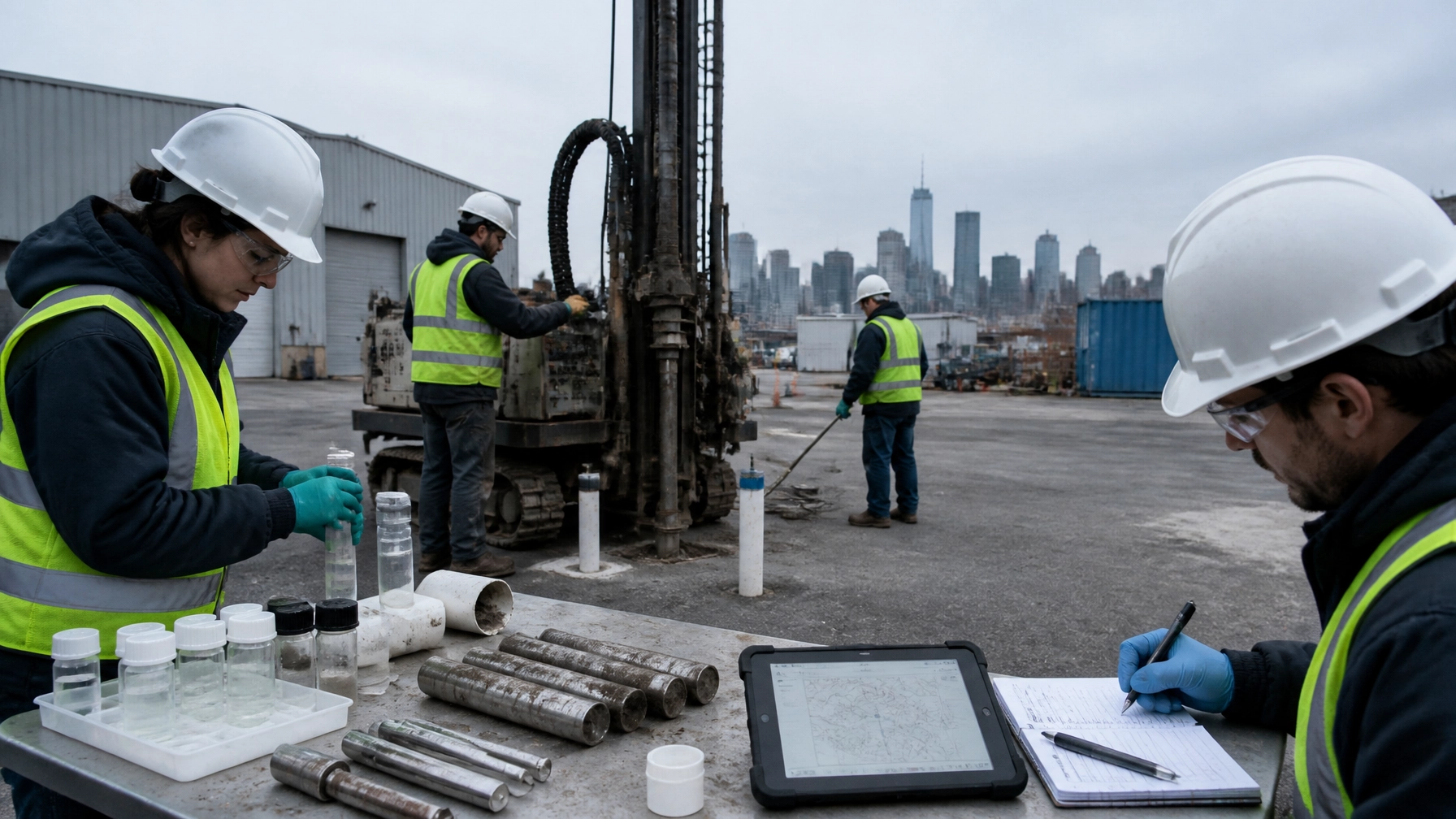
If a project includes trenching, excavation, demolition, tank removal, soil handling, or work at a historically industrial property, the energy scope can also trigger environmental obligations.
That is where Envicon's NYC environmental consulting team and regulatory compliance and permitting services fit into the process. We help coordinate the regulatory path, field conditions, documentation, and agency requirements before construction creates avoidable delays.
Environmental monitoring also matters during active work. Dust, odors, impacted soil, dewatering, vapor concerns, and contractor changes can affect both compliance and schedule. A retrofit that looks simple on paper can become a field problem if nobody is tracking what is actually happening onsite.
This is why compliance should be managed as a program, not as a stack of disconnected reports.

What NYC building owners should do now
Whether or not you purchased RECs, review your LL97 position before the next filing cycle.
1. Confirm filing status
Check the BEAM Portal and retain confirmation of submission. If the report was not filed, identify the reason and address it immediately.
2. Verify the building record
Review the 2026 Covered Buildings List, gross square footage, BIN, BBL, occupancy, and compliance pathway. DOB states that the CBL is a reference tool. Owners remain responsible for verifying their own information.
3. Separate electricity from onsite fuel
Do not evaluate REC eligibility using a single total emissions number. Break out grid electricity, natural gas, fuel oil, steam, and other applicable sources.
4. Model multiple scenarios
Compare:
- Physical energy upgrades.
- REC purchases.
- Penalty exposure.
- Financing and incentive programs.
- The cost of delay.
- Future emissions limits.
- The possibility of tighter REC rules.
5. Connect compliance to capital planning
A REC may be a short-term bridge for electricity-related emissions. It should not delay work that the property will need to meet tighter limits in 2030 and beyond.
6. Coordinate construction impacts early
If the project involves excavation, soil disturbance, demolition, tanks, groundwater, or vapor concerns, include environmental review and monitoring in the schedule before contractors mobilize.
The bottom line for Local Law 97 compliance 2026
The August 29 extension deadline was a filing deadline, not a penalty waiver. Owners who received an extension needed to file by that date. Owners who missed the applicable deadline may face a monthly filing penalty of $0.50 per square foot.
The new NYC LL97 REC option gives eligible building owners another tool. Qualifying Tier 4 RECs can address electricity-related emissions. They cannot offset onsite gas or oil combustion. They also do not replace accurate reporting, capital planning, or physical decarbonization.
The right strategy depends on the building's actual emissions profile, compliance pathway, operating systems, capital plan, and construction schedule.
At Envicon, collaboration is not a buzzword. It's how we work. We bring licensed professionals, field oversight, regulatory coordination, and direct accountability to the same table.
We don't just deliver reports. We help clear the path from compliance risk to a buildable, investable, and resilient asset.
Take the next step with Envicon