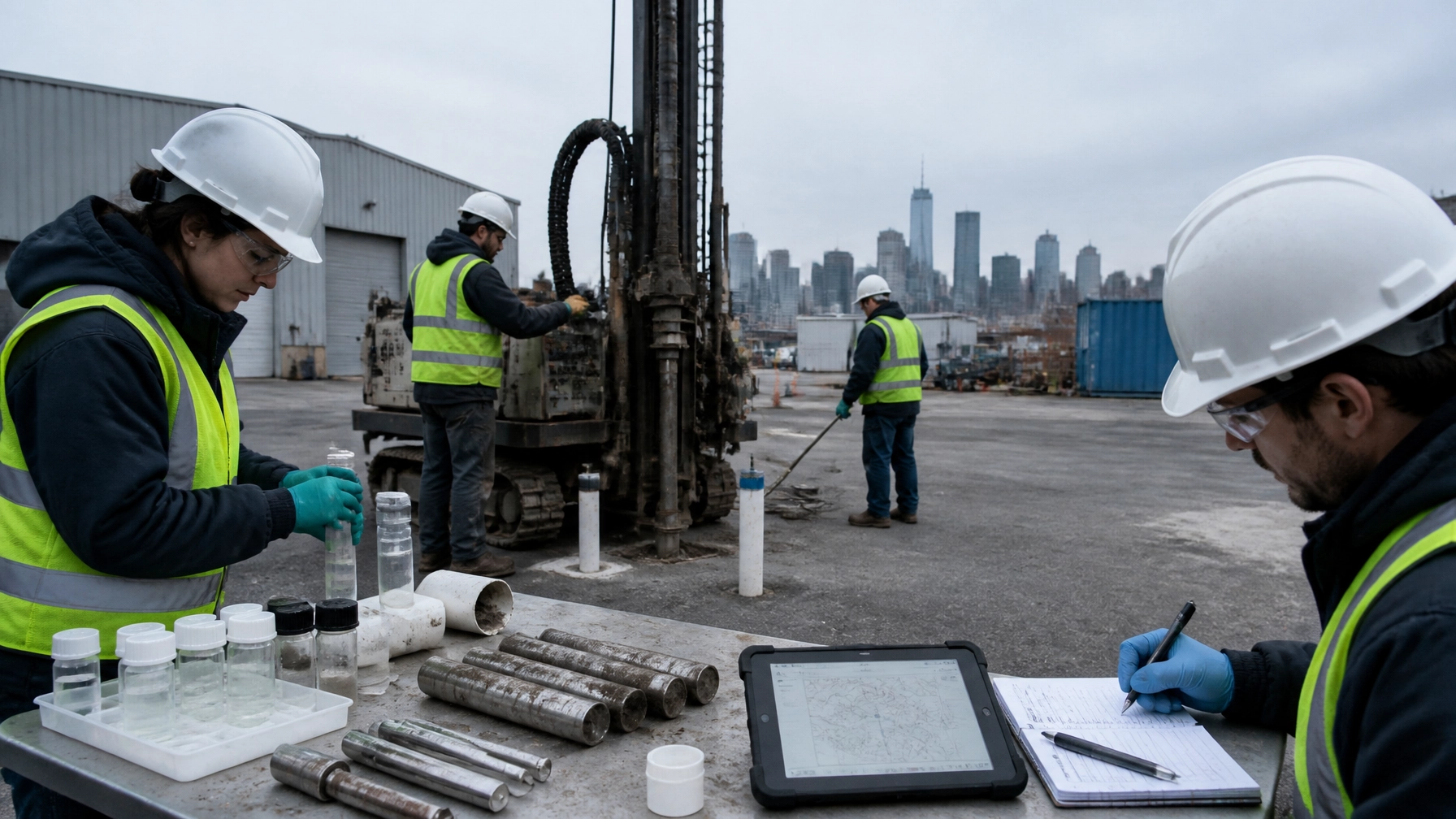
A Phase I ESA does not tell you exactly what is in the soil or groundwater. It tells you whether the property history and current conditions create enough environmental concern to justify intrusive investigation.
That distinction matters in 2026. Buyers, lenders, attorneys, and developers evaluating property in Jersey City, Newark, Hoboken, Bayonne, Bergen County, Hudson County, and Essex County are dealing with tighter underwriting, more scrutiny around PFAS, and construction schedules that leave little room for surprises.
The practical question is straightforward:
When is a Phase II ESA needed in New Jersey?
Usually, a Phase II ESA is appropriate when a Phase I ESA identifies a Recognized Environmental Condition, or REC, that could affect the property’s value, financing, redevelopment, or regulatory obligations.
What a Phase I ESA identifies under ASTM E1527-21
A Phase I Environmental Site Assessment performed under ASTM E1527-21 is a non-intrusive review. It includes records research, regulatory database review, interviews, site reconnaissance, and an Environmental Professional’s conclusions.
It does not include soil, groundwater, soil vapor, or building material sampling.
The purpose is to identify environmental conditions that may create liability or require further evaluation. Under ASTM E1527-21, a REC generally involves:
- The presence of hazardous substances or petroleum products caused by a release.
- The likely presence of hazardous substances or petroleum products caused by a release or likely release.
- Conditions that pose a material threat of a future release.
A Phase I can identify a current REC, historical REC, controlled REC, or de minimis condition. Those classifications matter. Not every environmental finding requires a Phase II, but a vague recommendation to “conduct additional assessment” should not be the end of the analysis.
Your consultant should explain:
- What condition created the REC.
- Where the potential source is located.
- Which environmental media could be affected.
- What investigation would resolve the uncertainty.
- How the finding could affect closing, financing, or construction.
Learn more about Envicon’s Phase I ESA services.
When is a Phase II ESA needed in New Jersey?
A Phase II is typically justified when the Phase I identifies a credible potential release and the parties need site-specific data before making a transaction or redevelopment decision.
Common triggers include:
1. Former industrial or manufacturing use
Former metal plating, chemical manufacturing, printing, dry cleaning, coating, auto repair, and petroleum operations can create soil, groundwater, or vapor concerns.
This is common across older industrial corridors in Newark, Bayonne, Jersey City, and Hudson County. A former warehouse may look clean today while buried tanks, historic fill, or solvent use remains relevant below grade.
2. Underground storage tanks or petroleum equipment
A current or former UST, dispenser, hydraulic lift, waste-oil tank, or loading area may justify targeted soil and groundwater sampling.
If the Phase I identifies a suspected tank but records do not establish closure or release status, a Phase II may include geophysical clearance, soil borings, field screening, and laboratory analysis.
3. Historical fill and urban redevelopment
Urban fill can contain petroleum-related compounds, metals, ash, coal residue, and other contaminants. Development plans that involve excavation, foundation work, utility installation, or dewatering increase the importance of understanding fill quality before closing.
A Phase II can help determine whether soil will require:
- Off-site disposal.
- Reuse under a soil management plan.
- Segregation and characterization.
- Clean cover or cap systems.
- Special handling during excavation.
4. Vapor intrusion concerns
A dry cleaner, former industrial building, petroleum release, or chlorinated solvent use may create a vapor intrusion concern.
The investigation may require soil vapor, sub-slab vapor, indoor air, or groundwater sampling. The appropriate scope depends on the building configuration, depth to groundwater, contaminant type, preferential pathways, and future building plans.
5. Lender or investor requirements
A lender may require Phase II data even when the Phase I recommendation is conditional or limited.
The lender may want a defined answer before approving:
- Acquisition financing.
- Construction financing.
- Refinancing.
- Portfolio acquisition.
- Brownfield redevelopment funding.
- A loan secured by a property with a known environmental condition.
A report that is technically acceptable but does not answer the lender’s underwriting questions can still delay the transaction.
What a Phase II ESA investigates
A strong Phase II is not a random collection of borings. It is a targeted investigation designed around the RECs and the decisions the transaction team needs to make.

Soil borings
Direct-push or hollow-stem auger borings can characterize shallow fill, native soil, source areas, and deeper intervals. Field staff may use photoionization detector screening to identify zones that warrant closer attention.
Boring locations should reflect the suspected source and the proposed development footprint. A grid that misses the former tank area does not resolve the REC.
Groundwater monitoring wells
Temporary or permanent wells may be installed when groundwater is a potential migration pathway or when the Phase I identifies a known or suspected release.
Groundwater work may evaluate:
- Contaminant concentrations.
- Groundwater flow direction.
- Whether impacts extend beyond the source area.
- Potential impacts to nearby properties or surface water.
- Whether dewatering could mobilize contaminants during construction.
Soil vapor and sub-slab sampling
Vapor sampling may be appropriate where volatile organic compounds, petroleum hydrocarbons, or chlorinated solvents are present or suspected.
The future use of the building matters. A proposed residential building with a parking level and occupied basement requires a different risk evaluation than an open industrial warehouse.
PFAS sampling
New Jersey’s June 15, 2026 rule adoption made PFNA, PFOA, PFOS, and GenX enforceable considerations within the state’s remediation framework. The amendments also expanded required analytical parameters under N.J.A.C. 7:26E-2.1(c) when contaminants at an Area of Concern are unknown or poorly documented.
That does not mean every private, transaction-only Phase II ESA automatically requires PFAS sampling. It does mean PFAS should receive deliberate consideration when:
- Site history is incomplete.
- Firefighting foam or fire training may have occurred.
- The property involved metal plating, textiles, paper, packaging, or certain manufacturing.
- The site is already subject to NJDEP oversight.
- The transaction may lead to an LSRP-managed investigation.
- A lender, purchaser, or regulator requires PFAS evaluation.
For a regulated site, the investigation must follow the applicable NJDEP requirements. For a private transaction, the sampling scope should be documented clearly so the buyer understands what was tested and what was not.
See NJDEP’s PFAS program resources and the 2026 regulatory discussion from Day Pitney.
Sampling plans and laboratory QA/QC
A Phase II should begin with a written Sampling and Analysis Plan, or SAP. The plan should identify:
- The REC or data gap being investigated.
- Proposed boring, well, and vapor locations.
- Sample depths and collection methods.
- Analytical parameters.
- Detection limits.
- Decontamination procedures.
- Quality assurance and quality control samples.
- Investigation-derived waste handling.
- Data validation requirements.
- Decision criteria and applicable standards.
Laboratory quality is just as important as field work. The project team should document chain of custody, sample preservation, holding times, cooler temperature, trip blanks, equipment blanks, duplicates, and laboratory reporting limits.
For PFAS work, field procedures require particular care because PFAS can occur in common sampling materials and personal protective equipment. The SAP should address potential cross-contamination before the crew arrives on site.

A practical Phase II decision tree
Use this framework during acquisition review:
Did the Phase I identify a REC?
|
|-- No
|   |-- No Phase II may be needed.
|   |-- Confirm lender, counsel, and redevelopment requirements.
|
|-- Yes
    |
    |-- Is the REC adequately resolved by existing reliable data?
    |      |
    |      |-- Yes
    |      |   |-- Document the conclusion.
    |      |   |-- Confirm data age, quality, and regulatory status.
    |      |
    |      |-- No
    |          |
    |          |-- Could contamination affect price, financing, or construction?
    |                 |
    |                 |-- No
    |                 |   |-- Obtain written risk acceptance from the decision-maker.
    |                 |
    |                 |-- Yes
    |                     |-- Scope a targeted Phase II.
    |                     |-- Add PFAS, vapor, or other analytes where justified.
    |                     |-- Determine whether an NJDEP or LSRP pathway applies.
The right answer is not always “sample everything.” It is to collect enough defensible data to make the next decision.
How much does a Phase II ESA cost in New Jersey?
There is no universal Phase II ESA cost in New Jersey. A small commercial parcel with one suspected UST is not comparable to a multi-acre former manufacturing property in Newark or Bayonne.
Primary cost drivers include:
- Property size and accessibility.
- Number and depth of borings.
- Need for permanent monitoring wells.
- Soil, groundwater, soil vapor, or indoor air scope.
- PFAS or other specialized laboratory analysis.
- Utility clearance and GPR.
- Traffic control or restricted-access work.
- Geology and depth to groundwater.
- Number of Areas of Concern.
- Laboratory turnaround time.
- Data validation requirements.
- Investigation-derived waste management.
- Whether the work must support NJDEP or LSRP requirements.
A targeted transaction Phase II may be less expensive than a full remedial investigation, but it should not be designed so narrowly that it leaves the central REC unresolved.
Connecting Phase II work to NJDEP, ISRA, and construction
A transaction Phase II can identify a problem before it becomes a construction claim. It can also show that additional regulatory coordination is necessary.
If the property is subject to the Industrial Site Recovery Act, an open NJDEP case, a prior discharge, or a known contaminated-site obligation, involve a New Jersey Licensed Site Remediation Professional early.
An LSRP may need to evaluate:
- Preliminary Assessment and Site Investigation requirements.
- Remedial Investigation needs.
- NJDEP reporting and case status.
- Response Action Outcome strategy.
- Engineering and institutional controls.
- Deed notices and Site Management Plans.
- Brownfield redevelopment options.
- Soil and groundwater management during construction.

The Phase II findings should also reach the civil engineer, architect, construction manager, and attorney. Contamination can affect excavation limits, shoring, dewatering, utility routing, foundation design, soil export, vapor mitigation, and the construction schedule.
That is where a report-only approach breaks down. The value is not just the laboratory table. The value is a clear path from finding to action.
How Envicon approaches NJ real estate environmental due diligence
Envicon combines Phase I and Phase II environmental due diligence with NJDEP LSRP coordination, regulatory strategy, and construction-focused planning.
Our team works across Jersey City, Newark, Hoboken, Bayonne, Bergen County, Hudson County, and Essex County. We coordinate directly with acquisition teams, lenders, attorneys, architects, contractors, and public agencies.
You get:
- A Phase II scope tied to the actual REC.
- Direct access to senior technical staff.
- Clear sampling and analysis plans.
- NJDEP and LSRP coordination when required.
- Laboratory QA/QC review.
- Practical cost and schedule implications.
- Soil and groundwater management planning.
- A defined next step instead of an open-ended recommendation.
We do not treat every property as if it needs the same investigation. We identify the risk, test the right locations, and explain what the results mean for your deal.
Takeaway
A Phase I ESA identifies potential environmental liability. A Phase II ESA determines whether that concern is supported by site-specific data.
You should consider a Phase II when a REC remains unresolved, the lender needs quantified risk, the project will disturb subsurface materials, or the property’s history creates a credible concern involving soil, groundwater, vapor, petroleum, solvents, metals, or PFAS.
The earlier you make that decision, the more options you have. You can adjust price, negotiate access and indemnity terms, plan remediation, apply for brownfield support, or redesign construction before the closing deadline controls the project.
Start with a transaction risk screen
If you’re evaluating a property in Jersey City, Newark, Hoboken, Bayonne, Bergen County, Hudson County, or Essex County, use Envicon’s proprietary project risk screener to identify the likely environmental diligence path.
You can also:
This article is for general information and does not replace project-specific advice from a qualified Environmental Professional, engineer, attorney, or NJDEP-licensed LSRP.
Sources
- ASTM E1527-21, Standard Practice for Environmental Site Assessments
- EPA recognition of ASTM E1527-21 for All Appropriate Inquiries
- NJDEP PFAS program
- NJDEP Technical Requirements for Site Remediation, N.J.A.C. 7:26E
- NJDEP Soil Remediation Standards, N.J.A.C. 7:26D
- NJDEP Ground Water Quality Standards, N.J.A.C. 7:9C
- Day Pitney summary of the June 15, 2026 NJDEP PFAS adoption