A Phase I Environmental Site Assessment is more than a box to check before acquiring commercial real estate. It is one of the documents your lender, attorney, insurer, and investment committee may rely on before releasing capital.
In 2026, the core standard remains ASTM E1527-21, which the U.S. Environmental Protection Agency recognizes as consistent with the federal All Appropriate Inquiries (AAI) rule under 40 CFR Part 312. A properly completed Phase I ESA can support CERCLA landowner liability protections: but only if the investigation, documentation, and timing are handled correctly.
This Phase I ESA checklist covers the documents and project information you should assemble before closing on property in New York or New Jersey.
“AAI is the process of evaluating a property's environmental conditions and assessing potential liability for any contamination.” : U.S. EPA
The 2026 Phase I ESA timing rule
Before reviewing the documents, confirm the assessment will still be current on the closing date.
Under ASTM E1527-21 and EPA’s AAI requirements:
- The overall inquiry must generally be completed within one year before acquisition.
- Certain components must be completed or updated within 180 days before closing.
- The 180-day components include:
- Interviews with current and past owners, operators, and occupants
- Federal, state, tribal, and local government records review
- Visual inspection of the property and adjoining properties
- Search for recorded environmental cleanup liens
- Environmental Professional declaration and related updates required by the standard
The report date alone does not tell you whether the Phase I ESA is still viable. The individual dates for the interviews, records review, site inspection, lien search, and professional declaration matter.
If your closing moves, your Phase I ESA may require an update. If any required component falls outside the one-year window, the assessment may need to be redone.
Review the current EPA AAI requirements and ASTM E1527-21 standard with your environmental professional and counsel.
Document checklist: what to provide before the assessment begins
A strong Phase I ESA starts with complete information from the buyer, seller, lender, and project team. At minimum, gather:
- Current title commitment or title report
- Legal description and tax lot information
- ALTA survey or recent property survey
- Current site plan and proposed development plans
- Purchase and sale agreement, if available
- Prior Phase I or Phase II ESA reports
- Remedial investigation or cleanup reports
- Environmental permits and agency correspondence
- Records of spills, releases, tank removals, or closures
- Information about current and historical occupants
- Known environmental liens, deed restrictions, or institutional controls
- Information about the intended future use of the property
- Purchase price information when contamination may affect fair market value
- Completed ASTM user questionnaire
The user questionnaire is not administrative filler. It documents information the buyer may know that cannot be confirmed through database research or a site visit.
ASTM’s Appendix X3 user questionnaire addresses issues such as environmental liens, activity and use limitations, specialized knowledge, prior reports, and the relationship between purchase price and uncontaminated fair market value.
If the seller or broker says, “There are no environmental issues,” document that statement and provide it to the Environmental Professional. Do not rely on an informal verbal assurance.
1. Title and land records
Title records are critical because environmental obligations may follow the property even when the current owner did not cause the contamination.
Your closing file should include documentation showing that the team reviewed:
- Recorded environmental cleanup liens
- Environmental easements
- Deed notices and deed restrictions
- Institutional controls
- Engineering controls
- Activity and Use Limitations, commonly called AULs
- Restrictions on groundwater use, excavation, or future construction
AULs may limit what you can build, how deep you can excavate, whether groundwater can be used, or how a capped area must be maintained. They can also affect financing, insurance, construction cost, and long-term property value.
The environmental lien search is generally a user responsibility under AAI. Your consultant may assist, but the buyer should confirm that the search was completed and retain the supporting documentation.
2. Historical property records
A Phase I ESA should establish how the property and nearby parcels were used over time.
Depending on availability, the historical records package may include:
- Aerial photographs
- Sanborn fire insurance maps
- City directories
- Topographic maps
- Building department records
- Property tax records
- Zoning and land-use records
- Historical site plans
- Prior surveys
- Newspaper or archive research
- Previous industrial or commercial permits
The review should address both the subject property and adjoining properties. A former dry cleaner, metal plating facility, gas station, rail yard, auto repair shop, manufacturing operation, or bulk storage facility next door may create a potential migration concern even if the subject parcel itself appears clean.
Historical sources rarely provide a complete answer by themselves. Their value comes from the pattern they establish. Aerial photographs may show tanks or waste areas. Sanborn maps may identify former industrial operations. City directories may reveal tenants that do not appear in current records.

3. Federal, New York, and New Jersey regulatory records
The regulatory database review should be broad enough to identify known or suspected releases on the property and nearby sites.
A typical federal review may include records associated with:
- CERCLA and Superfund sites
- RCRA hazardous waste facilities
- Underground storage tanks
- RCRA corrective action
- Brownfields
- Federal institutional controls
- Hazardous waste generators
For New York properties, the consultant should review applicable NYSDEC Environmental Site Database records, including:
- Spills and petroleum release incidents
- Brownfield Cleanup Program sites
- State Superfund sites
- Bulk storage facilities
- Institutional and engineering controls
- Other site remediation records
NYSDEC records are particularly important in New York City, Long Island, Westchester, and other areas where historic industrial use, petroleum storage, and urban fill are common.
For New Jersey properties, the review should account for NJDEP records involving:
- Contaminated sites
- Known contaminated sites
- Underground storage tanks
- Remediation cases
- Brownfield redevelopment
- Institutional and engineering controls
- Licensed Site Remediation Professional activity
The NJDEP Contaminated Site Remediation & Redevelopment program provides access to tools such as DataMiner, DocMiner, remediation guidance, and site records.
A Phase I ESA does not replace separate New Jersey obligations. If an industrial establishment is subject to the Industrial Site Recovery Act, the transaction may require additional compliance. A Phase I ESA also does not substitute for a Preliminary Assessment, Site Investigation, or LSRP-led remediation when New Jersey law requires those steps.
4. Site reconnaissance documentation
The physical inspection is where desktop research meets current site conditions.
The Phase I ESA file should include:
- Date and time of the inspection
- Name and qualifications of the Environmental Professional
- Site access limitations
- Interior and exterior observations
- Photographs of the property
- Property boundary or vicinity map
- Observations of adjoining properties
- Notes regarding current operations and occupants
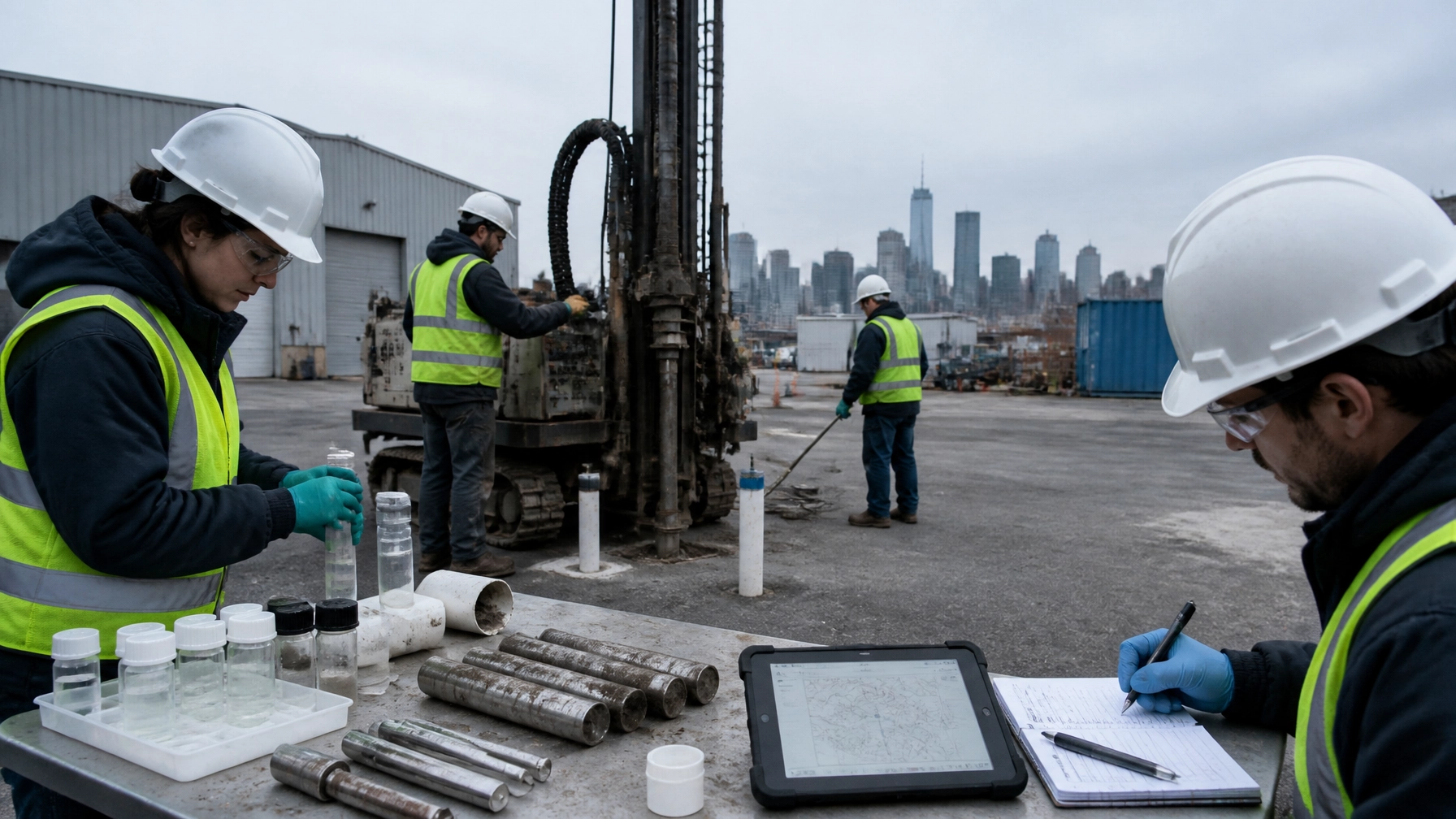
The Environmental Professional will typically look for:
- Aboveground and underground storage tanks
- Drums, containers, or chemical storage
- Staining, odors, or distressed vegetation
- Floor drains, sumps, pits, or lagoons
- Waste handling areas
- Electrical transformers and possible PCB concerns
- Evidence of dumping, fill, or burial
- Oil-water separators
- Vapor intrusion indicators
- Wells, septic systems, or dry wells
- Discolored water or stressed surface features
A site visit cannot eliminate all uncertainty. It can, however, identify conditions that require immediate follow-up before the transaction becomes difficult to unwind.

5. Interviews and written confirmations
Interviews are a required part of AAI, not an optional courtesy.
The consultant should attempt to interview:
- Current property owners
- Past owners
- Current operators
- Past operators
- Occupants and facility managers
- Property managers
- Local officials when appropriate
- Neighboring property owners when the site is abandoned
Interview records should identify who participated, when the interview occurred, and whether it took place in person, by phone, or in writing.
Ask direct questions:
- Have there been spills, fires, or chemical releases?
- Were tanks installed, removed, or abandoned?
- Was waste buried or stored onsite?
- Has groundwater been sampled?
- Were regulators involved?
- Were any environmental restrictions recorded?
- Have odors, staining, or vapor concerns been reported?
A vague answer is not the same as a clean answer. If the information is incomplete, the report should identify the resulting data gap and explain its significance.
6. The final signed Phase I ESA report
Before closing, obtain the complete report: not just an executive summary.
The final report should include:
- Property identification and legal description
- Purpose, scope, and limitations
- User-provided information
- Historical records review
- Regulatory database review
- Physical setting information
- Site reconnaissance findings
- Photographs and maps
- Interview summaries
- Identified data gaps
- Findings and professional opinions
- REC, CREC, HREC, and de minimis condition analysis
- Recommendations for additional investigation, if warranted
- References and supporting records
- Signed Environmental Professional declaration
- Appendices containing source materials
A Recognized Environmental Condition (REC) may indicate the presence or likely presence of hazardous substances or petroleum products due to a release or threatened release. A Controlled REC or Historical REC may involve known conditions that are controlled or addressed under an established regulatory framework.
The classification matters. It determines whether you should proceed to a Phase II ESA, negotiate an indemnity, request a credit, revise the construction budget, or change the development plan.
What a complete closing file should contain
Use this final checklist before releasing funds:
- Final ASTM E1527-21 Phase I ESA
- Signed Environmental Professional declaration
- Completed user questionnaire
- Title report and environmental lien search
- AUL, deed restriction, and institutional control documentation
- Federal, state, and local database reports
- NYSDEC or NJDEP records, when applicable
- Historical source exhibits
- Site reconnaissance photographs
- Property boundary and vicinity maps
- Interview notes or summaries
- Prior environmental reports
- Agency correspondence and remediation records
- Written explanation of significant data gaps
- Closing-date review confirming 180-day and one-year viability
Why local execution matters in New York and New Jersey
A national consultant may deliver a technically acceptable report and still leave you with unanswered questions about the next step. The issue is not whether the report contains pages. The issue is whether the findings help you close, finance, permit, and build.
At Envicon Group, our environmental professionals work directly with developers, lenders, attorneys, architects, contractors, and agencies across New York and New Jersey. We connect Phase I findings to practical decisions about Phase II sampling, remediation, permitting, soil management, and construction risk.
That field-first approach matters on dense urban sites, former industrial parcels, waterfront properties, and brownfields where records are incomplete and schedules are tight. We produce clear documentation, identify what requires action, and coordinate the next move instead of handing you a report and leaving you to interpret it.
Explore Envicon’s Phase I ESA Checklist resource or review our Environmental Assessment & Investigation services.
Final takeaway
A compliant Phase I ESA is built from more than a database search. Before closing, you need current records, complete user disclosures, documented interviews, a defensible site inspection, title and lien research, state-specific review, and a signed report that clearly explains RECs and data gaps.
Start early. Track every date. Preserve every supporting document.
The goal is not to collect another report. The goal is to remove the environmental obstacles between your transaction and a buildable site.
Ready to close with fewer surprises?