If you’re budgeting for a commercial property acquisition, refinance, or development project, the typical Phase I ESA cost in New York City and New Jersey falls between $2,200 and $4,500 for a standard commercial property.
Rush work usually costs $3,000 to $5,500, depending on the closing date, property history, site access, lender requirements, and the amount of research required.
Those numbers are useful starting points. They are not a substitute for a site-specific scope. A Manhattan office building, a Brooklyn warehouse, and a former industrial property in Jersey City do not carry the same environmental risk. The price should reflect the site, not a generic national template.
For a lender-ready assessment, review Envicon’s Phase I ESA service and use the Envicon Cost Estimator to get an initial project range.
2026 Phase I ESA pricing in NYC and NJ
| Project scope | Typical 2026 cost | Typical timing |
|---|---|---|
| Standard Phase I ESA | $2,200–$4,500 | About 2–3 weeks |
| Rush Phase I ESA | $3,000–$5,500 | About 3–7 business days |
| Complex industrial or multi-building site | $4,500–$8,000+ | Scope dependent |
| Phase I with enhanced vapor review | $3,500–$7,000+ | Scope dependent |
| Phase II ESA, if recommended | Additional cost | Based on sampling plan |
These are planning ranges for commercial properties in the NY/NJ market. A final fee depends on the property address, size, current and historical use, available records, access conditions, transaction schedule, and the intended user of the report.
A lender may also require additional forms, reliance language, environmental lien searches, or review against a specific checklist. Those requirements should be identified before the consultant begins.
What does a Phase I ESA include?
A Phase I Environmental Site Assessment evaluates the potential for hazardous substances or petroleum products to have affected a property. It does not normally include soil, groundwater, or vapor sampling.
A standard Phase I ESA performed under ASTM E1527-21 and aligned with All Appropriate Inquiries, or AAI, generally includes:
- Historical records review
- Environmental database review
- Regulatory file research
- Site reconnaissance
- Interviews with owners, occupants, and other knowledgeable parties
- Review of adjoining and nearby properties
- Evaluation of recognized environmental conditions
- Documentation of significant data gaps
- A written report signed by an Environmental Professional
The objective is not to produce the longest report. The objective is to identify conditions that could affect liability, financing, redevelopment, or the next step in the transaction.
Envicon’s process includes historic aerials, Sanborn maps, city directories, topographic maps, agency databases, site reconnaissance, interviews, and a clear REC, HREC, or CREC determination.

ASTM E1527-21 and AAI: why the standard matters
ASTM E1527-21 provides the standard process for performing a Phase I ESA. EPA identifies ASTM E1527-21 as consistent with the federal AAI requirements under 40 CFR Part 312.
AAI matters because certain purchasers may seek protection from potential CERCLA liability as an innocent landowner, contiguous property owner, or bona fide prospective purchaser. Completing a Phase I ESA is only one part of that process. Continuing obligations and other requirements still apply.
According to the EPA’s AAI guidance:
- The overall AAI process must be completed or updated within one year before acquisition.
- Certain components, including interviews, government records review, site inspection, and environmental lien searches, must be completed or updated within 180 days before acquisition.
- The report must document the inquiry and include the Environmental Professional’s opinions and conclusions.
A report that is too old, incomplete, or not prepared under the required standard can create problems with lenders, counsel, and liability planning.
What drives Phase I ESA cost in New York City?
The answer to “how much does a Phase I ESA cost in New York?” depends heavily on the property and the transaction.
Common NYC cost drivers include:
Property history
A former dry cleaner, gas station, metalworking facility, printing operation, auto repair shop, or manufacturing site requires more analysis than a newer office building with a clean history.
Manhattan properties may involve dense historic development, adjoining properties with overlapping uses, underground structures, old fuel systems, and limited site access. Brooklyn, Queens, the Bronx, and Staten Island may involve former industrial corridors, rail infrastructure, bulk storage, or mixed commercial and residential uses.
Site size and building count
A single small commercial parcel is faster to evaluate than a multi-building campus, portfolio, or assemblage with several tax lots.
Records availability
Some properties have clear records and cooperative ownership. Others require additional research because historic directories, agency files, permits, or prior reports are incomplete.
Site access
A site reconnaissance requires reasonable access to the property and relevant building areas. Limited access, active construction, tenant restrictions, or safety concerns can increase coordination time.
Transaction schedule
A standard Phase I may take two to three weeks. A closing inside one week requires immediate records ordering, field scheduling, expedited review, and disciplined communication.
For projects across all five boroughs, Envicon provides NYC environmental consulting support for developers, lenders, attorneys, REITs, and institutional owners.
What drives Phase I ESA cost in New Jersey?
The same core factors apply when evaluating Phase I ESA cost in NJ, but local conditions can change the scope.
In Newark, Jersey City, Hudson County, and Bergen County, environmental due diligence often involves historic industrial operations, urban fill, underground storage tanks, waterfront development, and active or closed NJDEP cases.
A Phase I may also identify the need to evaluate:
- NJDEP regulatory files
- Historic industrial operations
- Known contaminated sites nearby
- Former USTs and petroleum releases
- Activity and use limitations
- Remedial Action Permits
- Potential NJ ISRA applicability
- Soil management concerns
- Vapor intrusion or vapor encroachment risk
Jersey City projects can carry additional complexity because former industrial parcels often sit within dense redevelopment areas. Envicon’s Jersey City environmental consulting team works with developers and transaction teams throughout Hudson County.
Vapor encroachment screening and vapor intrusion concerns
A Phase I ESA may identify a potential vapor concern without proving that vapor intrusion is occurring.
Vapor encroachment screening evaluates whether volatile contaminants in soil or groundwater could migrate toward a property. Common risk sources include:
- Former dry cleaners
- Gas stations
- Industrial manufacturing
- Solvent use
- Petroleum storage
- Nearby contaminated properties
- Historic spills or releases
An enhanced vapor review may increase the Phase I ESA cost. If the records and site conditions support further investigation, the next step may include soil-gas, sub-slab, indoor-air, soil, or groundwater sampling.

When is a Phase II ESA appropriate?
A Phase II ESA becomes appropriate when the Phase I identifies a recognized environmental condition that cannot be resolved through records review and professional judgment alone.
A Phase II may involve:
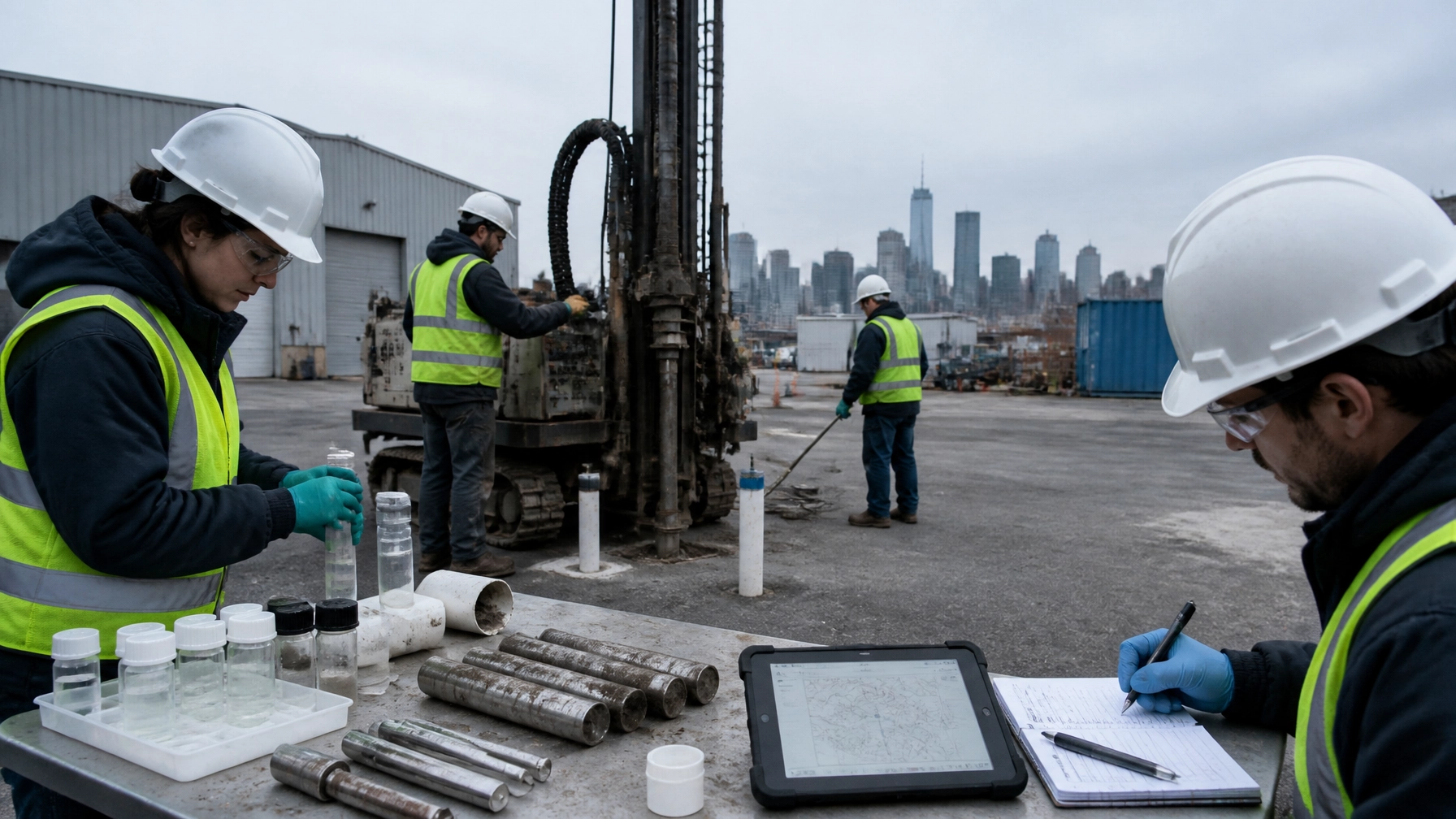
- Soil borings and laboratory analysis
- Groundwater monitoring wells
- Soil-gas or sub-slab sampling
- Indoor-air testing
- UST investigation
- Petroleum or solvent characterization
- Waste characterization
- Remedial cost evaluation
The Phase II scope should respond to the actual REC. It should not become an automatic, oversized testing program.
A focused Phase II can give you the information needed to price remediation, negotiate the purchase agreement, satisfy a lender, or determine whether the site can support the proposed development.
See Envicon’s Phase II ESA services for subsurface investigation and follow-up planning.
Why lender review causes avoidable delays
Many Phase I reports do not fail because the property is contaminated. They fail because the report does not match the lender’s expectations.
Common lender review issues include:
- The report is older than the applicable AAI timing window.
- The consultant did not complete the required site visit.
- The Environmental Professional’s qualifications or signature are missing.
- RECs are identified without a clear recommendation.
- The report does not address the lender’s reliance requirements.
- Environmental liens or activity and use limitations were not reviewed.
- Vapor concerns receive a vague or unsupported conclusion.
- The report uses a national template that does not address local agency records.
A lender approved Phase I environmental consultant in NJ or NYC should ask for the lender’s checklist before starting. That simple step can prevent a report from returning for revisions after the closing schedule is already compressed.
Envicon provides fixed-fee scopes, same-business-day proposals, priority scheduling, and direct communication with transaction teams. We don’t hand you a report and leave you to interpret it. We explain what the findings mean and what action, if any, comes next.

How to reduce unnecessary Phase I ESA cost
You can control cost without cutting corners.
Before requesting a proposal, gather:
- The property address and tax lot information
- The current owner and operator
- The intended use
- The anticipated closing date
- The lender or program requirements
- Prior environmental reports
- Available surveys and site plans
- Known USTs, spills, or regulatory cases
- Access information for the site visit
The right consultant should then recommend the appropriate level of work. That may be a standard Phase I ESA, a rush Phase I, an enhanced vapor review, or a Phase II investigation.
The cheapest report is not always the least expensive option. A rejected report can cause rework, delayed financing, another site visit, and a missed closing. The better benchmark is whether the scope is complete, defensible, and aligned with the decision you need to make.
How much does a Phase I ESA cost? The practical answer
For most standard commercial properties, budget $2,200 to $4,500.
For a rush Phase I ESA in NYC or NJ, budget $3,000 to $5,500.
Expect the cost to increase when the property has industrial history, multiple buildings, limited access, complex regulatory records, vapor concerns, special lender requirements, or a closing deadline measured in days rather than weeks.
The right Phase I ESA gives you more than a compliance document. It gives you a clear path through due diligence.
Get a site-specific Phase I ESA cost estimate
Envicon Group is a New York and New Jersey environmental consulting firm with experience supporting developers, lenders, attorneys, investors, and public agencies.
We provide Phase I and Phase II ESAs, vapor assessments, brownfield support, regulatory coordination, and construction oversight across Manhattan, Brooklyn, Queens, the Bronx, Staten Island, Jersey City, Newark, Bergen County, Hudson County, and throughout New Jersey.
Start with a clear scope
- Call Envicon now at (917) 764-2171
- Get a free quote today
- Use the proprietary Phase I ESA Cost Estimator
Takeaway: A Phase I ESA should be priced around the property, the lender, and the deadline. In NYC and NJ, a clear scope completed by the right Environmental Professional can protect your transaction from avoidable delay and give you the facts needed to move forward.