Meta description: Learn when NYC excavation, E-Designation, brownfield, UST, underpinning, and drilling work requires a NYSDOH CAMP, including VOC and PM10 action levels, records, complaint response, and stop-work procedures.
A Community Air Monitoring Plan is not paperwork that sits in a project file. On an NYC excavation site, it is an active control system that protects nearby residents, workers outside the exclusion zone, your agency schedule, and your budget.
For projects involving NYC OER E-Designation requirements, brownfield cleanup, UST removal, underpinning, drilling, test pits, or remedial excavation, real-time perimeter monitoring may be required before intrusive work begins. The approved RAP, RAWP, CHASP, CEQR determination, and site-specific CAMP control the final requirements.
The basic rule is simple:
“The intent [of CAMP] is to provide a measure of protection for the downwind community.”
Source: NYC OER Community Air Monitoring Plan
When a CAMP is triggered on an NYC project
An E-Designation does not automatically mean that every construction activity requires the same monitoring setup. The scope depends on the environmental requirements attached to the tax lot and the approved OER work plan.
For an E-1 hazardous materials designation, CAMP commonly becomes part of the remedial and construction requirements when work will disturb soil, fill, groundwater, or other potentially contaminated media.
Typical triggers include:
- Soil excavation and loading
- UST removal or closure activities
- Test pits and trenching
- Soil borings and monitoring well installation
- Drilled piles, micropiles, underpinning, or other intrusive foundation work
- Excavation for footings, elevator pits, utilities, or below-grade structures
- Brownfield remediation under an OER-approved RAP or RAWP
- Handling, staging, stockpiling, or transporting contaminated or potentially contaminated soil
- Work adjacent to occupied residential, commercial, institutional, or public spaces
NYC OER states that environmental requirements tied to an E-Designation must be investigated and addressed before a building permit can be issued and before occupancy requirements are satisfied. Review the applicable NYC OER E-Designation requirements before the excavation schedule is finalized.
For a project in Manhattan, Brooklyn, Queens, or the Bronx, the CAMP should be integrated into the construction sequence. It should not be added after the contractor has already mobilized.
What a NYSDOH Generic CAMP must contain
A site-specific CAMP based on the NYSDOH Generic CAMP should tell the field team exactly what to monitor, where to place equipment, how to respond to an exceedance, and what records to preserve.
At a minimum, the plan should address:
Monitoring parameters
The primary parameters are:
- Total organic vapors, commonly measured with a photoionization detector
- PM10, or particulate matter with an aerodynamic diameter of 10 micrometers or less
- Wind direction and wind speed
- Temperature, relative humidity, and other meteorological conditions when needed for interpretation
CAMP monitoring is not a substitute for worker respiratory protection or a site-specific Construction Health and Safety Plan. It serves a different purpose. CAMP protects the surrounding community and people outside the immediate work activity from airborne releases.
Monitor locations
VOC monitoring typically occurs at the downwind perimeter of the immediate work area or exclusion zone.
Particulate monitoring generally requires both:
- An upwind station to establish background conditions
- A downwind station to measure potential migration from the work area
The stations must move when wind direction changes. A fixed monitor in the wrong wind position is not a defensible monitoring program.
Most plans require at least two monitoring stations each day. The exact number depends on site layout, work area size, nearby receptors, wind conditions, and the approved plan.
Calibration and equipment checks
Instruments should be appropriate for the contaminants known or suspected to be present. The equipment must be checked and calibrated according to the plan and manufacturer requirements. NYC and New York State remedial plans commonly require daily calibration for the instruments used to measure the contaminants of concern.
The field record should identify:
- Instrument type and serial number
- Calibration date and time
- Calibration gas or standard used
- Calibration results
- Monitor location
- Start and stop times
- Alarm settings
- Battery or equipment issues
- Any period when monitoring was interrupted
A monitor that was never calibrated, or whose calibration record cannot be found, creates a documentation problem when the agency or counsel asks how the readings were generated.

VOC action levels and stop-work requirements
The standard NYSDOH Generic CAMP approach compares downwind readings to upwind background readings.
More than 5 ppm above background
If total organic vapors exceed 5 parts per million above background for a 15-minute average, intrusive work must be temporarily halted and monitoring must continue.
If instantaneous readings quickly fall below 5 ppm above background, work may resume with continued monitoring. The field team should still document the reading, the activity underway, the response, and the restart decision.
Persistent readings between 5 ppm and 25 ppm
If VOC readings remain above 5 ppm but below 25 ppm, work stays halted while the team:
- Identifies the likely source.
- Evaluates the excavation or handling method.
- Implements corrective controls.
- Continues monitoring.
- Confirms that readings have returned below the applicable threshold before restarting.
Controls may include covering or wetting exposed soil, changing excavation methods, reducing the size of an active work area, improving vapor suppression, changing truck loading procedures, or pausing work during unfavorable wind conditions.
More than 25 ppm
If total organic vapor levels exceed 25 ppm at the work area perimeter, the activity must be shut down while the source and corrective action are evaluated.
These thresholds are not suggestions. They are schedule events. A contractor that continues digging after a required halt can create a larger agency, community, and legal problem than the original reading.
PM10 action levels and dust response
PM10 monitoring uses a 15-minute averaging period and compares downwind conditions to the upwind background level.
The commonly applied response structure is:
- More than 100 micrograms per cubic meter above upwind background, or visible dust leaving the work area: begin dust suppression and evaluate the operation.
- More than 150 micrograms per cubic meter above upwind background after controls are implemented: stop work and reevaluate the activity.
- If suppression cannot control the release, maintain the shutdown until the condition is corrected and the approved plan allows work to resume.
The final numeric values and response language must match the approved site-specific CAMP. Some OER and NYSDEC documents refine how the 100 and 150 microgram thresholds are applied. Do not rely on a generic template without checking the current RAP, RAWP, CHASP, and agency approval.
Dust controls should be planned before the first exceedance. Common controls include:
- Water misting at the point of disturbance
- Covered soil stockpiles
- Reduced drop heights during loading
- Limited truck and equipment speeds
- Stabilized access points
- Smaller active excavation areas
- Covered trucks and controlled loading procedures
- Pausing work during high-wind conditions

Real-time data logging is part of the work
A CAMP is only as strong as its field records.
The monitoring team should log continuous readings and preserve the 15-minute averages used for action-level decisions. Instantaneous readings used to halt or restart work should also be recorded.
Daily records commonly include:
- Date, weather, wind speed, and wind direction
- Upwind background readings
- Downwind VOC and PM10 readings
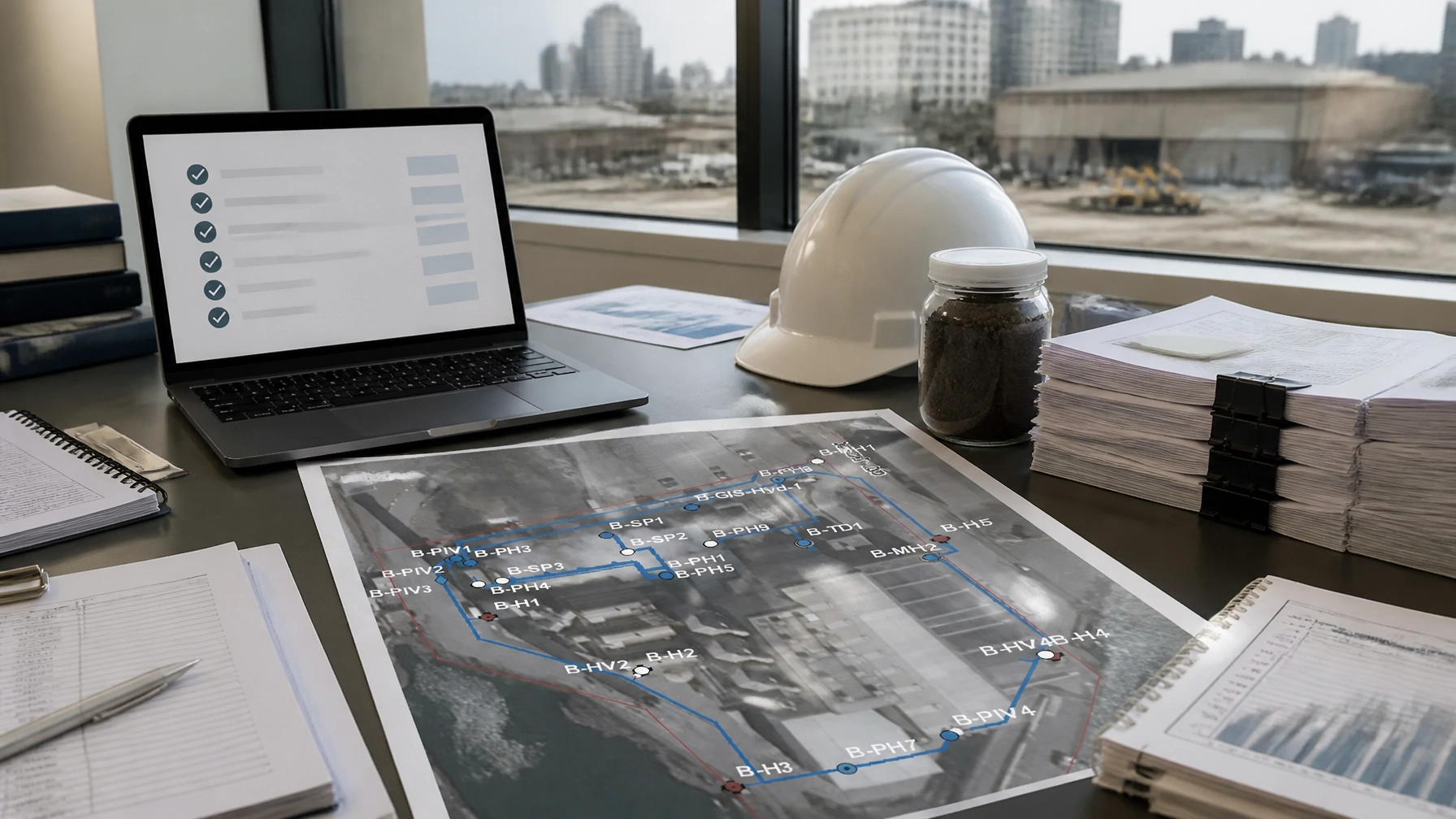
- Monitor locations and daily site maps
- Instrument calibration and bump-test records
- Work activities and equipment operating during each reading
- Alarm events and action-limit reports
- Dust, odor, or visible emissions observations
- Corrective measures
- Work stoppage and restart times
- Notifications to the project manager, OER, NYSDEC, or NYSDOH when required
- Community complaints and the response taken
Records should be downloaded and field-logged daily. Keep them onsite and organize them so they can be provided to the agency, lender, owner, attorney, or community representative without reconstructing the project months later.
Community complaints require a field response
A complaint about dust, odor, or visible emissions should not be treated as a public relations issue alone. It is field data.
The response process should include:
- Record the time, location, contact information if available, and nature of the complaint.
- Check wind direction and monitoring data for the relevant period.
- Inspect the perimeter and active work area.
- Verify whether visible dust, odor, truck track-out, or another condition is present.
- Implement additional controls or pause work when appropriate.
- Notify the project manager and agency contacts according to the approved plan.
- Document the response and any follow-up communication.
In a dense neighborhood, the monitor should be near the actual receptor risk. A station hidden behind equipment or placed where it cannot capture the downwind condition does not protect the project.
Why CAMP protects the schedule
A stop-work event can cost far more than the CAMP itself.
The direct costs may include:
- Idle excavation and trucking crews
- Re-mobilization
- Delayed concrete or foundation work
- Lost inspection windows
- Additional dust or vapor controls
- Agency notifications and response meetings
- Community complaints and project scrutiny
- Schedule impacts to DOB, lender, and closing commitments
The larger risk is a record that shows the team knew an action level had been exceeded but did not respond properly.
This is where an experienced environmental consultant in NYC makes a difference. The person who writes the CAMP should understand how it will operate at the fence line, during a UST pull, beside occupied buildings, or while a drill rig is advancing through suspect fill.
Envicon provides CAMP preparation, staffed field monitoring, action-level response, daily reporting, and construction oversight through one coordinated team. Our field staff actually run the monitors. Our engineers coordinate directly with owners, contractors, architects, attorneys, and agency reviewers. We do not write defensive reports and leave the site team to interpret them.
That matters on NYC OER brownfield cleanup projects where the field decision and the agency record must match.
Learn more about Community Air Monitoring and staffed field monitoring, Construction Oversight and Field Engineering, and NYC E-Designation and OER compliance. Envicon supports projects across Manhattan, Brooklyn, Queens, and the Bronx.
FAQ
Is CAMP required for every NYC E-Designation project?
No. The approved CEQR determination, RAP, RAWP, CHASP, and OER requirements control. CAMP is commonly required when an E-1 hazardous materials project involves excavation, soil handling, drilling, UST work, or other intrusive activities.
What VOC level requires work to stop?
The standard response is a temporary halt when total organic vapors exceed 5 ppm above upwind background for a 15-minute average. Levels above 25 ppm at the perimeter require shutdown and corrective action. Always follow the approved site-specific plan.
What PM10 level requires work to stop?
The commonly applied NYSDOH Generic CAMP structure uses 100 micrograms per cubic meter above upwind background as a dust-suppression trigger and 150 micrograms per cubic meter above background as the work-stoppage threshold when controls do not reduce the reading. Confirm the exact language in the approved CAMP.
How long must CAMP records be kept?
Keep records for the period required by the approved RAP, RAWP, CHASP, agency program, contract, and applicable project obligations. At a minimum, preserve daily logs, raw and averaged readings, calibration records, maps, action-limit reports, complaints, corrective actions, and agency notifications through project closeout.
Can the same consultant prepare the CAMP and monitor the site?
Yes. An integrated team can improve consistency because the plan writer understands the response procedures and the field team understands the agency commitments. The key is qualified staff, calibrated equipment, clear authority to stop work, and complete records.
Takeaway
For NYC excavation and E-Designation work, CAMP is a schedule-protection tool.
Build it into the RAP, RAWP, CHASP, procurement package, and mobilization plan. Define the monitors, action levels, controls, complaint response, and records before soil is disturbed.
Then staff it with people who will make the right call when the reading changes.
Collaboration is not a buzzword. It is how compliant projects keep moving.
Ready to protect your NYC excavation schedule?