A Phase I ESA does not answer every environmental question. It identifies the conditions that require a closer look.
For a 2026 acquisition in Brooklyn, that closer look may include soil borings, groundwater sampling, soil vapor testing, sub-slab sampling, indoor air, or PFAS analysis. The right scope depends on the recognized environmental conditions, the property’s historical uses, the lender’s requirements, and whether the investigation may later need to support NYSDEC or NYC Office of Environmental Remediation coordination.
A targeted Phase II ESA should reduce uncertainty. It should not create a larger investigation without a reason.
What a Phase I REC means for your Brooklyn acquisition
A recognized environmental condition, or REC, is not a finding of confirmed contamination. It is a reason to investigate.
The Phase I report should identify:
- The suspected source of contamination
- The media that may be affected
- The likely migration pathways
- The historical area of concern
- The proposed redevelopment or excavation plan
- Any applicable regulatory records
- Any lender or transaction deadline
That information drives the Phase II sampling plan.
A former dry cleaner may justify soil and groundwater sampling for chlorinated solvents, along with soil vapor or sub-slab sampling for compounds such as PCE and TCE. A former gas station may require targeted borings around USTs, dispensers, and product lines. A waterfront industrial property may require a broader look at historic fill, petroleum impacts, metals, PCBs, and groundwater conditions.
The scope should follow the risk. A grid of random borings across an entire property may look thorough, but it can miss the actual source area while increasing cost and schedule.
What a Phase II ESA typically includes
A Brooklyn Phase II environmental site assessment may include several investigation components.
Soil borings and field screening
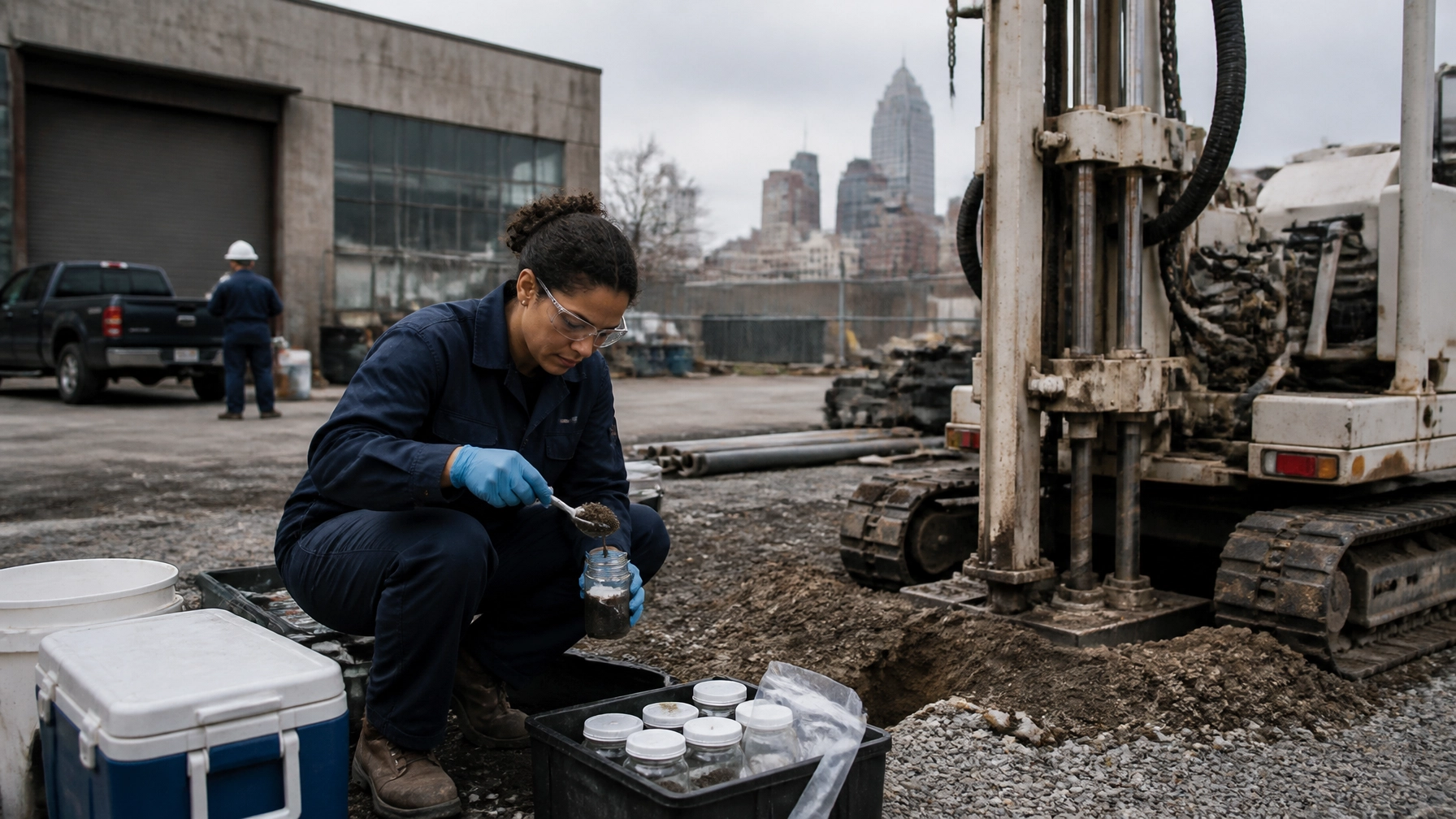
Direct-push or hollow-stem auger borings are placed near suspected source areas and along potential migration pathways. Field staff document soil type, odors, staining, fill material, groundwater observations, and photoionization detector readings where appropriate.
Sampling intervals should reflect the REC and the site geology. Historical fill can vary significantly over short distances, especially at redeveloped industrial parcels. A boring plan that ignores fill placement, utility corridors, former tanks, or basement structures can leave material data gaps.
Groundwater wells and sampling
Groundwater sampling may use temporary points or permanent monitoring wells, depending on the objective.
Groundwater data can help determine:
- Whether contamination is present below the property
- Whether impacts appear localized or migrating
- Whether a dissolved plume may affect adjacent parcels
- Whether groundwater could act as a vapor source
- Whether future excavation or dewatering may create additional obligations
Sampling methods, well construction, development, stabilization, purging, and laboratory handling all affect data quality. A groundwater result without proper field documentation may not support a lender decision or later regulatory review.

Soil vapor, sub-slab vapor, and indoor air
Soil vapor testing is important when volatile organic compounds may have migrated beneath or near a building.
Depending on the property, the investigation may use:
- Soil vapor points outside the building
- Sub-slab vapor probes inside the building
- Indoor air samples
- Outdoor ambient air samples
- Building pressure and HVAC observations
- Product inventory and chemical-use interviews
Indoor air sampling is not automatic. It becomes more important when a building is occupied, will be occupied, or contains a potential vapor pathway connected to contaminated soil or groundwater.
The NYSDOH Soil Vapor Intrusion Guidance provides the framework for evaluating soil vapor and indoor air conditions in New York. NYC properties may also be subject to specific OER Phase II ESA requirements, particularly where an E-Designation, Restrictive Declaration, or other city review applies.
Soil vapor sampling for PFAS is not required under NYSDEC’s current PFAS remedial guidance. Soil vapor investigations focus on volatile compounds, while PFAS evaluation generally focuses on soil, groundwater, surface water, and sediment.
For a dedicated vapor scope, see Envicon’s Vapor Intrusion Assessment service.
PFAS in a 2026 Phase II ESA
PFAS analysis requires a site-specific decision.
NYSDEC’s PFAS program guidance is especially important when a property may enter a state remedial program or when the historical use suggests a potential PFAS source. Relevant uses may include:
- Metal plating and finishing
- Fire-training areas or firefighting foam storage
- Airports and aviation support facilities
- Industrial laundries
- Textile and waterproofing operations
- Chemical manufacturing
- Waste handling or treatment operations
At a private transaction site, PFAS should not be added simply because it is a current topic. The question is whether the historical use, site setting, regulatory pathway, or lender requirements justify the analysis.
If soil or groundwater samples are already being collected for a potentially affected property, PFAS may need to be included in the analytical program. The laboratory must receive clear instructions on PFAS-compatible containers, tubing, clothing, field equipment, blanks, and chain-of-custody procedures.
PFAS work is sensitive to cross-contamination. A technically correct laboratory method cannot fix poor field controls.

Laboratory QA/QC and data gaps
The laboratory report is only one part of the investigation record.
A defensible Phase II program should address:
- Sample locations and depths
- Field duplicates
- Equipment blanks where appropriate
- Trip blanks for volatile compounds
- Laboratory method blanks
- Holding times
- Preservation requirements
- Detection limits
- Data validation
- ELAP accreditation where required
- Chain-of-custody records
- Deviations from the work plan
For NYC OER-related work, laboratory and analytical requirements may be more specific than those used for a private, non-regulatory transaction investigation. The final report should state what was sampled, what was not sampled, and why.
Data gaps are not automatically failures. A data gap becomes a transaction problem when the report does not explain its effect on the property decision.
For example, an inaccessible area beneath an operating building may require a limitation, alternate sampling location, or future investigation. The buyer, lender, and counsel should understand whether that limitation affects the risk conclusion.
Private transaction diligence versus regulatory investigation
A private Phase II ESA supports a transaction decision. It helps the buyer, lender, attorney, or investor understand environmental exposure before closing.
A regulatory remedial investigation serves a different purpose. It may require an approved work plan, agency coordination, formal delineation, public records, prescribed analytical methods, long-term monitoring, and a defined cleanup or closure pathway.
The two scopes can overlap, but they are not interchangeable.
NYSDEC or NYC OER coordination may become appropriate when:
- The property is already under an agency case
- An E-Designation or Restrictive Declaration applies
- The buyer plans to enter the Brownfield Cleanup Program
- The Phase I identifies a spill, petroleum release, or significant historical source
- The investigation suggests off-site migration
- The proposed work will disturb contaminated soil
- A lender requires a regulatory closure path
- The transaction depends on a no-further-action or equivalent determination
Envicon helps clients determine whether the immediate need is transaction diligence, regulatory investigation, or a staged approach that keeps both options open.
Phase II ESA Brooklyn cost and scope decisions
The cost of a Phase II environmental site assessment in Brooklyn depends on the number of borings, laboratory parameters, groundwater conditions, building access, traffic control, utility clearance, vapor work, and reporting requirements.
Envicon’s Brooklyn service information lists a planning range of approximately $8,000 to $25,000 for Phase II ESA work involving soil and groundwater. That is not a quote. A vapor program, PFAS analysis, difficult access, or agency coordination can change the scope.
The right question is not simply, “What does a Phase II ESA cost?”
It is:
What is the smallest defensible scope that answers the Phase I question and protects the transaction?
Phase II decision table
| Site condition or transaction driver | Typical investigation response | Main decision supported |
|---|---|---|
| Former dry cleaner | Soil, groundwater, soil vapor, and potentially sub-slab or indoor air sampling | Is there a chlorinated solvent source or vapor pathway? |
| Former gas station or UST area | Targeted borings, petroleum analysis, groundwater, and tank records review | Are petroleum impacts present, and is tank closure needed? |
| Historic fill or industrial use | Soil borings, metals, SVOCs, PCBs, petroleum, and fill characterization | Will excavation or disposal create cost exposure? |
| Waterfront or former manufacturing site | Soil, groundwater, sediment or source-area review as appropriate | Are impacts localized, migrating, or connected to historic operations? |
| Potential PFAS source | PFAS in relevant soil and groundwater samples, with strict QA/QC | Does PFAS affect underwriting or a future regulatory pathway? |
| Occupied or planned occupied building near VOC impacts | Soil vapor, sub-slab, indoor air, and outdoor air as appropriate | Is vapor intrusion a current or future occupant concern? |
| E-Designation or active agency case | Work plan and analytical program coordinated with NYC OER or NYSDEC | Will the investigation satisfy the applicable regulatory process? |
The Envicon approach
Envicon scopes the investigation around the REC, the property, and the closing decision. We coordinate with lenders, attorneys, owners, contractors, and agency contacts when the project requires it.
Our deliverable should tell you:
- What we found
- What remains uncertain
- Whether the data is sufficient
- What additional work may be required
- What the likely cost exposure is
- Whether the site can proceed toward acquisition, redevelopment, or regulatory coordination
That is the difference between receiving a report and receiving a path forward.
We serve projects across Brooklyn, Queens, Manhattan, the Bronx, Staten Island, and Westchester. Our team combines field investigation, environmental analysis, regulatory coordination, and project management without putting your acquisition into a national queue.
Takeaway
A Phase II ESA Brooklyn NY investigation should be targeted, technically defensible, and tied to the transaction.
Start with the Phase I REC. Place borings where the history and site conditions indicate a source. Evaluate groundwater and soil vapor based on actual pathways. Add PFAS when the site history, regulatory route, or lender requirements justify it. Document QA/QC and identify data gaps before they become closing problems.
The objective is not more sampling. It is better information before you commit capital.
Request a Phase II scope review
- Request a Phase II scope review
- Call Envicon at (917) 764-2171
- Use the proprietary project risk screener
- Review Phase II ESA services
- Learn more about vapor intrusion assessment