A June 15, 2026 NJDEP amendment changes the baseline question for industrial property transactions in New Jersey.
When contaminants in an Area of Concern are unknown or poorly documented, investigators must now account for five additional analytes across applicable environmental media:
- GenX chemicals
- PFNA
- PFOS
- PFOA
- 2,3,7,8-TCDD, commonly called dioxin
That does not mean every private Phase II Environmental Site Assessment requires the same full default panel. It does mean that buyers, sellers, lenders, attorneys, and LSRPs need to understand when the regulatory trigger applies and when a narrower, defensible scope makes more sense.
This matters across Newark, Jersey City, Hoboken, Bayonne, Hudson County, Bergen County, and Essex County, where industrial properties often carry incomplete operating records, historic fill, former manufacturing uses, petroleum storage, and overlapping regulatory obligations.
What changed under NJDEP 7:26E-2.1(c)
The June 15, 2026 amendment to N.J.A.C. 7:26E-2.1(c) expands the analytes required when contaminants associated with an Area of Concern are unknown or not well documented.
The expanded default list works alongside traditional requirements such as:
- Target Compound List and Target Analyte List compounds
- Tentatively identified compounds, where applicable
- Hexavalent chromium
- Extractable petroleum hydrocarbons
- pH
- PFNA
- PFOA
- PFOS
- GenX chemicals
- 2,3,7,8-TCDD
The key phrase is unknown or poorly documented contaminants.
That phrase is the regulatory trigger. It is not a blanket instruction that every acquisition Phase II must test every medium for every compound regardless of site history.
NJDEP’s PFAS program and Technical Requirements for Site Remediation materials should be reviewed with the project-specific facts, the applicable Area of Concern, and the current regulatory pathway.
The regulatory trigger is not every private Phase II scope
A private Phase II ESA is usually designed to answer specific questions raised by a Phase I ESA, lender, buyer, seller, or redevelopment plan.
For example, a former machine shop with a documented solvent use may need a focused volatile organic compound program. A former petroleum terminal may require petroleum-related compounds, EPH, groundwater sampling, and UST investigation. A plating operation may justify metals and hexavalent chromium.
The scope should follow the recognized environmental conditions and the historical operations.
The expanded NJDEP default testing requirement becomes more important when:
- The site operated under multiple industrial tenants.
- Records do not identify the chemicals used.
- An Area of Concern has no reliable contaminant profile.
- Historic fill or undocumented disposal occurred.
- A previous investigation used a narrow list without explaining why.
- Site ownership changed repeatedly.
- A former operator cannot confirm storage, discharge, or waste-handling practices.
- The property is entering an NJDEP remedial investigation or ISRA pathway.
A lender-driven Phase II may still have its own requirements. A transaction team may also request additional PFAS testing even when the strict regulatory trigger is not established.
Those are separate decisions.
“Default testing is a starting point for uncertainty. It is not a substitute for understanding the property.”
Industrial property environmental due diligence in Newark
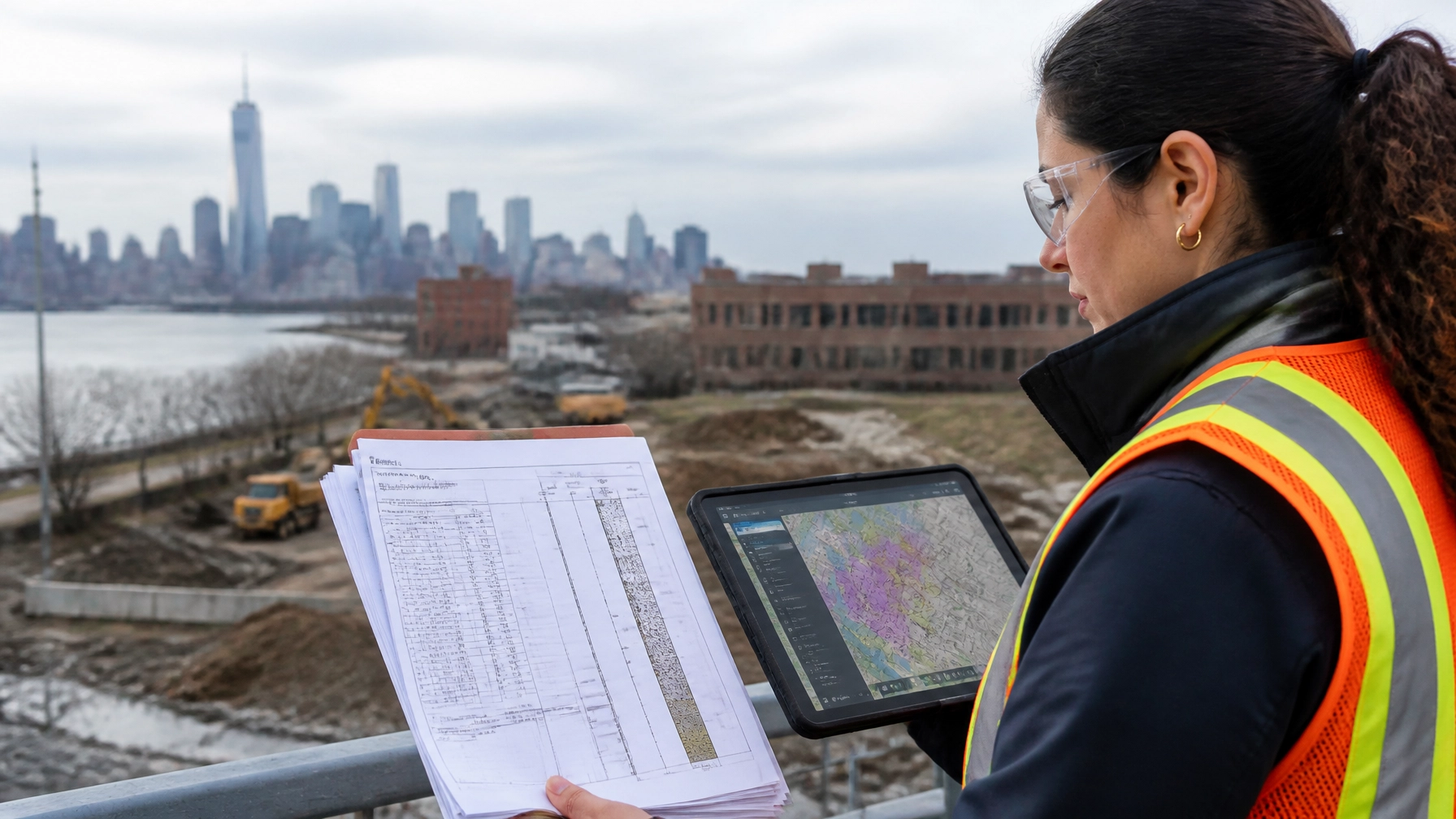
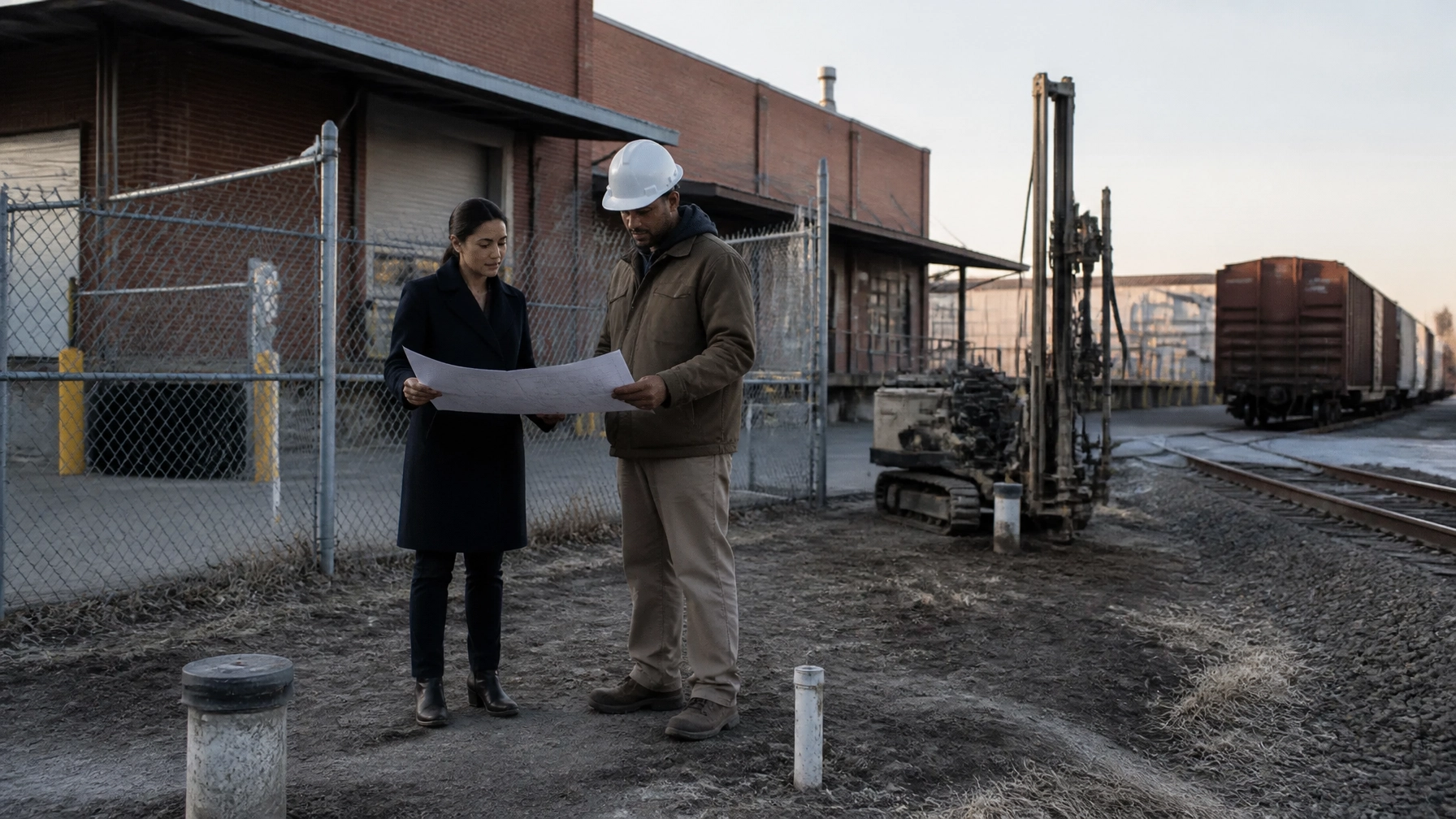
Newark industrial properties often combine long operating histories with redevelopment pressure. A parcel may have served as a warehouse, metalworking facility, trucking terminal, fuel depot, chemical distributor, or rail-served manufacturing site.
That history matters more than the property’s current appearance.
A clean warehouse floor does not eliminate subsurface risk. Contamination may remain beneath slabs, loading docks, former process areas, tank farms, maintenance bays, drainage structures, or filled lowlands.
A defensible Phase II scope starts with the property’s history and maps each Area of Concern before sampling begins.
Envicon’s Phase II ESA process uses REC-driven boring and monitoring well layouts. The objective is not to scatter borings across a parcel. The objective is to collect data that answers the transaction question and supports the next decision.
What should the Phase II scope include?
1. Historical operations and AOC mapping
Start with a property timeline.
Review available:
- Sanborn fire insurance maps
- Historic aerial photographs
- City directories
- Agency files
- NJDEP records
- Prior environmental reports
- UST and AST records
- Spill documentation
- Waste manifests
- Process descriptions
- Interviews with current and former operators
Then map likely Areas of Concern, such as:
- Former tanks and piping
- Loading and unloading areas
- Degreasing or solvent-use areas
- Plating and metalworking areas
- Waste storage zones
- Stormwater inlets and dry wells
- Former burn areas
- Rail spurs
- Historic fill placement
- Adjacent upgradient industrial parcels
If the records do not identify the chemicals associated with an AOC, the NJDEP default analytes need to be addressed directly in the Sampling and Analysis Plan.
2. Media-specific sampling
The phrase “all media” requires careful application.
A typical industrial property Phase II may include:
- Soil: surface soil, subsurface soil, historic fill, and material beneath slabs or proposed excavation areas.
- Groundwater: temporary wells or permanent monitoring wells placed according to groundwater flow and suspected source areas.
- Soil vapor: sub-slab or soil vapor sampling where volatile chemicals or vapor intrusion pathways are possible.
- Surface water or sediment: where drainage features, wetlands, waterways, or discharge pathways connect to the AOC.
PFAS and dioxin do not behave identically.
PFAS can migrate through groundwater and may be affected by sampling materials, field handling, and background conditions. Dioxin is strongly associated with soil and fine-grained materials, but its evaluation still depends on source history and the applicable regulatory program.

3. Laboratory and QA/QC controls
PFAS sampling requires stricter field controls than a conventional petroleum or VOC program.
The work plan should address:
- PFAS-free or PFAS-compatible sampling materials
- Avoidance of fluoropolymer materials where required
- Field blanks and equipment blanks
- Trip blanks when appropriate
- Dedicated or properly decontaminated equipment
- Sample preservation and temperature control
- Chain-of-custody documentation
- Laboratory method and reporting limits
- NJDEP or NELAP laboratory credentials
- Data validation requirements
Dioxin analysis also requires a qualified laboratory and a clear analytical method. The team should confirm detection limits, sample mass, turnaround time, and reporting format before mobilization.
A low-quality sample plan creates expensive problems later. It can force resampling, delay lender review, and weaken the transaction’s reliance on the report.
Decision table for Newark and Jersey City transactions
| Site condition or transaction driver | Likely scope decision | Regulatory and business consideration |
|---|---|---|
| Documented single-use facility with known chemicals | Targeted Phase II based on the documented contaminants | Explain why NJDEP default testing does or does not apply |
| Multiple historic industrial uses with incomplete records | Evaluate expanded default analytes, including PFAS and dioxin | Unknown AOC contaminants may trigger N.J.A.C. 7:26E-2.1(c) |
| Active NJDEP case or ISRA transaction | Coordinate Phase II with the LSRP and NJDEP pathway | A lender report alone may not satisfy regulatory obligations |
| Former plating, metalworking, or chemical facility | Include metals, VOCs, SVOCs, and process-specific compounds | Add PFAS and dioxin when the contaminant profile is uncertain |
| Planned excavation or redevelopment | Sample soil and fill where construction will disturb material | Results affect disposal, reuse, worker protection, and schedule |
| Groundwater encountered during drilling | Install temporary or permanent wells as warranted | Consider PFAS, dissolved-phase impacts, and dewatering implications |
| Existing report is more than several years old | Perform a gap review before relying on it | Standards, analyte lists, site conditions, and lender requirements may have changed |
PFAS default analytes for a Phase II in Jersey City
Jersey City, Hoboken, Bayonne, and the wider Hudson County market include former rail, manufacturing, warehouse, waterfront, and utility uses.
A Phase II at one property may need a very different scope from a neighboring property.
The right question is not, “Should we test for PFAS because the property is in Jersey City?”
The right questions are:
- What did the property do?
- What Areas of Concern exist?
- Are the contaminants documented?
- Is the investigation regulatory, lender-driven, or both?
- Could soil or groundwater be disturbed during redevelopment?
- Does an existing NJDEP case or LSRP file control the scope?
- Will the lender accept the proposed analyte list?
Envicon’s Jersey City environmental consulting team works with developers, attorneys, lenders, and contractors on these transaction and redevelopment questions. Local review matters. The same report may receive different scrutiny depending on whether it supports a closing, an ISRA transfer, a remedial investigation, or a construction start.
LSRP and ISRA coordination
An industrial property sale may trigger obligations under New Jersey’s Industrial Site Recovery Act, the Spill Compensation and Control Act, or the Site Remediation Reform Act.
That does not mean every transaction follows the same path.
The team should screen:
- Whether the seller operates an ISRA subject facility
- Whether a General Information Notice or response obligation applies
- Whether an LSRP is already assigned
- Whether an active NJDEP case exists
- Whether a Response Action Outcome, Remedial Action Permit, or deed notice affects the parcel
- Whether the buyer’s redevelopment plan changes the exposure pathways
- Whether the Phase II can support both lender diligence and regulatory decision-making
An LSRP should be involved early when the property has an active case, known discharge, ISRA obligation, or likely remediation pathway. Envicon provides NJ LSRP services, including site investigation, remedial planning, NJDEP coordination, and closure strategy.
The practical advantage is simple. One team can connect the sampling plan to the regulatory outcome instead of delivering a report that leaves the buyer to start over.
Cost and schedule planning
A standard commercial Phase II ESA commonly falls within an approximately $8,000 to $25,000 planning range, depending on site size, access, boring count, wells, analytical program, and reporting requirements. Envicon identifies a typical field and laboratory timeline of approximately three to five weeks, including laboratory work, for a defined Phase II scope.
An expanded PFAS and dioxin program can increase both cost and schedule because it may require:
- Additional sample locations
- Separate sampling protocols
- Specialized laboratory analysis
- Longer laboratory turnaround
- Data validation
- More complex waste handling
- Additional groundwater or soil vapor work
- Regulatory or lender review
Do not price this work from a generic per-boring rate. The cost depends on the uncertainty that the investigation must resolve.
A same-day scope review can identify whether the project needs a focused transaction screen, a full Phase II, or a coordinated Phase II and LSRP investigation.
What to do with legacy environmental reports
Do not discard older reports. Do not rely on them without a gap analysis.
Review each legacy report for:
- Date of field work
- Laboratory methods
- Analytes tested
- Sample locations
- Detection limits
- QA/QC documentation
- Site conditions at the time
- Changes in building use
- Changes in NJDEP standards
- Areas not investigated
- Whether PFAS or dioxin were considered
- Whether the report addressed soil, groundwater, and vapor pathways
A legacy report may still provide useful source information and historical data. It may also leave a material gap under the current NJDEP framework.
The best next step is often a focused gap memo that compares the old report against the current transaction, lender, and regulatory requirements before anyone remobilizes a drill rig.
The takeaway for industrial buyers and sellers
The June 15, 2026 amendment makes uncertainty more expensive to ignore.
For industrial property sales in Newark and Jersey City, the Phase II scope should connect four things:
- Historical operations
- Area of Concern documentation
- NJDEP and lender requirements
- The actual transaction and redevelopment schedule
PFAS and dioxin testing may be mandatory when an AOC’s contaminants are unknown or poorly documented. It is not automatically mandatory for every private Phase II. The distinction must be documented in the work plan and supported by the site facts.
If your property has incomplete records, a former industrial use, an active NJDEP matter, or a closing deadline, get the scope right before field work begins.
Sources
- NJDEP PFAS program
- NJDEP Technical Requirements for Site Remediation, N.J.A.C. 7:26E
- NJDEP rules and regulations
- NJDEP rule adoption materials
- NJDEP PFAS standards and regulations
- Envicon Phase II Environmental Site Assessment
- Envicon NJ LSRP Services
Review your industrial property risk before closing
Envicon Group provides an industrial property risk review for buyers, sellers, lenders, attorneys, and developers across Newark, Jersey City, Hoboken, Bayonne, Hudson County, Bergen County, and Essex County.
We can review your Phase I, legacy reports, historical operations, lender requirements, and transaction timeline. Then we will tell you what the Phase II should include and what it should not.
- Request an industrial property risk review
- Call Envicon at (917) 764-2171
- Use the project risk screener
Solve environmental and engineering challenges with precision, speed, and trust. The goal is not another report. The goal is a clear path to closing, compliance, and a buildable site.