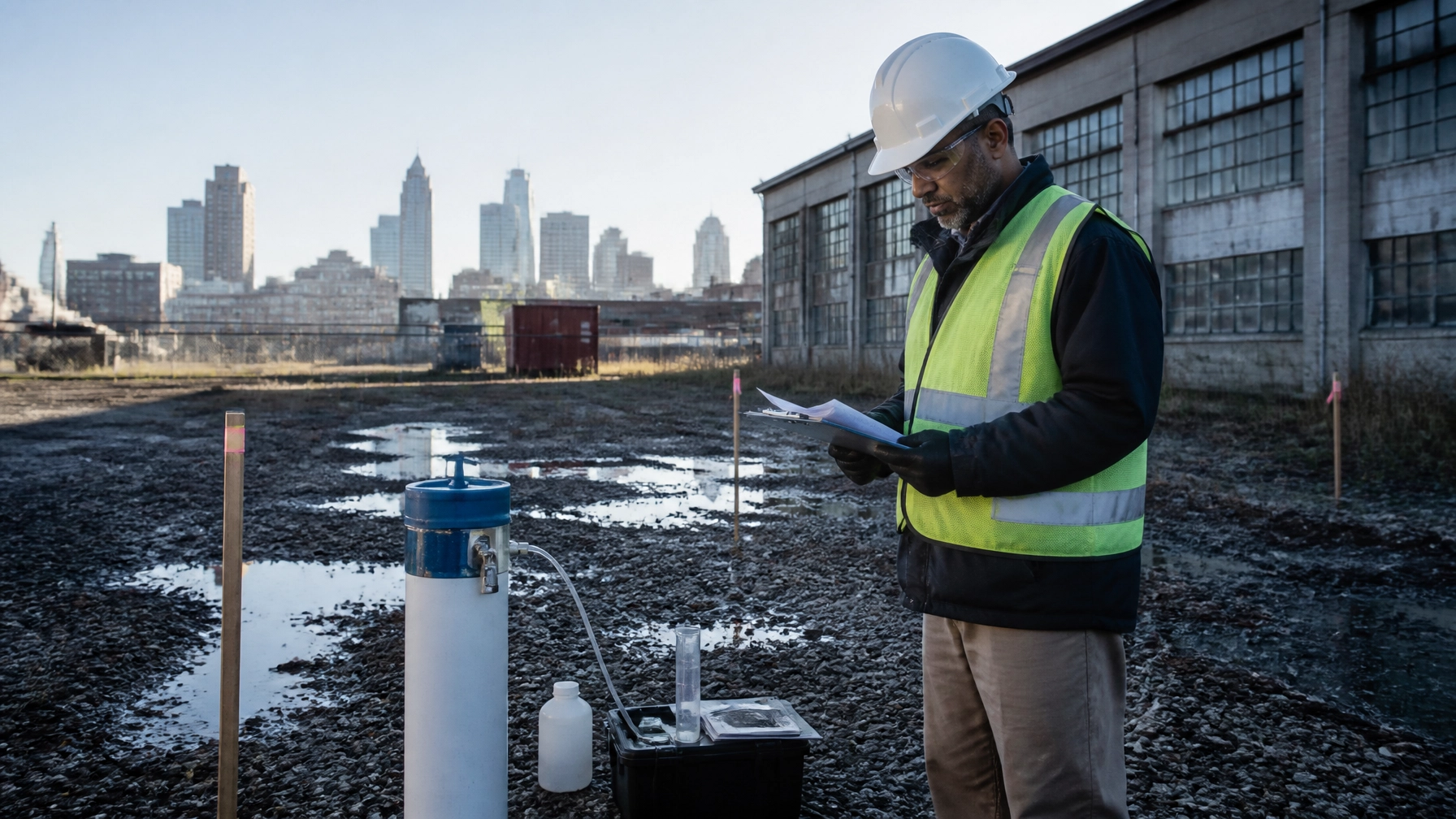
A New Jersey industrial property sale can trigger environmental obligations before the closing date is on the calendar.
Under the Industrial Site Recovery Act, the first deadline may arrive only five calendar days after a triggering event. That event can include signing an agreement of sale, transferring ownership or operations, closing an industrial establishment, or completing certain corporate transactions.
For owners, buyers, attorneys, lenders, and developers in Newark, Hoboken, Jersey City, Bayonne, Bergen County, Hudson County, and Essex County, the practical question is not simply whether contamination exists. The question is whether the property and transaction require an ISRA response, what must be filed, who will manage the remediation, and whether the environmental work can support the closing schedule.
This guide outlines the NJ ISRA property sale timeline 2026 and the documents that help keep a transaction moving.
ISRA applicability starts with the industrial establishment screen
ISRA does not apply to every commercial property. The analysis begins with whether the site qualifies as an “industrial establishment.”
The current ISRA rules at N.J.A.C. 7:26B use applicable North American Industry Classification System codes, or NAICS codes. The operations must also involve the generation, manufacture, refining, transportation, treatment, storage, handling, or disposal of hazardous substances or wastes on site, subject to applicable exceptions and limitations.
A screening review should consider:
- The current and historical operations at the property
- The applicable NAICS code or codes
- Whether hazardous substances or wastes were handled on site
- Whether the property is owner-occupied or leased
- Whether multiple tenants operate in separate leaseholds
- Whether contiguous parcels are controlled by the same owner or operator
- Whether the transaction transfers real property, business assets, ownership interests, or operations
- Whether an exemption, waiver, or alternate compliance option may apply
The NAICS code alone does not answer the question. The actual operations and transaction structure matter.
That is why a standard Phase I ESA may not be enough for an industrial closing. A Phase I can identify recognized environmental conditions and historical uses. An ISRA review adds a New Jersey-specific transfer screen that evaluates the regulatory consequences of the transaction itself.
Envicon can coordinate a Phase I Environmental Site Assessment with an ISRA applicability review so the buyer and seller are working from one set of facts.

What triggers ISRA in a 2026 property sale?
Under N.J.A.C. 7:26B-3.2, common triggering events include:
- Signing an agreement of sale for the industrial establishment or its real property
- Executing an agreement to transfer ownership or operations
- Closing operations or publicly announcing a decision to close
- Executing a lease for 99 years or longer
- Exercising an option to purchase
- Transferring more than 50 percent of an industrial establishment’s assets within the applicable period
- Certain mergers, consolidations, stock transfers, partnership changes, or LLC interest transfers
- Certain dissolution, insolvency, receivership, or bankruptcy events
- Changing operations in a way that changes the primary NAICS code from one subject to ISRA to one that is not subject to ISRA
The trigger may occur before the deed records and before the buyer takes possession.
For that reason, the transaction team should not wait until the anticipated closing date to ask whether ISRA applies.
ISRA GIN deadline Newark: five calendar days
The General Information Notice, or GIN, is the formal notice to NJDEP that an ISRA triggering event has occurred.
The current rule states that the owner or operator must submit the GIN within five calendar days after the triggering event. For a sale, the relevant date may be the date the agreement of sale is signed. It is not automatically the closing date.
The GIN generally identifies:
- The industrial establishment and site identification information
- The current owner and operator
- The applicable NAICS code or codes
- The transaction or event that triggered ISRA
- The date the agreement, transfer, or other event occurred
- The proposed closing or transfer date
- The authorized agent
- The person responsible for conducting the remediation
- Applicable NJDEP fees and supporting information
The rule also requires corrections or amendments when information in the original GIN is later found to be incomplete, inaccurate, or incorrect.
For a Newark transaction, the practical takeaway is simple:
Do the ISRA applicability screen before signing if possible. If the agreement is already signed, confirm the GIN deadline immediately.
The NJDEP ISRA information page, current ISRA rules, and NJDEP SRP forms page should be reviewed with the project’s environmental professional and counsel.
When should the LSRP be retained?
A Licensed Site Remediation Professional should be involved as early as possible after an ISRA trigger is identified.
The LSRP helps determine the required scope, manages the investigation and remediation under New Jersey’s Site Remediation Reform Act framework, prepares or certifies required submissions, coordinates with NJDEP, and develops the path toward regulatory closure.
For an LSRP property sale in Hoboken NJ, early retention matters because the site may involve:
- Former manufacturing or warehouse operations
- Petroleum storage and underground storage tanks
- Historical fill
- Solvents, metals, petroleum, or other hazardous substances
- Groundwater impacts
- Vapor intrusion concerns
- Existing deed notices or engineering controls
- Prior NJDEP cases that were never fully closed
A buyer should not assume that an old No Further Action letter resolves every current obligation. The LSRP must review the actual property boundaries, Areas of Concern, institutional controls, engineering controls, and current site conditions.
Envicon’s NJ LSRP Services include PA/SI, remedial investigation, RAWP preparation, remedial action oversight, deed notice coordination, NJDEP correspondence, and RAO strategy.
The PA, SI, RI, and remedial action sequence
ISRA remediation typically follows the established New Jersey site remediation framework.
Preliminary Assessment
The Preliminary Assessment, or PA, reviews current and historical operations, site records, interviews, regulatory files, aerial photographs, and potential Areas of Concern.
The PA asks where hazardous substances may have been used, stored, released, or disposed of. It also identifies data gaps that require field investigation.
Site Investigation
If the PA identifies Areas of Concern, the Site Investigation, or SI, evaluates whether contamination is present.
Depending on the property, this may include:
- Soil borings and laboratory analysis
- Groundwater sampling
- Soil vapor or sub-slab sampling
- Underground storage tank investigation
- Drainage and process-area review
- Sampling around former tanks, floor drains, transformers, and chemical storage areas
Remedial Investigation
If contamination is confirmed, the Remedial Investigation, or RI, defines its nature and extent. The LSRP evaluates horizontal and vertical impacts, exposure pathways, receptors, off-site migration, and the information needed to select a remedy.
Remedial action and the RAP or RAWP
The remedial action addresses the contamination through excavation, disposal, treatment, containment, monitoring, engineering controls, institutional controls, or a combination of measures.
Project teams sometimes use the term RAP for a remedial action plan. In current New Jersey practice, the formal document is commonly a Remedial Action Workplan, or RAWP.
A RAWP is not the same as a final closure document. It explains how the selected remedy will be implemented. The LSRP may also need to prepare a Site Management Plan, establish a Classification Exception Area, coordinate a deed notice, or document long-term monitoring requirements.

RAO, NFA, deed notices, and closing readiness
An older New Jersey file may contain a No Further Action letter, or NFA. For current LSRP-led remediation, the primary closure document is generally the Response Action Outcome, or RAO.
An RAO may address:
- Unrestricted use
- Limited restricted use
- Restricted use
- Engineering controls
- Institutional controls
- Groundwater monitoring
- Vapor mitigation
- Deed notice requirements
- Long-term inspection and certification obligations
A deed notice does not necessarily prevent a sale. It does affect what the buyer owns, what can be built, how the property can be used, and what post-closing obligations must continue.
If contamination remains under a cap, building slab, pavement, or other engineering control, the transaction documents should clearly allocate responsibility for:
- Maintaining the control
- Inspecting the control
- Repairing damage
- Preventing disturbance
- Completing biennial certifications
- Managing soil during future excavation
- Maintaining financial assurance when required
- Continuing groundwater or vapor monitoring
NJ ISRA property sale timeline 2026
The actual schedule depends on the site, transaction structure, NJDEP requirements, sampling results, and the selected remedy. The following timeline is a planning framework, not a guarantee.
| Transaction stage | Typical environmental action | Closing-readiness objective |
|---|---|---|
| Before signing | ISRA applicability and NAICS screen; Phase I ESA; review of NJDEP records | Identify whether the transaction may trigger ISRA |
| Agreement signed | Confirm triggering event and calculate five-calendar-day deadline | Prepare and submit the GIN on time |
| First days after trigger | Retain LSRP; gather historical records, leases, site plans, permits, and prior reports | Establish one responsible technical lead |
| Early investigation | Complete PA and, if required, SI | Identify Areas of Concern and potential cost exposure |
| Confirmed contamination | Conduct RI and evaluate remedial alternatives | Define scope, budget, schedule, and risk allocation |
| Remedy planning | Prepare RAP or RAWP, Site Management Plan, and control documents as needed | Align remedy with redevelopment and lender requirements |
| Before closing | Complete RAO or obtain an applicable authorization, remediation certification, waiver, or alternate compliance path | Document the legal and technical basis for transfer |
| Closing and post-closing | Record deed notices and transfer monitoring or control obligations | Preserve compliance after ownership changes |
Buyer and seller coordination
The seller usually controls historical records and has direct knowledge of operations. The buyer needs enough information to underwrite environmental risk and confirm that the planned use is compatible with the site’s conditions.
The transaction team should coordinate:
- Purchase and sale agreement
- Environmental indemnity
- Access agreement
- GIN and NJDEP correspondence
- LSRP engagement letter
- PA, SI, RI, and RAWP documents
- RAO, NFA, or other final remediation documents
- Deed notice and institutional control documents
- Site Management Plan
- Remediation cost estimate
- Remediation Funding Source
- Remediation Certification
- Waiver or alternate compliance application
- Soil management and disposal requirements
- Construction and redevelopment plans
A buyer should also confirm whether future excavation, foundation work, utility installation, dewatering, or vapor mitigation will change the remedial obligations.
This is where a direct, field-first consultant makes a difference. Envicon coordinates with owners, buyers, attorneys, lenders, contractors, architects, and regulators instead of handing over a report and leaving the transaction team to interpret it.
ISRA due diligence Jersey City and the surrounding market
Industrial properties in Jersey City, Hoboken, Bayonne, Newark, and nearby Bergen and Essex County communities often carry layered histories. A parcel may have changed tenants several times while retaining old tanks, floor drains, fill, utility corridors, or groundwater impacts.
The right question is not whether the property looks clean today. The right question is whether the site history, current operations, transaction structure, and regulatory file support the proposed transfer and redevelopment plan.
If you are planning an NJ industrial property closing, start before the agreement is signed when possible. If the agreement is already signed, treat the five-day GIN deadline as an immediate work item.
Request an ISRA closing-readiness review
Envicon Group helps owners, developers, attorneys, lenders, and buyers solve environmental and engineering challenges with precision, speed, and trust.
We can review the property history, NAICS operations, transaction structure, existing NJDEP records, and proposed closing schedule. Then we give you a practical path forward.
- Request an ISRA closing-readiness review
- Call Envicon at (917) 764-2171
- Use the proprietary project risk screener
- Learn more about NJ LSRP services
- Review Envicon’s Jersey City environmental services
ISRA compliance is not a box to check at the end of a transaction. It is part of the deal schedule from the beginning. The earlier the environmental path is clear, the more control you have over cost, timing, and closing risk.