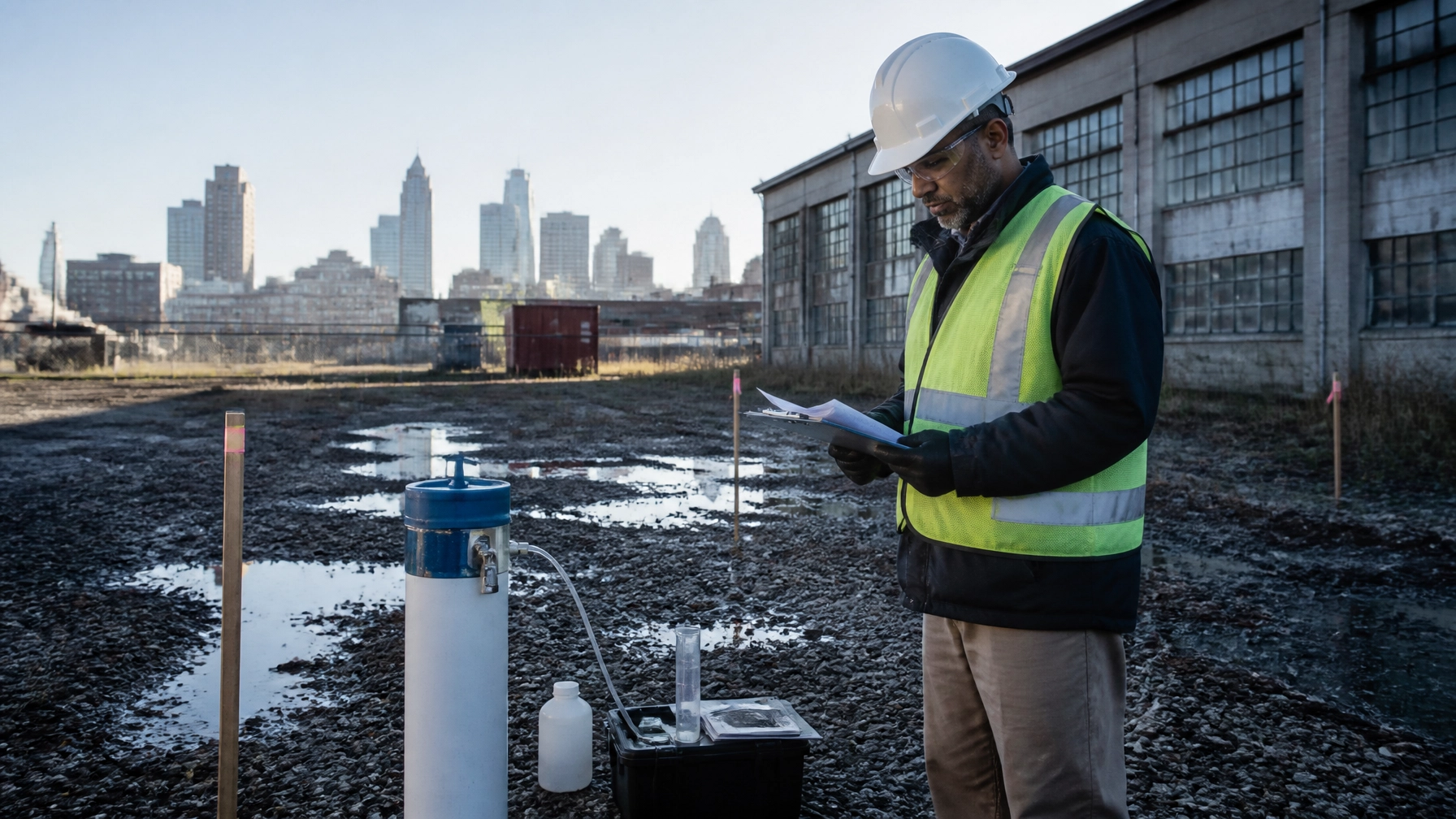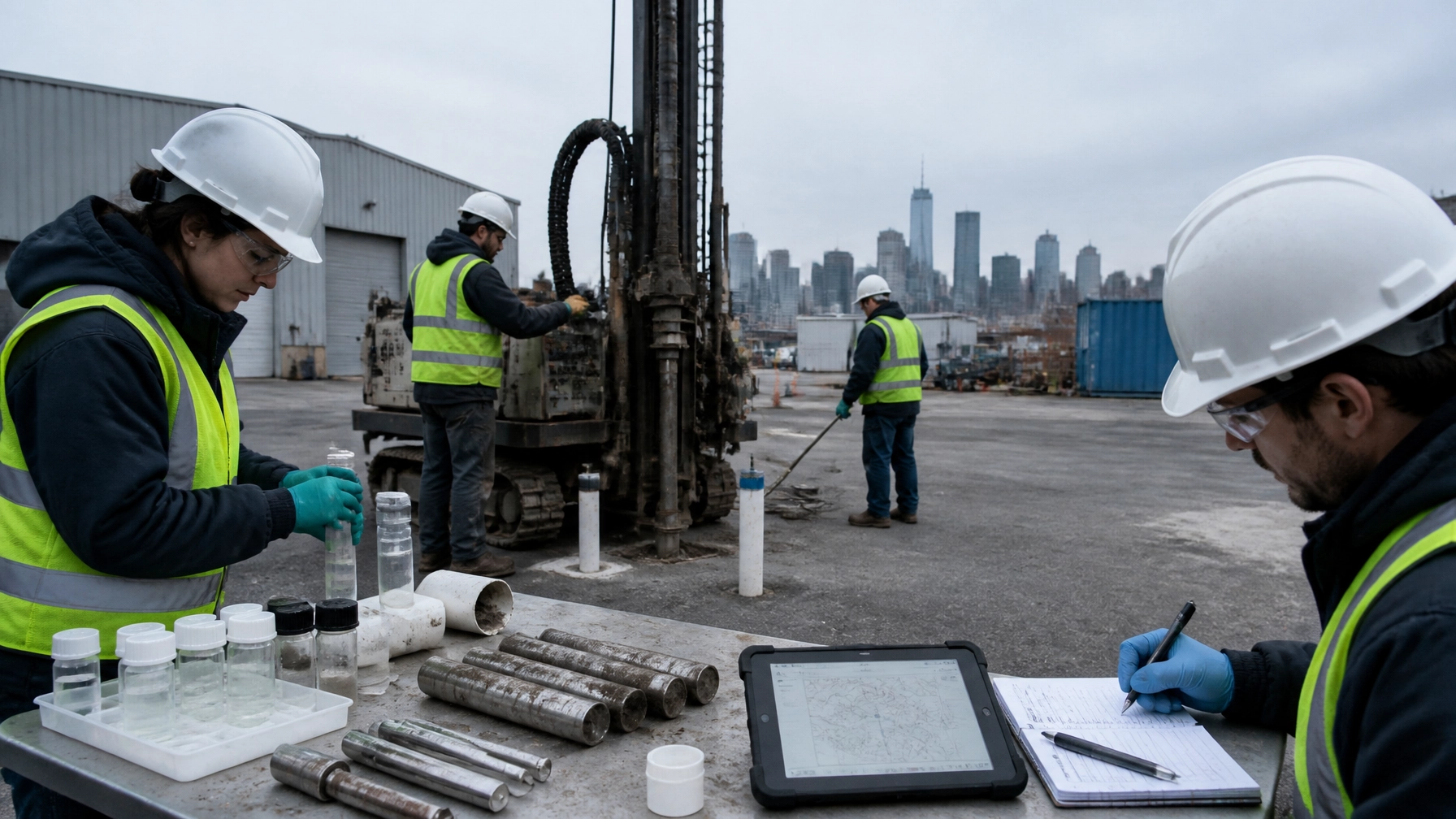
A property sale in Jersey City, Newark, Hoboken, Bayonne, Bergen County, or Essex County can carry PFAS risk even when the Phase I ESA shows no obvious current release.
The issue is documentation. Older industrial records often identify a process without identifying every chemical used. Fire-training areas, metal finishing, manufacturing, landfills, wastewater operations, and facilities that used fluorinated products can create data gaps that matter during acquisition.
On June 15, 2026, NJDEP adopted a new GenX groundwater quality standard and updated the regulatory picture for PFAS-related due diligence. The result is straightforward: buyers need to understand whether PFAS was considered, how samples were collected, and whether the available data can support a lender, an LSRP, or a future redevelopment plan.
This is not a reason to test every property the same way. It is a reason to match the investigation to the property history, Areas of Concern, planned construction, and transaction requirements.
What changed on June 15, 2026?
NJDEP’s June 15, 2026 adoption established a final groundwater quality standard for GenX chemicals, also identified as hexafluoropropylene oxide dimer acid and its ammonium salt.
NJDEP’s current Ground Water Quality Standards table lists the following Class II groundwater standards:
| Constituent | NJDEP groundwater standard |
|---|---|
| GenX chemicals | 0.020 µg/L |
| PFNA | 0.013 µg/L |
| PFOA | 0.014 µg/L |
| PFOS | 0.013 µg/L |
| 2,3,7,8-TCDD | 0.00001 µg/L |
The values are expressed in micrograms per liter, which is equivalent to parts per billion in water.
For 2,3,7,8-TCDD, NJDEP lists a health-based criterion of 0.0000002 µg/L, a practical quantitation level of 0.00001 µg/L, and a groundwater standard of 0.00001 µg/L. The standard reflects the higher of the applicable criterion and the PQL.
These are groundwater standards. They aren't universal cleanup numbers for every sample, every soil type, or every property. Applicable standards depend on the medium, exposure pathway, groundwater classification, land use, and regulatory program.
Review the official June 15, 2026 NJDEP adoption document and NJDEP’s current Ground Water Quality Standards table before relying on older criteria.
What does this mean for a PFAS Phase II ESA?
A private transaction Phase II ESA is not automatically the same as a full NJDEP remedial investigation.
A transaction Phase II is usually designed to answer a business question:
- Is there evidence of contamination?
- Does the Phase I REC require additional investigation?
- Could the condition affect financing, closing, redevelopment, or value?
- Is a regulatory response likely?
- What cost and schedule exposure should the buyer underwrite?
A regulatory investigation under NJDEP’s Site Remediation Program has a different purpose. It must satisfy applicable technical requirements, data quality objectives, reporting obligations, and LSRP responsibilities.
The scope should not be copied from a national template. It should be built around the site’s Areas of Concern.
Where hazardous substances in an AOC are unknown or poorly documented, NJDEP technical requirements can call for a broader analytical program. The relevant analytes include:
- GenX
- PFNA
- PFOA
- PFOS
- 2,3,7,8-TCDD
- Other parameters required by the applicable AOC and technical rules
That does not mean every soil boring or monitoring well at every New Jersey property requires the same PFAS panel. The correct question is whether the AOC history and available records support a narrower scope.
A former plating facility in Newark, a fire-training area near Bayonne, and a warehouse conversion in Jersey City do not present the same conceptual site model.
Soil and groundwater implications
PFAS behaves differently from many conventional petroleum or chlorinated solvent contaminants. Some PFAS compounds are highly mobile in groundwater. Others can remain associated with soil, fill, sediment, or treatment residuals.
For a buyer, the investigation should consider:
- Historic fill and imported soil
- Shallow groundwater depth and flow direction
- Surface water or wetland connections
- Former process areas
- Fire-suppression or fire-training activities
- Wastewater treatment and discharge areas
- Proposed excavation depth
- Planned dewatering
- Potential vapor or indoor-air pathways from co-contaminants
- Existing engineering or institutional controls
Soil results matter because contaminated soil can act as a continuing source to groundwater. Groundwater results matter because they can affect treatment design, discharge planning, long-term monitoring, and regulatory closure.
A single nondetect result does not necessarily resolve a PFAS concern if the sample location does not represent the suspected release area. Conversely, a detected compound does not automatically establish the full extent of contamination or require immediate excavation.
The data must be interpreted against the site model.

Laboratory QA/QC can decide whether the data is usable
PFAS investigations require more than sending bottles to a laboratory.
NJDEP’s PFAS Sampling Fact Sheet states:
“Selection of PFAS analytical methods can be complex and should include consultation with the certified laboratory.”
That consultation should happen before field work begins. The sampling and analysis plan should define the matrix, target analytes, method, reporting limits, containers, preservation, holding times, and data quality objectives.
Important controls include:
- PFAS-appropriate sample containers
- Documented chain of custody
- Field blanks and equipment rinsate blanks when warranted
- PFAS-free water for decontamination and blank samples
- Avoidance of fluoropolymer materials that could bias results
- Clean, powder-free nitrile gloves
- Proper sample order from lower-impact to higher-impact areas
- Laboratory accreditation or certification appropriate to the method
- Data validation and review of estimated, qualified, or nondetect results
NJDEP notes that equipment, tubing, drilling fluids, clothing, personal-care products, and decontamination materials can introduce positive bias. Adsorption can also create negative bias and make concentrations appear lower than they are.
The practical point is simple. A report with the right analyte names but weak QA/QC may not give a lender, regulator, or buyer confidence.

ISRA and LSRP impacts on a property sale
PFAS results can affect a New Jersey transaction in two separate ways.
First, the property may be subject to the Industrial Site Recovery Act. ISRA applicability depends on the establishment’s operations, industrial classification, transaction type, and available exemptions or waivers. The sale itself does not eliminate the need to evaluate the ISRA pathway.
Second, a known or suspected discharge may require work under the Site Remediation Reform Act with an NJDEP-licensed LSRP.
An LSRP may need to address:
- Preliminary Assessment and Site Investigation findings
- Additional delineation
- Remedial Investigation requirements
- Remedial Action Work Plans
- Groundwater monitoring
- Engineering or institutional controls
- Soil and investigation-derived waste management
- NJDEP submissions and regulatory correspondence
- Response Action Outcome strategy
Envicon’s NJ LSRP Services team works across these steps. The objective is not to create a larger study. It is to define the regulatory path before the transaction team commits to a closing date or construction budget.
Decision table for New Jersey buyers
| Transaction condition | Recommended next step |
|---|---|
| No PFAS-related use, release, or data gap identified | Document the records review and explain why PFAS sampling isn't warranted |
| Historic use is known, but PFAS documentation is incomplete | Add targeted PFAS analysis to the Phase II scope for the relevant AOCs |
| AOC contaminants are unknown or poorly documented | Consult the NJDEP technical requirements and develop a broader analytical program |
| PFAS is detected in soil or groundwater | Confirm QA/QC, delineate the result, compare it to applicable standards, and evaluate regulatory implications |
| Site is an industrial establishment or active NJDEP case | Screen ISRA and coordinate with an LSRP before closing |
| Construction will require excavation or dewatering | Add soil management, waste characterization, discharge, and treatment planning to the underwriting |
| Lender requires quantified environmental exposure | Provide a clear concentration summary, uncertainty discussion, cost range, and path forward |
Treatment planning and lender risk
PFAS can affect value even before a cleanup remedy is selected.
A lender may focus on:
- Whether contamination is confirmed
- Whether the plume is delineated
- Whether groundwater treatment is required
- Whether construction dewatering could mobilize contaminants
- Whether disposal facilities will accept impacted soil or water
- Whether long-term monitoring or institutional controls are likely
- Whether the buyer has budgeted a credible contingency
Potential treatment strategies may include granular activated carbon, specialty ion exchange, source removal, excavation, containment, groundwater extraction, or a combination of approaches. The right remedy depends on concentration, flow, co-contaminants, treatment goals, discharge limits, and the regulatory pathway.
A conceptual remedy is not a final design. But a credible early-stage treatment screen is far more useful than a report that simply recommends additional investigation without identifying the likely cost drivers.

What buyers should request before signing a purchase agreement
Ask for:
- The current Phase I ESA and all prior environmental reports
- A list of known and suspected AOCs
- Historic industrial use records
- NJDEP case records and DataMiner results
- Existing sampling data, including laboratory reports and data validation
- Any ISRA documents, RAOs, deed notices, CEAs, or engineering controls
- The proposed redevelopment and excavation plan
- Lender environmental conditions
- A PFAS-specific scope review by a qualified environmental professional
For a Jersey City acquisition, start with Envicon’s Phase II ESA services and Jersey City environmental consulting team. We also support transactions in Newark, Hoboken, Bayonne, Hudson County, Bergen County, and Essex County.
Takeaway
The 2026 NJDEP PFAS framework makes documentation more important, not less.
The strongest due diligence program does three things:
- Identifies whether PFAS is relevant to the property’s actual history.
- Produces defensible soil and groundwater data with appropriate QA/QC.
- Connects the findings to ISRA, LSRP, lender, treatment, and closing decisions.
You don't need a bloated report. You need a clear answer about risk, cost, responsibility, and the path to a buildable asset.
Request a PFAS Risk-Screening Review
Envicon can review your Phase I, historical records, existing analytical data, and transaction timeline before you authorize a full investigation.
- Request a PFAS risk-screening consultation
- Call Envicon at (917) 764-2171
- Review PFAS assessment services
We solve environmental and engineering challenges with precision, speed, and trust. The goal is not another report. The goal is a cleared path to closing and redevelopment.