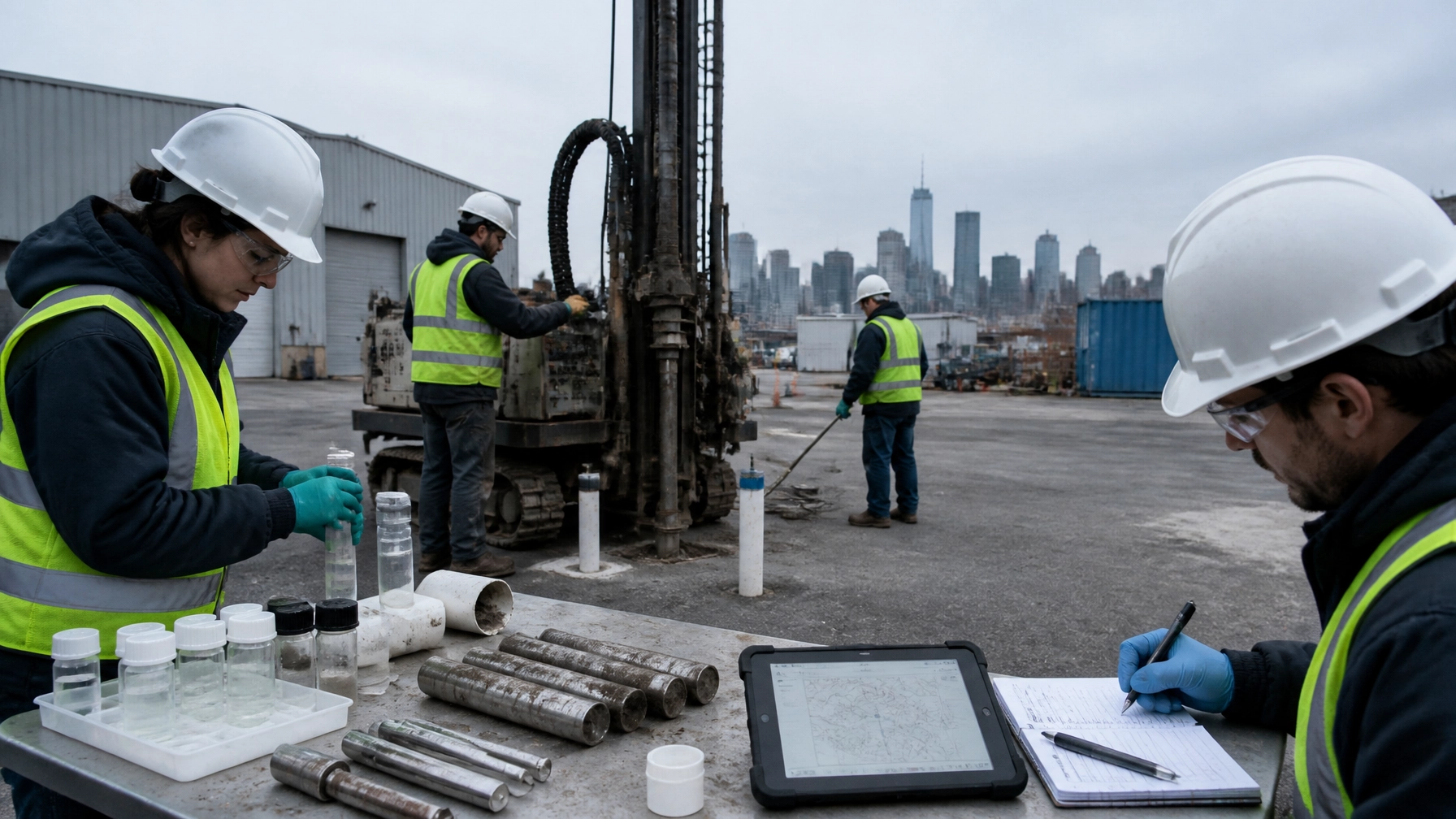
A 2026 commercial property closing in Newark, Jersey City, Hoboken, Bayonne, or another industrial market can turn on one question: Does New Jersey’s Industrial Site Recovery Act apply, and has the transaction triggered an environmental obligation?
For buyers and sellers, the answer affects the purchase agreement, lender underwriting, remediation budget, closing date, and future redevelopment plans.
Envicon provides NJDEP LSRP services in Newark, Jersey City, Hudson County, Essex County, and surrounding New Jersey markets. We help transaction teams identify the trigger, organize the technical record, coordinate with counsel, and create a defensible path to regulatory closure.
“Notification to the NJDEP must occur within 5 calendar days after the ISRA triggering event.”
Source: NJDEP General Information Notice instructions
ISRA applicability starts with the property’s operating history
ISRA generally applies to an “industrial establishment” when the operation meets the applicable industrial classification requirements, operated in New Jersey on or after December 31, 1983, and used or stored hazardous substances or hazardous wastes.
The property may qualify even if the current use is no longer industrial. A former manufacturing building converted to warehouse space, a former chemical facility proposed for residential redevelopment, or a former dry-cleaning property may still require a careful ISRA analysis.
The review should examine:
- Current and historical NAICS or SIC classifications
- Hazardous substances and hazardous wastes used or stored onsite
- Former tanks, process areas, floor drains, pits, and waste handling areas
- Prior spills, discharge reports, NJDEP correspondence, and enforcement matters
- Existing PA, SI, RI, remedial action, RAO, deed notice, or permit records
- Whether multiple tenants operated separate industrial establishments
For a NJDEP LSRP Jersey City property sale, this review should happen before the parties finalize a closing schedule. The same applies to an industrial acquisition in Newark, Harrison, Hoboken, Bayonne, Bergen County, or Essex County.
What events can trigger ISRA?
ISRA triggering events can include more than the final transfer deed. Depending on the facts, a trigger may occur when a party:
- Executes an agreement to transfer ownership of the industrial establishment or property
- Sells or transfers the operating business
- Ceases all or substantially all regulated operations
- Transfers or assigns certain leasehold interests
- Executes a qualifying long-term lease
- Changes operations in a way that changes the primary industrial classification
- Transfers a controlling corporate interest or undergoes a qualifying merger
- Enters certain dissolution, bankruptcy, foreclosure, or receivership situations
A signed agreement of sale can therefore create an ISRA issue before the scheduled closing date. The specific facts, transaction documents, operating status, exemptions, and applicable rule provisions control.
Do not assume that a Phase I ESA alone resolves the issue. A Phase I can identify recognized environmental conditions, but ISRA applicability is a separate regulatory and transaction question.
General Information Notice timing is short
Once an ISRA triggering event occurs, the owner or operator generally must submit a General Information Notice, or GIN, within five calendar days.
Calendar days matter. Weekends and holidays count.
The GIN is typically submitted through NJDEP Online for non-confidential submissions. NJDEP also provides separate instructions for confidential submissions and related forms through its Site Remediation Program forms page.
The GIN should not be treated as a routine closing checklist item. The transaction team must first identify the correct trigger date. That date may be the execution of an agreement, cessation of operations, or another event identified under the applicable ISRA provisions.
A missed deadline can create avoidable regulatory exposure and complicate negotiations between the buyer and seller.
LSRP retention and the path from PA to RAO
For an ISRA-triggered matter, the owner or operator generally must retain and notify NJDEP of a Licensed Site Remediation Professional within 45 days of the triggering event.
The LSRP helps determine the technical scope, manages regulatory submissions, oversees investigation and remediation, and may issue the Response Action Outcome when the applicable requirements are complete.
The technical sequence commonly includes the following steps.
1. Preliminary Assessment
The Preliminary Assessment, or PA, reviews historical records, current operations, site reconnaissance, hazardous substance use, and Areas of Potential Environmental Concern.
The PA helps determine whether additional investigation is necessary. It also gives the transaction team an early view of potential cost and schedule exposure.
2. Site Investigation
If the PA identifies areas requiring further evaluation, the Site Investigation, or SI, uses targeted sampling to evaluate soil, groundwater, soil vapor, or other relevant media.
Sampling locations should reflect actual site history. A generic grid may miss a former waste storage area, dry well, UST, loading dock, process line, or drainage pathway.
3. Remedial Investigation
If the SI confirms contamination above applicable standards, the Remedial Investigation, or RI, defines the horizontal and vertical extent of the impact and evaluates exposure pathways.
The RI supports remedial design and helps the project team understand whether the site can support the proposed use, including residential, commercial, industrial, or mixed-use redevelopment.
4. Remedial action and RAP obligations
Remedial action may include excavation, offsite disposal, soil treatment, groundwater treatment, vapor mitigation, capping, institutional controls, or a combination of measures.
Where residual contamination remains, the project may require a Remedial Action Permit, or RAP, for ongoing obligations. A RAP can establish continuing requirements for engineering controls, groundwater monitoring, biennial certifications, inspection, maintenance, or reporting.
Engineering controls can include:
- Soil caps and clean cover systems
- Concrete slabs or asphalt barriers
- Vapor barriers and sub-slab depressurization systems
- Groundwater treatment systems
- Containment structures
- Impermeable liners or other physical barriers
Institutional controls may include deed notices, groundwater use restrictions, classification exception areas, or land use restrictions. These controls can support closure, but they create long-term responsibilities that the buyer must understand before closing.
5. Response Action Outcome
An RAO is issued by the LSRP when the required investigation and remedial action have been completed or when the applicable controls and monitoring requirements are properly established.
An RAO may support regulatory closure under unrestricted or restricted-use conditions. It does not eliminate the need to review the underlying reports, continuing obligations, deed notices, RAP requirements, or redevelopment limitations.
The NJDEP PA and SI guidance provides a useful starting point for understanding how remediation is initiated and progressed.

Buyer and seller responsibility must be separated clearly
The current owner or operator generally carries the statutory responsibility for addressing ISRA obligations. However, the purchase agreement can allocate the economic cost, control of the environmental work, access rights, indemnities, escrow, and post-closing duties between the parties.
That contractual allocation does not automatically release a party from obligations owed to NJDEP.
Seller considerations
The seller should:
- Confirm ISRA applicability before signing the agreement
- Identify the actual triggering event and deadline
- File the GIN when required
- Retain an LSRP within the applicable timeframe
- Provide prior environmental reports and NJDEP correspondence
- Disclose known discharges, open cases, controls, and monitoring obligations
- Define whether the seller will complete remediation before closing
- Establish a defensible plan for any post-closing work
Buyer considerations
The buyer should:
- Order a Phase I ESA early
- Consider a Phase II ESA or PA where conditions warrant
- Review NJDEP case status and prior RAOs
- Confirm whether the proposed redevelopment changes the risk profile
- Review engineering and institutional controls
- Require access for sampling and verification
- Negotiate closing conditions, escrows, indemnities, and post-closing covenants
- Obtain lender and counsel approval for any incomplete remediation
A buyer may acquire a property before full remediation is complete, but that decision requires careful legal and technical structuring. The purchase agreement should address who controls the LSRP relationship, who pays for additional work, who maintains the RAP, and what happens if NJDEP requires more investigation after closing.
2026 ISRA transaction closing timeline
The following is a planning framework, not a substitute for transaction-specific legal advice.
| Timing | Recommended action |
|---|---|
| 90 to 120 days before closing | Review historical use, NAICS or SIC classifications, NJDEP records, prior reports, and known discharges. |
| 60 to 90 days before closing | Complete or update the Phase I ESA. Determine whether a PA, SI, or Phase II ESA is appropriate. |
| Before signing or immediately after signing | Confirm whether the agreement creates an ISRA triggering event. Coordinate with environmental counsel. |
| Within 5 calendar days of the trigger | Submit the GIN when required under current ISRA rules. |
| Within 45 days of the trigger | Retain and notify NJDEP of the LSRP when required. |
| Weeks 2 through 8 | Complete PA or SI work, identify data gaps, and develop the remediation schedule. |
| Three months and beyond | Advance RI, remedial design, RAP requirements, controls, monitoring, and RAO strategy as applicable. |
| Before closing | Confirm documentation, escrow, indemnity, access, lender approval, and post-closing responsibilities. |

Why local LSRP coordination matters
A transaction in Newark is not identical to one in Jersey City. A waterfront parcel in Hudson County may involve groundwater, vapor, fill, flood exposure, and redevelopment controls. A former industrial property in Essex County may present different historical operations, records, and access constraints.
The work also requires coordination among:
- Real estate counsel
- Environmental counsel
- Lenders and underwriters
- Developers and investors
- Architects and civil engineers
- Contractors and demolition teams
- NJDEP and local officials
Envicon keeps the technical work connected to the closing objective. We do not hand over a report and leave the transaction team to interpret it. We identify the environmental path, track the milestones, and communicate directly with the people responsible for the deal.
That is the difference between ordering an environmental report and obtaining NJDEP case closure before closing.

Final takeaway
ISRA can affect a New Jersey property transaction before the deed changes hands. A signed agreement, operating closure, ownership transfer, or other qualifying event may start the GIN and LSRP deadlines.
For an LSRP for brownfield acquisition in New Jersey, start with four questions:
- Does the property qualify as an industrial establishment?
- What event triggers ISRA, and on what date?
- What investigation or remediation remains?
- Who will carry the technical, financial, and regulatory responsibilities after closing?
Current statutes, regulations, NJDEP guidance, transaction documents, and counsel guidance control. Have the property reviewed before the deadline controls the deal.
Request an LSRP transaction review
If you’re buying or selling an industrial or brownfield property in Newark, Jersey City, Hoboken, Bayonne, Bergen County, Hudson County, or Essex County, Envicon can review the transaction timeline and outline the next steps.
- Request an LSRP transaction review
- Call Envicon now at (917) 764-2171
- Run the proprietary project risk screener
- Contact the Envicon team
Precision, speed, and trust are how complex sites become buildable assets.