New Jersey’s June 15, 2026 amendments to the Technical Requirements for Site Remediation change how many Phase II investigations must be scoped.
Under amended N.J.A.C. 7:26E-2.1(c), investigators must analyze for GenX chemicals, PFNA, PFOS, PFOA, 2,3,7,8-TCDD, and other required parameters when hazardous substances at an Area of Concern are unknown or not well documented.
That matters for industrial property PFAS due diligence in Newark, Jersey City, Hoboken, Bayonne, Hudson County, Bergen County, and Essex County.
The issue is not simply whether PFAS were known to be used at the property. The issue is whether the site history is strong enough to show what was used, stored, discharged, or released at each Area of Concern.
If it is not, the Phase II scope gets broader.
What changed under NJDEP PFAS baseline sampling 2026 rules?
The June 2026 rulemaking formalized PFAS standards and amended the analytical requirements in N.J.A.C. 7:26E.
For an AOC where contaminants are unknown or poorly documented, the required analytical list now includes:
- GenX chemicals
- PFNA, or perfluorononanoic acid
- PFOS, or perfluorooctane sulfonate
- PFOA, or perfluorooctanoic acid
- 2,3,7,8-TCDD
- TCL plus TICs and TAL
- Hexavalent chromium
- Extractable petroleum hydrocarbons
- pH
The exact scope still depends on the environmental media and site conditions. “All media” does not mean every project must sample air, sediment, groundwater, and soil regardless of site conditions. It means that the required analytes must be included across the applicable environmental media being investigated.
That can include:
- Soil
- Groundwater
- Surface water
- Sediment
- Soil vapor pore spaces
- Air, where an applicable pathway and method exist
The controlling source is the NJDEP courtesy copy of N.J.A.C. 7:26E, dated June 15, 2026.
Why unknown or poorly documented AOCs create a larger Phase II
An Area of Concern is not limited to a leaking underground storage tank. Under the Tech Regs, an AOC can include a former tank, loading area, process floor drain, sump, waste storage area, dry well, stormwater system, discharge area, fill area, or environmental medium where contamination may have migrated.
In Newark or Bayonne, that can mean multiple historic operations layered on top of one another. In Jersey City or Hoboken, the concern may involve industrial fill, former manufacturing, waterfront operations, rail infrastructure, or redevelopment over a property with incomplete records.
An AOC may be considered poorly documented when:
- Former operators cannot be identified.
- Historical plans are incomplete or unavailable.
- The property changed ownership several times.
- Chemical storage or waste handling records are missing.
- A previous consultant identified contamination but did not define the source.
- Historic fill obscures the original site grade and use.
- Existing environmental reports list “unknown source” conditions.
- The property was part of a larger industrial complex.
- Former tenants used shared drains, sumps, utilities, or loading areas.
A Phase I may identify the risk. The Phase II must resolve it.

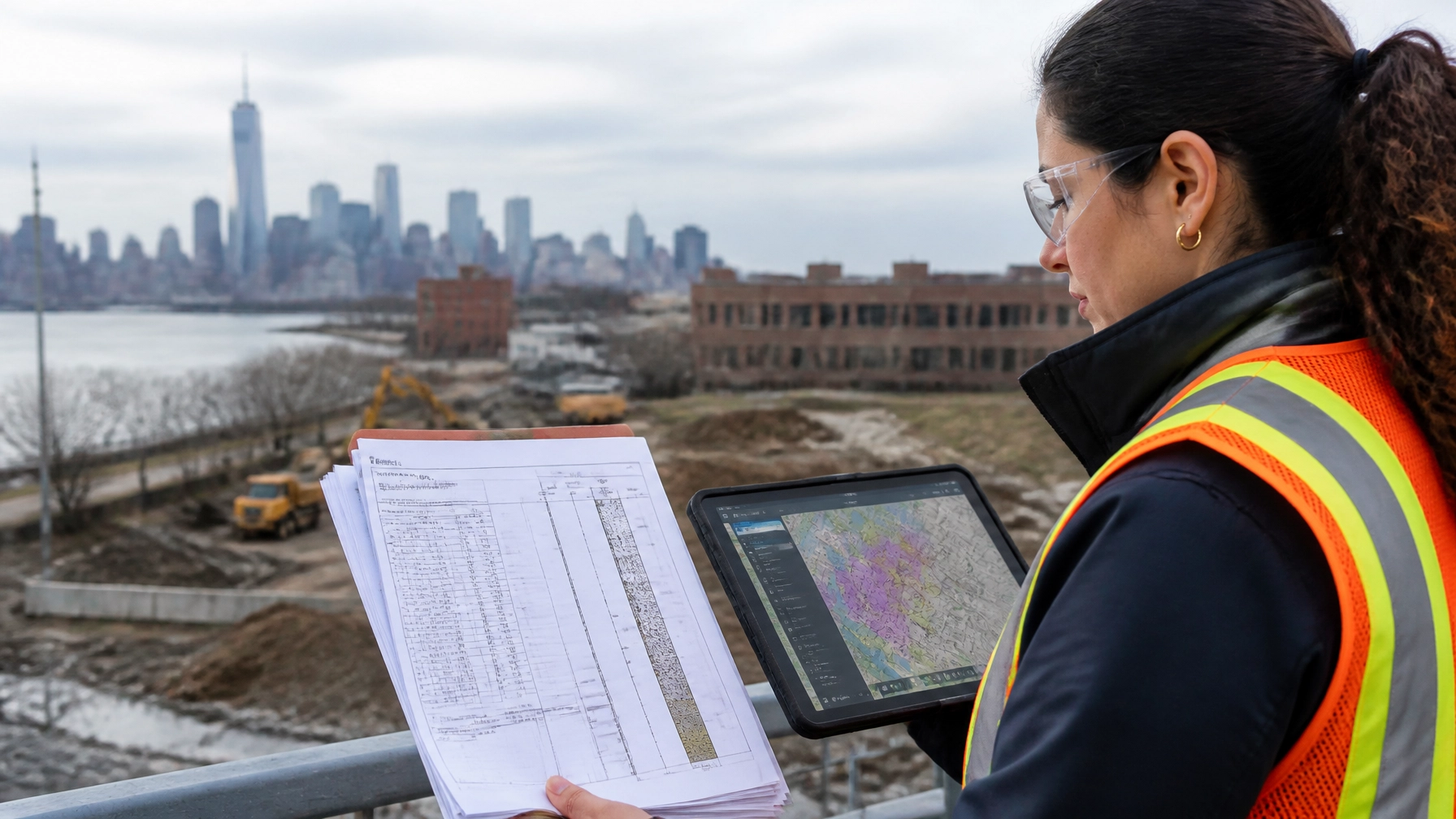
NJDEP PFAS baseline Phase II Newark: start with site history
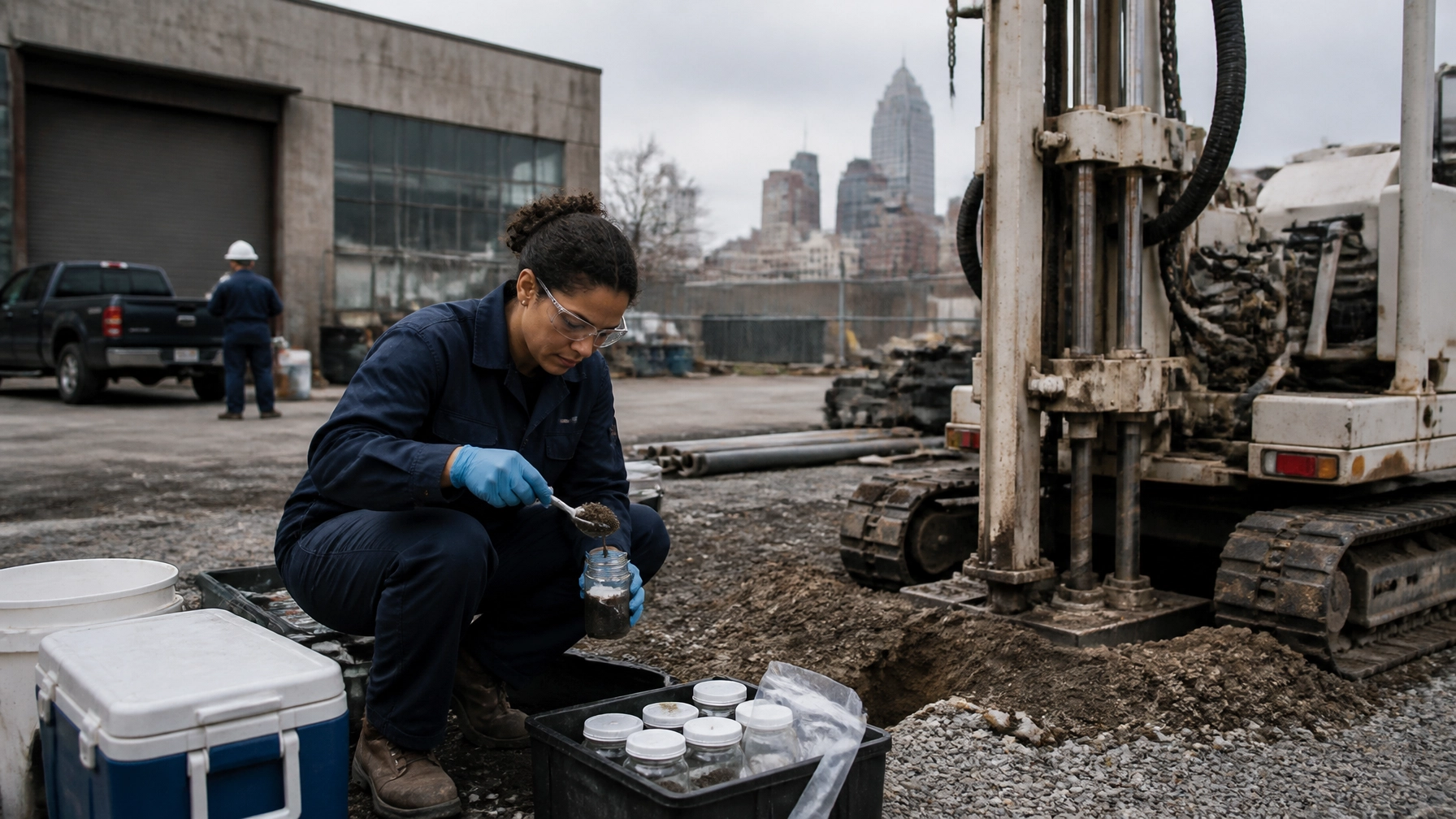
The best sampling plan starts before the drill rig arrives.
NJDEP’s 2024 Field Sampling Procedures Manual places site history, physical setting, sample locations, laboratory selection, and quality assurance inside the sampling plan process.
For a Newark warehouse or industrial parcel, we review:
- Historical Sanborn fire insurance maps
- Aerial photographs and topographic maps
- City directories and industrial records
- NJDEP case files and DataMiner information
- Previous Phase I, Phase II, and remedial reports
- UST and aboveground storage tank records
- Building plans and drainage layouts
- Former tenant operations
- Fire-training, plating, textile, metal, chemical, and manufacturing uses
- Historic fill placement and imported material sources
- Nearby properties that may have contributed off-site impacts
The goal is to classify each AOC as documented, partially documented, or unknown.
That classification affects the analytical scope, number of samples, laboratory method, field controls, and cost.
Unknown AOC PFAS testing Jersey City: what the field plan should address
For unknown AOC PFAS testing in Jersey City, the sampling plan should connect each sample to a specific question.
Examples include:
- Did the former loading area affect shallow soil?
- Is groundwater impacted beneath the former process floor?
- Did a dry well or storm sewer create a migration pathway?
- Is historic fill contributing to groundwater impacts?
- Could contamination have migrated from an adjacent parcel?
- Does the proposed construction excavation create a soil management issue?
- Are results needed for a private acquisition, NJDEP case, ISRA transaction, or both?
A defensible plan identifies the sample locations, depths, matrix, analytes, laboratory method, quality controls, and decision criteria before mobilization.
For PFAS work, field procedures matter as much as the analyte list.
NJDEP’s PFAS Sampling Fact Sheet states:
“The Department is requesting that the full list of PFAS compounds analyzed and reported by the respective analytical methods be reported.”
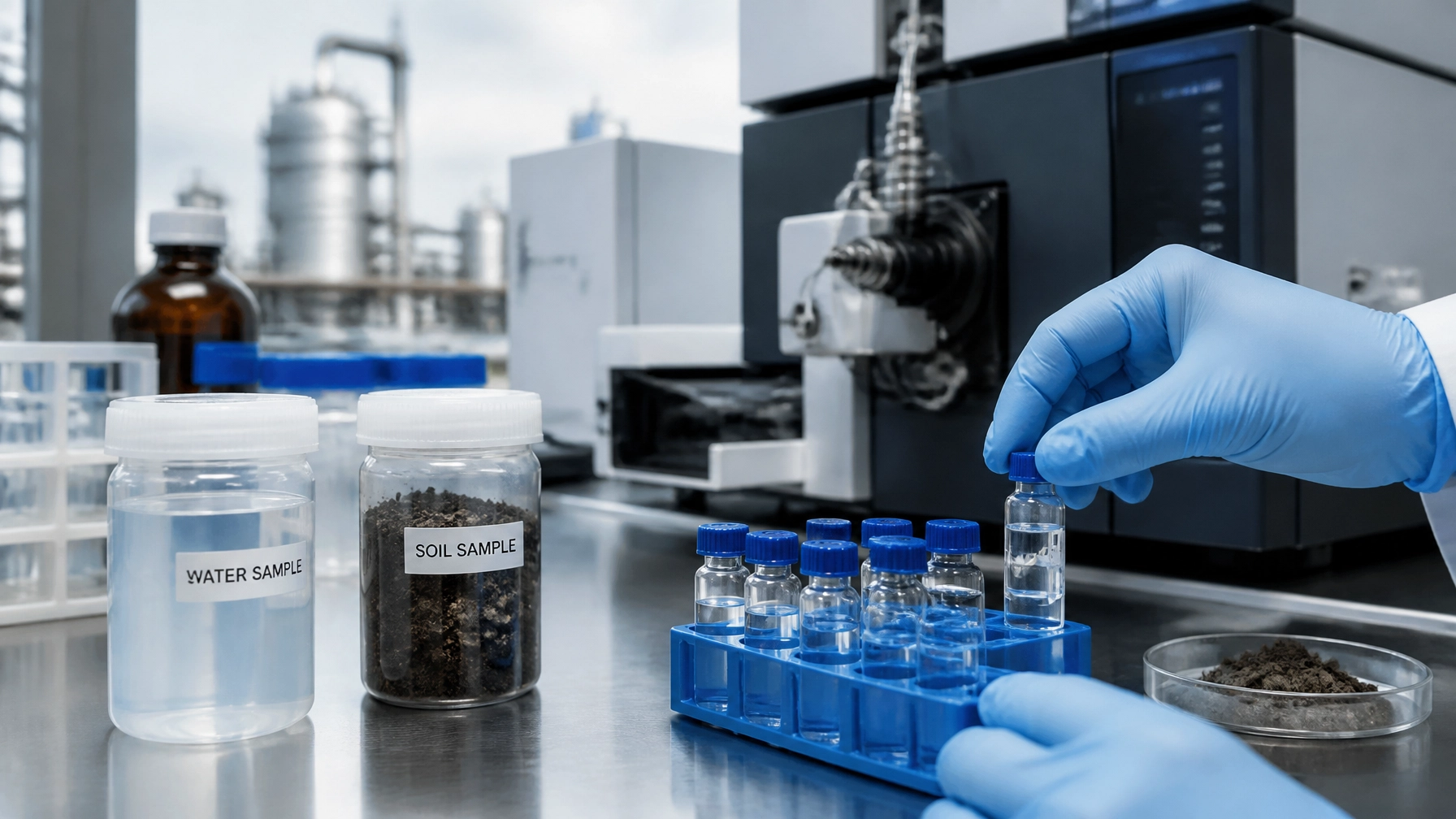
That means a laboratory should not selectively report only the four compounds that appear most familiar. The project team must understand the full target list generated by the selected method and make sure the report identifies detections, non-detects, reporting limits, and any data usability concerns.
PFAS field QA/QC is not optional
PFAS exists in many common products and materials. Cross-contamination can compromise results at very low concentrations.
A project-specific QAPP and Sampling and Analysis Plan should address:
- PFAS-free water for equipment and field blanks
- Field reagent blanks where applicable
- Equipment rinsate blanks based on project objectives
- Matrix spike and matrix spike duplicate samples
- Sample containers supplied or approved by the laboratory
- Chain of custody and temperature control
- Clean, powder-free nitrile gloves
- Avoidance of PTFE, Teflon, fluoropolymer tubing, and similar materials
- PFAS sampling before other sampling that may use fluoropolymer materials
- Low-flow or passive groundwater sampling where appropriate
- No field filtration unless the method and project objectives support it
- Documentation of drilling water, bentonite, well materials, and decontamination products
- Separate handling of potentially high-concentration samples and investigation-derived waste
For groundwater, turbidity deserves attention. NJDEP’s fact sheet notes that low-flow or passive methods are preferred when turbidity could bias results. Samples should not be filtered in the field because adsorption can create a negative bias.

7:26E PFAS all media requirement versus private transaction scope
A regulatory investigation and a private transaction investigation are related, but they are not identical.
A private buyer may want a focused Phase II to price risk before closing. NJDEP, an LSRP, or an ISRA pathway may require a broader investigation that supports regulatory decision-making and eventual closure.
The scope should make that distinction clear.
| Situation | Likely scope | Key issue |
|---|---|---|
| Well-documented AOC with defined contaminants | Targeted analytes and media tied to the documented release | The records must support the exclusion of PFAS |
| Unknown or poorly documented AOC | Baseline analytes, including PFNA, PFOA, PFOS, GenX, and 2,3,7,8-TCDD, across applicable media | The 7:26E requirement drives broader testing |
| Private acquisition with no NJDEP case | Transaction-focused Phase II with lender and buyer objectives | The report may not satisfy future NJDEP obligations |
| ISRA-triggered industrial transfer | PA/SI, LSRP oversight, and regulatory reporting under NJDEP requirements | Timing and documentation must align with ISRA |
| Existing NJDEP case with PFAS information | Scope determined through the LSRP’s professional judgment and regulatory requirements | Existing data must be evaluated for usability |
| Positive PFAS result | Additional delineation, receptor review, and potential remedial action | Cost and schedule can expand quickly |
A private Phase II can be narrower than a regulatory site investigation. It should not be presented as equivalent unless the scope, documentation, and reporting requirements support that conclusion.
Cost and schedule planning
Envicon’s Phase II ESA process typically runs three to five weeks, including laboratory work, when access, drilling, laboratory capacity, and scope are confirmed. PFAS may add coordination time because the laboratory must confirm methods, containers, preservatives, reporting limits, and target analytes before field work.
The cost depends on:
- Number of AOCs
- Number and depth of borings
- Need for monitoring wells
- Soil, groundwater, sediment, or surface water matrices
- PFAS analytical method and target list
- Conventional contaminants analyzed alongside PFAS
- Access restrictions and utility clearance
- Historic fill and groundwater conditions
- Investigation-derived waste management
- Data validation requirements
- Whether the work supports a private transaction or NJDEP case
For context, Envicon’s Jersey City environmental services page identifies a typical Phase II ESA range of $8,000 to $25,000 for soil and groundwater investigations. A PFAS baseline scope involving multiple unknown AOCs or all applicable media may fall outside that range.
The right answer is not the cheapest sample plan. It is the smallest defensible plan that answers the regulatory and business question.
How Envicon approaches the work
We do not treat PFAS as a laboratory add-on after the sampling plan is finished.
Our Phase II ESA team coordinates:
- Site history and AOC review
- NJDEP and ISRA implications
- LSRP involvement where required
- Sampling and Analysis Plan development
- PFAS-specific QA/QC
- Certified laboratory coordination
- Field documentation and chain of custody
- Data usability review
- Comparison to applicable standards
- Cost and schedule implications
- Next-step recommendations
When the property is subject to NJDEP oversight, our NJ LSRP services connect the Phase II scope to the broader path toward delineation, remediation, RAO, or other closure strategy.
You should know what the data means before you commit to the next phase.
The takeaway
In 2026, an unknown AOC is not a blank space in the scope. It is a reason to investigate more carefully.
For industrial properties in Newark, Jersey City, Hoboken, Bayonne, Hudson, Bergen, and Essex, incomplete records can trigger broader PFAS analysis under N.J.A.C. 7:26E. The practical response is a clear site history, a defensible sampling plan, PFAS-specific QA/QC, complete laboratory reporting, and an early decision about whether the work supports a transaction, NJDEP case, ISRA obligation, or all three.
If your property has an unknown source, historic fill, incomplete operational records, or an upcoming closing, contact Envicon Group before the scope is finalized.
Ready to scope the investigation?
- Call Envicon now at (917) 764-2171
- Get a free quote today
- Use the proprietary project risk screener
- View the complete list of Envicon services
Precision matters. So does knowing what the data means before it changes your deal.