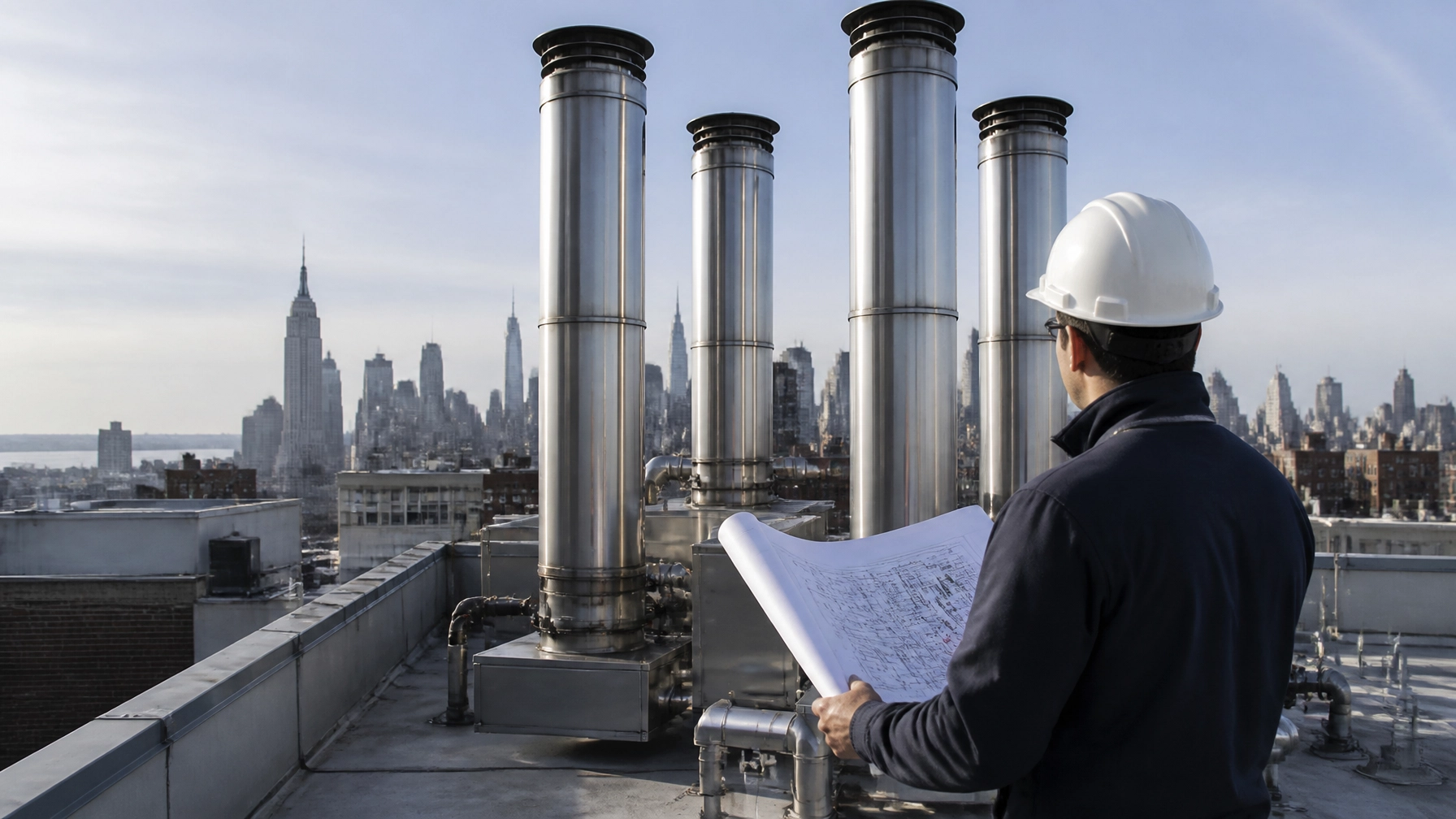
New York facility owners now have more time to meet several greenhouse gas reporting and monitoring obligations under 6 NYCRR Part 253. The New York State Department of Environmental Conservation issued an enforcement-discretion letter on July 31, 2026 that changes when DEC will begin enforcing selected deadlines.
It does not repeal Part 253. It does not eliminate reporting obligations. It gives covered facilities additional time to organize data, prepare monitoring plans, complete registrations, and submit required reports.
For facilities in New York City, Long Island, Westchester, and other industrial markets, the dates below should become part of your compliance calendar now.
The practical meaning of NYSDEC enforcement discretion
The distinction matters.
The underlying Part 253 deadlines remain in the regulation. NYSDEC’s letter states that the agency will exercise discretion regarding enforcement of certain late submissions until the revised dates. Facility owners should treat those revised dates as firm operational deadlines.
A missed deadline can still create problems with:
- Future agency interactions
- Air permit modifications
- Environmental audits
- Property acquisitions and dispositions
- Lender and investor diligence
- Facility expansions or equipment replacements
- Corporate environmental reporting
The safest approach is not to wait until the last day of the enforcement-discretion period. Use the additional time to build a defensible reporting system.
Review the official NYSDEC mandatory greenhouse gas reporting program and read the July 31, 2026 Part 253 enforcement-discretion letter.

NYSDEC Part 253 GHG reporting deadlines 2026 through 2028
The following table summarizes the dates facility owners should use for planning.
| Obligation | Underlying Part 253 date | Enforcement-discretion date or practical deadline |
|---|---|---|
| 2026 emissions data report | June 1, 2027 | December 31, 2027 |
| 2026 emissions verification statement | December 1, 2027 | April 1, 2028 |
| Large emission source monitoring plan | December 31, 2026 | June 30, 2027 |
| Waste facility monitoring plan | September 1, 2026 | March 1, 2027 |
| Electricity source registration | February 1, 2027 | August 31, 2027 |
| 2027 emissions data report | June 1, 2028 | September 1, 2028 |
| 2027 emissions verification statement | December 1, 2028 | No extension identified in the letter |
The schedule applies only to the obligations and facility categories addressed by the enforcement-discretion action. It does not create a blanket extension for every Part 253 requirement.
Normal reporting schedules resume for later reporting years unless NYSDEC issues additional guidance.
Who may be affected?
Part 253 applicability depends on the facility’s emissions profile, source types, operations, and other regulatory criteria. A facility should not assume that its current air permit status answers the Part 253 question.
Potentially affected operations can include:
- Large emission sources that meet the applicable Part 253 criteria
- Solid or liquid waste management facilities
- Facilities with covered units that import or export electricity
- Industrial and commercial operations with significant stationary combustion
- Utilities, manufacturing facilities, institutional plants, and energy-intensive operations
- Facilities undergoing ownership changes, redevelopment, or major equipment upgrades
Facilities in Queens, Brooklyn, the Bronx, Long Island, and Westchester may also have overlapping obligations under existing air permits, NYSDEC reporting programs, NYC requirements, or local construction and operating approvals.
Part 253 analysis should be coordinated with your existing permit file. Do not treat GHG reporting as a separate administrative exercise.
New York GHG monitoring plan deadline 2027
The most immediate planning issue is the monitoring-plan schedule.
Large emission sources should plan to complete their required monitoring plans by June 30, 2027, the date identified for enforcement discretion. Waste facilities should plan around March 1, 2027. Facilities with applicable electricity sources should complete registration by August 31, 2027.
A monitoring plan should be more than a generic narrative. It should explain how the facility will collect, calculate, review, and retain emissions data.
Your plan may need to address:
- Emission source identification
- Fuel and material consumption data
- Metering and measurement methods
- Operating hours and production records
- Emission factors and calculation methods
- Calibration and maintenance procedures
- Quality assurance and quality control
- Missing or incomplete data
- Responsible personnel
- Record retention and verification support
- Changes in equipment, ownership, or operating conditions
The plan should match what happens in the field. If operators collect data one way while the written plan describes another process, the inconsistency can become a problem during verification or inspection.
Prepare records before you prepare the report
The 2026 emissions report deadline may appear distant, but the supporting records are generated every day.
Facility owners should begin assembling a reporting file that includes:
- Monthly fuel purchase and usage records
- Meter readings and calibration documentation
- Equipment operating logs
- Production and throughput data
- Maintenance records
- Stack testing or source-test information
- Existing air permit reports
- Electricity import or export documentation
- Waste processing and throughput records
- Prior emissions inventories
- Correspondence with NYSDEC or other reviewing agencies

A verifier should be able to trace the final report back to the source records without reconstructing the facility’s history from scattered files.
That standard also matters in a transaction. A buyer, lender, or investor will want to know whether the facility can support its reported emissions with organized records. A report without supporting documentation creates uncertainty. Uncertainty becomes a negotiating issue.
Coordinate Part 253 with air permitting
GHG reporting should align with the facility’s air permit, source inventory, and compliance reporting systems.
Start by comparing:
- Source identification numbers
- Equipment descriptions
- Fuel types
- Permitted operating limits
- Actual operating conditions
- Emission factors
- Stack and process information
- Facility ownership and operating entities
- Permit modifications or pending applications
A change in fuel, production rate, combustion equipment, control technology, or operating schedule may affect more than one compliance program. The Part 253 report should not conflict with Title V records, state facility permits, emission statements, or other agency submissions.
For facilities planning construction, expansion, or redevelopment, the review should also include whether proposed work changes source applicability or requires permit coordination.
Envicon supports this work through compliance and permitting services, including air emissions reporting, permit coordination, compliance audits, recordkeeping systems, and agency communication.
Transaction diligence for industrial properties
Part 253 belongs in environmental transaction diligence for industrial properties.
For a buyer evaluating a facility in Long Island, Westchester, or New York City, request:
- The facility’s Part 253 applicability analysis
- Monitoring plans and registration records
- 2026 and 2027 emissions data
- Verification statements
- NYSDEC correspondence
- Air permits and recent modifications
- Compliance certifications
- Notices of violation or open corrective actions
- Metering, calibration, and source records
- Capital needs required to maintain compliant monitoring
Sellers should identify gaps before the property enters a formal diligence period. Waiting for the buyer’s consultant to discover an incomplete monitoring plan can delay closing and reduce negotiating leverage.
A practical diligence question is simple: Could an independent verifier understand how this facility calculated its emissions and reproduce the result from the records available?
If the answer is no, the facility needs a reporting-readiness review.
What facility owners should do now
Use the enforcement-discretion period to complete specific work, not to defer it.
Recommended next steps
-
Confirm applicability. Review Part 253 definitions, source categories, facility operations, and electricity or waste-related activities.
-
Build a source inventory. Reconcile Part 253 sources with the current air permit and facility equipment list.
-
Assign ownership. Identify the person responsible for monthly data collection, quality control, reporting, and agency correspondence.
-
Prepare the monitoring plan. Document the actual measurement and calculation process used at the facility.
-
Create a records index. Store fuel, meter, maintenance, production, testing, and permit records in one inspection-ready system.
-
Check verification readiness. Identify missing records before the 2026 verification statement deadline of April 1, 2028.
-
Coordinate with transactions. Include Part 253 obligations in purchase agreements, environmental representations, indemnities, and closing conditions.
-
Track agency guidance. Review the NYSDEC GHG reporting page for updates and revised forms.
The bottom line
The July 31, 2026 letter provides useful time, but it does not remove the compliance obligation.
For planning purposes, New York facility owners should remember these dates:
- Waste facility monitoring plans: March 1, 2027
- Large emission source monitoring plans: June 30, 2027
- Electricity source registrations: August 31, 2027
- 2026 emissions data report: December 31, 2027
- 2026 verification statement: April 1, 2028
- 2027 emissions data report: September 1, 2028
The strongest position is an organized one. Know which sources are covered, document how measurements are taken, reconcile the data with air permitting, and maintain records that can withstand verification.
Enforcement discretion buys time. It does not replace preparation.
Sources
- NYSDEC Mandatory Greenhouse Gas Reporting
- NYSDEC July 31, 2026 Enforcement-Discretion Letter for 6 NYCRR Part 253
- NYSDEC Part 253 Enforcement-Discretion FAQ
Request a Part 253 reporting-readiness review
Envicon helps New York facility owners, industrial operators, developers, lenders, and transaction teams evaluate GHG reporting obligations, monitoring plans, air permit coordination, and verification readiness.
Request a consultation or learn about Envicon compliance and permitting services.
You can also call (917) 764-2171 to speak with our team.
We solve environmental and engineering challenges with precision, speed, and trust. For Part 253, that means building a reporting process that works in the facility, holds up in review, and keeps the transaction or operation moving.