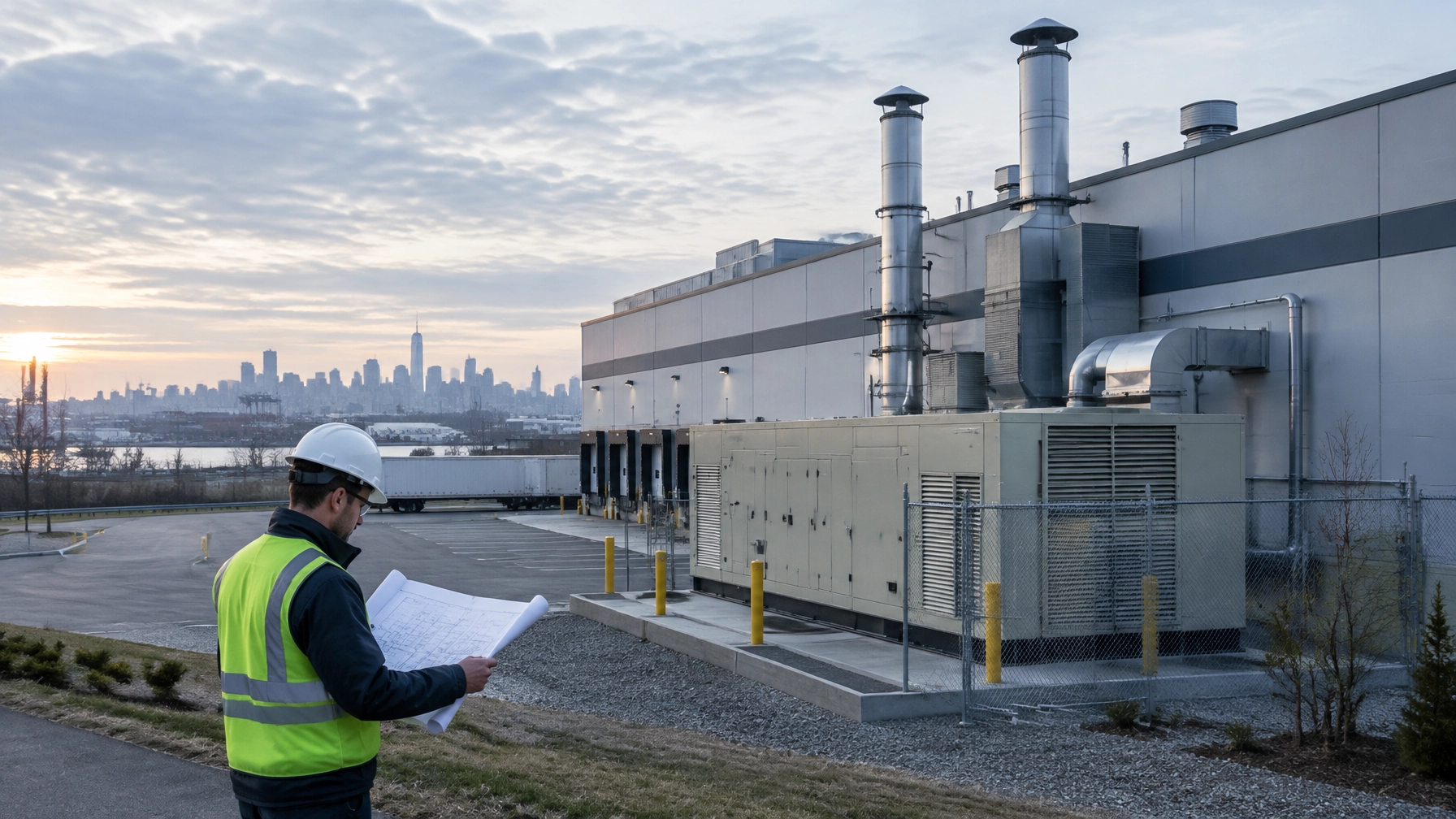
A new generator, conveyor, dust collector, storage tank, or production line can change a New Jersey facility’s air permitting obligations before the equipment ever starts.
That matters for industrial and warehouse operators in Newark, Elizabeth, Kearny, Paterson, and Middlesex County. It also matters for developers performing environmental due diligence for developers in New Jersey. An air permit gap can affect construction schedules, financing, property value, and the cost of taking over an operating facility.
NJDEP’s framework is not one permit for every facility. The correct path depends on the equipment, emissions, facility-wide potential to emit, applicable federal standards, and whether the site is a minor source or a Title V major facility.
The practical rule is simple:
“Permit applicability should be resolved before equipment is ordered, installed, or operated.”
NJDEP air permitting starts with the source, not the building
Under N.J.A.C. 7:27-8, a source that falls into a listed significant-source category generally requires both:
- A preconstruction permit, also called a permit to construct, install, or alter.
- An operating certificate, also called a certificate to operate.
The preconstruction permit authorizes construction or modification. The operating certificate authorizes operation after the equipment is installed.
NJDEP defines equipment broadly. It can include the equipment itself, connected ductwork, vents, stacks, chimneys, and control apparatus.
Common triggers at industrial and warehouse facilities include:
- Commercial fuel-burning equipment at or above 1,000,000 BTU per hour.
- Stationary material handling equipment using pneumatic, bucket, or belt conveying systems.
- Storage tanks over applicable capacity or vapor-pressure thresholds.
- Solid material storage equipment.
- Surface coating, cleaning, welding, or processing equipment.
- Stationary reciprocating engines at or above 37 kilowatts, subject to the emergency-generator provisions.
- Equipment that emits regulated air contaminants, including VOCs, particulate matter, NOx, CO, and hazardous air pollutants.
The fact that equipment is inside a warehouse does not automatically make it exempt. Indoor operations can still vent through a stack, affect facility-wide emissions, or trigger a source-specific requirement.
The New Jersey air permit hierarchy
Permit to construct and certificate to operate
For a minor facility, or a major facility that does not yet hold a Title V operating permit, NJDEP generally regulates significant source equipment through Subchapter 8.
The permit to construct must be obtained before a significant source is constructed, installed, or modified. The certificate to operate must be valid before the source operates.
NJDEP states that the preconstruction permit application also serves as the operating certificate application. The two authorizations may be issued together in one document.
Do not confuse ordering equipment with authorization to operate it. Receiving a generator or placing a unit on a foundation does not authorize testing, startup, or normal operation.
Minor source permits
A facility can remain below Title V thresholds and still need permits for individual equipment.
For example, a warehouse may not be a major facility, but it could still need authorization for:
- Emergency generators.
- Boilers or heaters.
- Solid material storage.
- Dust-generating material handling.
- Fuel storage.
- Coating or cleaning operations.
A minor source permit does not mean the facility is free from ongoing obligations. The permit may include operating limits, fuel restrictions, emission limits, testing, monitoring, recordkeeping, and renewal requirements.
General permits
A general permit is a standardized permit and certificate for a defined class of significant sources. NJDEP lists general permits for equipment such as:
- Emergency generators burning distillate or gaseous fuels.
- Boilers and heaters.
- Solid material storage equipment.
- Manufacturing and material handling equipment.
- Temporary equipment.
- Certain storage tanks and solvent operations.
Registration under a general permit can be faster than a case-by-case application. It is not automatic authorization.
The owner must confirm that the equipment meets the general permit’s applicability criteria, submit the correct registration, pay the applicable fee, and operate within every parameter selected during registration.
NJDEP’s Subchapter 8 rule is clear that an incorrect or deficient registration can expose the owner or operator to penalties for operating without a permit.
Permits by rule and assumed exemptions
Operators sometimes refer to an operation as being covered by a “permit by rule.” That term should be used carefully in New Jersey.
NJDEP’s primary framework distinguishes among:
- Significant sources that require permits and certificates.
- Insignificant sources that do not require a permit under the applicable criteria.
- General permits that require registration.
- Facility-wide operating permits for major sources.
A facility should not assume that an equipment category is covered simply because another state uses a permit-by-rule system or because a vendor describes the equipment as “exempt.”
The proper question is whether the source is:
- Exempt under the specific New Jersey rule.
- An insignificant source under the applicable threshold.
- Eligible for a general permit.
- Subject to a case-by-case preconstruction permit.
- Required to be included in a Title V operating permit.
That determination should be documented before installation.
When does a New Jersey facility become Title V?
NJDEP regulates major facilities under N.J.A.C. 7:27-22.
A facility generally becomes subject to Title V when its potential to emit reaches a major-facility threshold. Key thresholds include:
| Air contaminant | Major facility threshold |
|---|---|
| VOC | 25 tons per year |
| NOx | 25 tons per year |
| Carbon monoxide | 100 tons per year |
| PM10 | 100 tons per year |
| PM2.5 | 100 tons per year |
| Sulfur dioxide | 100 tons per year |
| Lead | 10 tons per year |
| Any single HAP | 10 tons per year |
| Combined HAPs | 25 tons per year |
These are screening thresholds, not a substitute for a facility-specific applicability analysis.
Potential to emit means the maximum capacity of a source or facility to emit under its physical and operational design. Federally enforceable limits on hours, production, fuel use, or material throughput can affect that calculation. Without enforceable restrictions, an owner generally cannot rely on informal operating practices to reduce potential to emit.
A new generator may therefore matter even if it operates only during outages. A facility’s permit applicability analysis must consider the unit’s rated capacity, fuel, operating restrictions, emergency-use provisions, and applicable federal standards.
Minor modification versus significant modification
For a Title V facility, the change classification determines the review path.
Administrative amendment
An administrative amendment is reserved for limited changes that do not:
- Increase actual emissions.
- Create emissions of a new contaminant.
- Violate an applicable requirement.
- Subject the facility to a new applicable requirement.
- Qualify as a seven-day notice, minor modification, or significant modification.
Typical examples include a company-name change, ownership transfer, contact update, stack designation correction, or certain measurable emission reductions.
Under N.J.A.C. 7:27-22.20, an administrative amendment generally must be submitted before the change, except for certain ownership or identifying-information changes.
Minor modification
A minor modification may apply to a new significant source operation or a change that:
- Increases actual emissions by insignificant amounts.
- Does not increase emissions but may increase ambient concentrations.
- Changes raw materials, production, stack parameters, operating hours, or production rates.
- Introduces a new air contaminant or changes an allowable limit.
A Title V minor modification requires an administratively complete application. EPA and affected states receive a 45-day review period. NJDEP’s final action deadline is generally 90 days after completeness or 15 days after the EPA review period, whichever is later.
Construction or operation may sometimes proceed at the owner’s risk after preconstruction approval. That is not the same as unconditional approval.
Significant modification
A significant modification is required when the change triggers more substantial requirements, including:
- PSD requirements.
- Emission offset requirements.
- NSPS or NESHAP applicability.
- A significant change to federally enforceable monitoring, recordkeeping, or reporting.
- A relaxation of a federally enforceable compliance condition.
- A case-by-case emission limit.
- A change requiring air-quality modeling or a major-source analysis.
Significant modifications require public notice and comment. The facility may generally begin construction after the required preconstruction approval, but it cannot operate the modified facility until NJDEP approves the significant modification.
Emission statements and the calculation logic NJDEP expects
Covered facilities must submit annual emission statements under N.J.A.C. 7:27-21.
NJDEP identifies reporting thresholds including:
- 10 tons per year of VOC.
- 25 tons per year of NOx.
- 5 tons per year of lead.
- 100 tons per year of CO, ammonia, SO2, PM2.5, PM10, TSP, or methane.
Emission statements report actual emissions. They are not the same as a potential-to-emit calculation, but the two must make sense together.
At a conceptual level, a DEQ-005-style emissions calculation follows this logic:
Emission rate = activity or throughput × emission factor × operating time × control adjustment
The supporting file may include:
- Fuel type and annual fuel consumption.
- Generator size and operating hours.
- Material throughput.
- Raw-material composition.
- Storage capacity and vapor pressure.
- Emission factors.
- Control-device efficiency.
- Stack or vent information.
- Production rates and operating limits.
- Actual operating records.
NJDEP requires emission statements to be prepared using RADIUS or its successor. Electronic submissions are due annually by May 15. Non-applicability forms are due by February 1.
The important point is consistency. A new generator, dust collector, storage tank, or material-handling line must be reflected in the facility’s permit analysis and, where applicable, the next emission statement.

Equipment changes that commonly create permit gaps
Before approving a purchase order or construction package, review:
- Standby generators and rental generators.
- Boiler or heater replacements.
- Conveyor systems and pneumatic material handling.
- Grain, aggregate, powder, or recycled-material storage.
- Dust collectors and changes in exhaust routing.
- New loading, unloading, crushing, grinding, or screening equipment.
- Welding, cutting, coating, and solvent-cleaning operations.
- New or modified storage tanks.
- Changes in fuel type.
- Increased production hours or throughput.
- New raw materials or chemicals.
- Stack height, diameter, temperature, velocity, or flow changes.
A dust collector can reduce emissions while still changing the permit analysis. A new stack can change dispersion. A generator can trigger both state and federal requirements. A warehouse conversion can introduce industrial operations that were not present when the existing permit was issued.

Why unpermitted operation becomes expensive
Operating without a required permit creates more than a filing problem.
NJDEP can require the owner to:
- Stop operation.
- Submit a late permit or certificate application.
- Reconstruct historical emissions.
- Prepare engineering calculations.
- Perform testing or modeling.
- Install or upgrade control equipment.
- Pay permit fees and penalties.
- Address violations through an enforcement order or consent agreement.
- Delay construction, financing, leasing, or a property closing.
NJDEP’s Subchapter 8 states that failure to comply may result in civil or criminal penalties. Subchapter 22 also states that filing an application does not stay existing permit conditions or relieve the facility from other legal requirements.
That is why air permitting belongs in acquisition diligence, capital planning, and equipment procurement. It should not begin after the generator arrives.
For developers, air permitting can also intersect with an NJDEP LSRP and the NJ Brownfield Tax Credit. A former industrial property may have unresolved air records, historic equipment, or redevelopment assumptions that need to be tested before closing.
A better permitting process for New Jersey operators
Envicon starts with applicability. We review the facility, equipment list, fuels, materials, operating hours, emissions, existing permits, and planned changes before recommending a filing path.
That can mean:
- A minor source permit.
- A general permit registration.
- A permit revision.
- A Title V administrative amendment.
- A Title V minor modification.
- A Title V significant modification.
- An emission statement update.
- A documented exemption or insignificant-source determination.
We also coordinate directly with NJDEP reviewers when questions arise. You get a clear answer before equipment is purchased, not a long report after the schedule has already slipped.
Our regulatory compliance and permitting team works with owners, developers, contractors, attorneys, architects, and facility managers across New Jersey. We bring the field conditions, calculations, permit history, and project schedule into one decision.
Takeaway
NJDEP air permitting is a decision tree.
The right path depends on the source, emissions, facility-wide potential to emit, equipment changes, and applicable requirements. A general permit is not a blanket exemption. A minor source can still require source-specific authorization. A standby generator can affect Title V status. A dust-generating operation can create a permit obligation that no one identified during procurement.
Solve the applicability question first. Then buy the equipment.
- Call Envicon now at (917) 764-2171
- Use our proprietary project risk screener
- Check us out on LinkedIn