Pending approval. Do not schedule or publish.
New Jersey’s February 2026 remedial action permit modernization changed how owners manage vapor intrusion obligations. Indoor air is now an express RAP media component. The Indoor Air Notification Area, or IANA, creates a formal institutional control for properties where indoor air protections, monitoring, or vapor mitigation remain necessary.
For owners in Newark, Jersey City, Hoboken, Bayonne, Hudson County, Bergen County, and Essex County, this is not just a paperwork update. It affects property transfers, tenant notices, municipal coordination, GIS mapping, mitigation system maintenance, and the path from an active remedy to an RAO or NFA.
The practical question is simple:
What does your property owner need to maintain so the RAP remains protective and transferable?
What changed in February 2026?
NJDEP now recognizes indoor air as a third RAP media component alongside soil and groundwater. The updated framework allows a single combined RAP to address all three media.
NJDEP’s current forms library includes:
- The RAP Initial / New Media Component Application for Soil, Ground Water, and Indoor Air
- The Indoor Air Notification Area Fact Sheet Form
- The Indoor Air Monitoring Plan Spreadsheet for Indoor Air RAP
- The RAP Technical Modification Application for Soil, Ground Water, and Indoor Air
- The RAP Termination or Removal of a Media Component Application
- The Remedial Action Protectiveness / Biennial Certification Form
As of September 2026, owners should verify the version and date of every form directly on the NJDEP CSRR Forms Library before preparing a submission. NJDEP updated several RAP and IANA forms during 2026.
What is an NJDEP Indoor Air Notification Area?
An NJDEP Indoor Air Notification Area is an institutional control established when a property requires long-term management of a vapor intrusion condition or indoor air engineering control.
The IANA defines the area where affected buildings, units, owners, tenants, occupants, municipalities, and other parties may need notice regarding indoor air conditions and continuing obligations. NJDEP maps IANAs as GIS deliverables under N.J.A.C. 7:26C-7.5(c)1.
An IANA may apply when:
- Indoor air concentrations exceed applicable Indoor Air Remediation Standards.
- A completed vapor intrusion pathway requires mitigation.
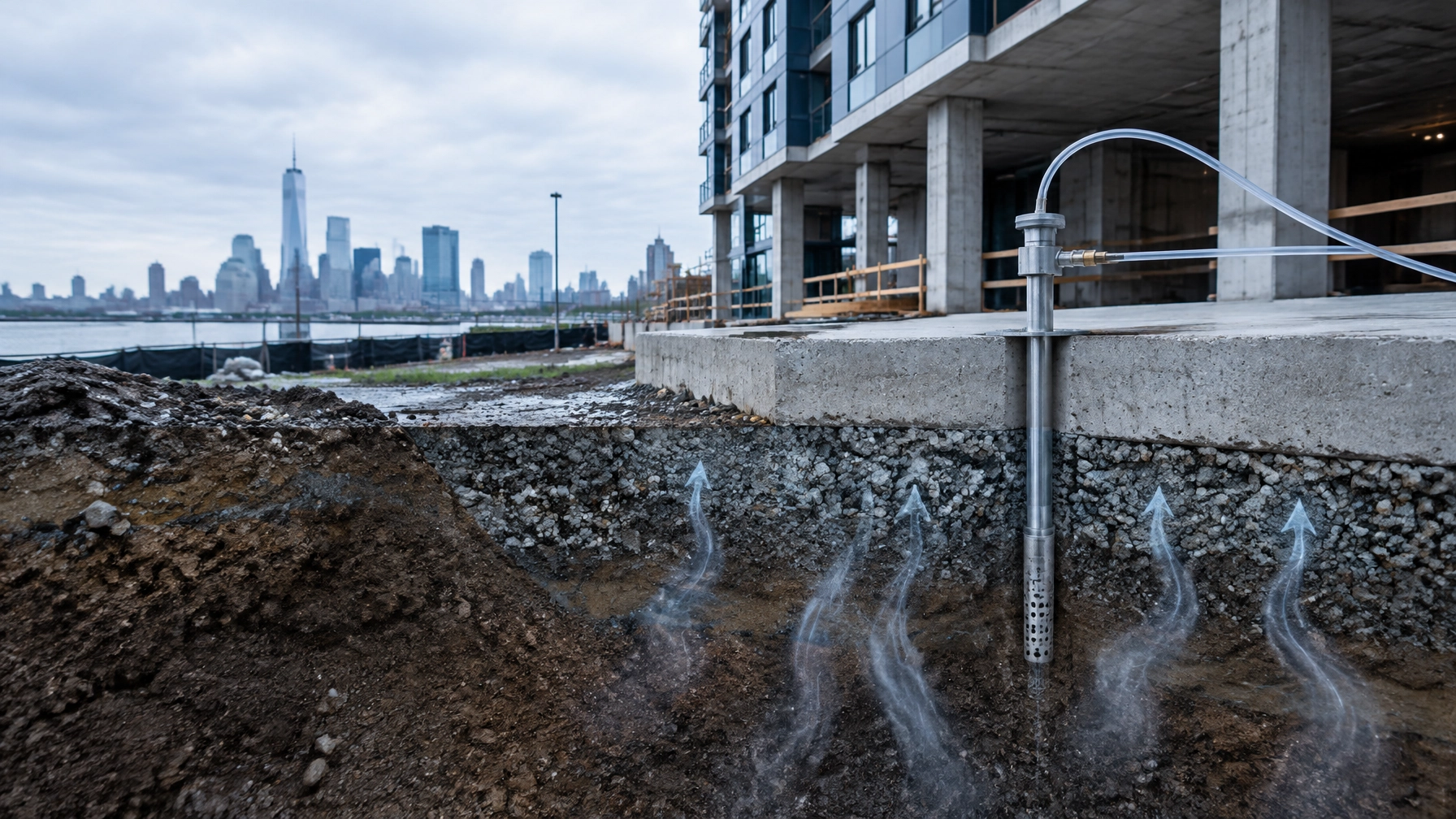
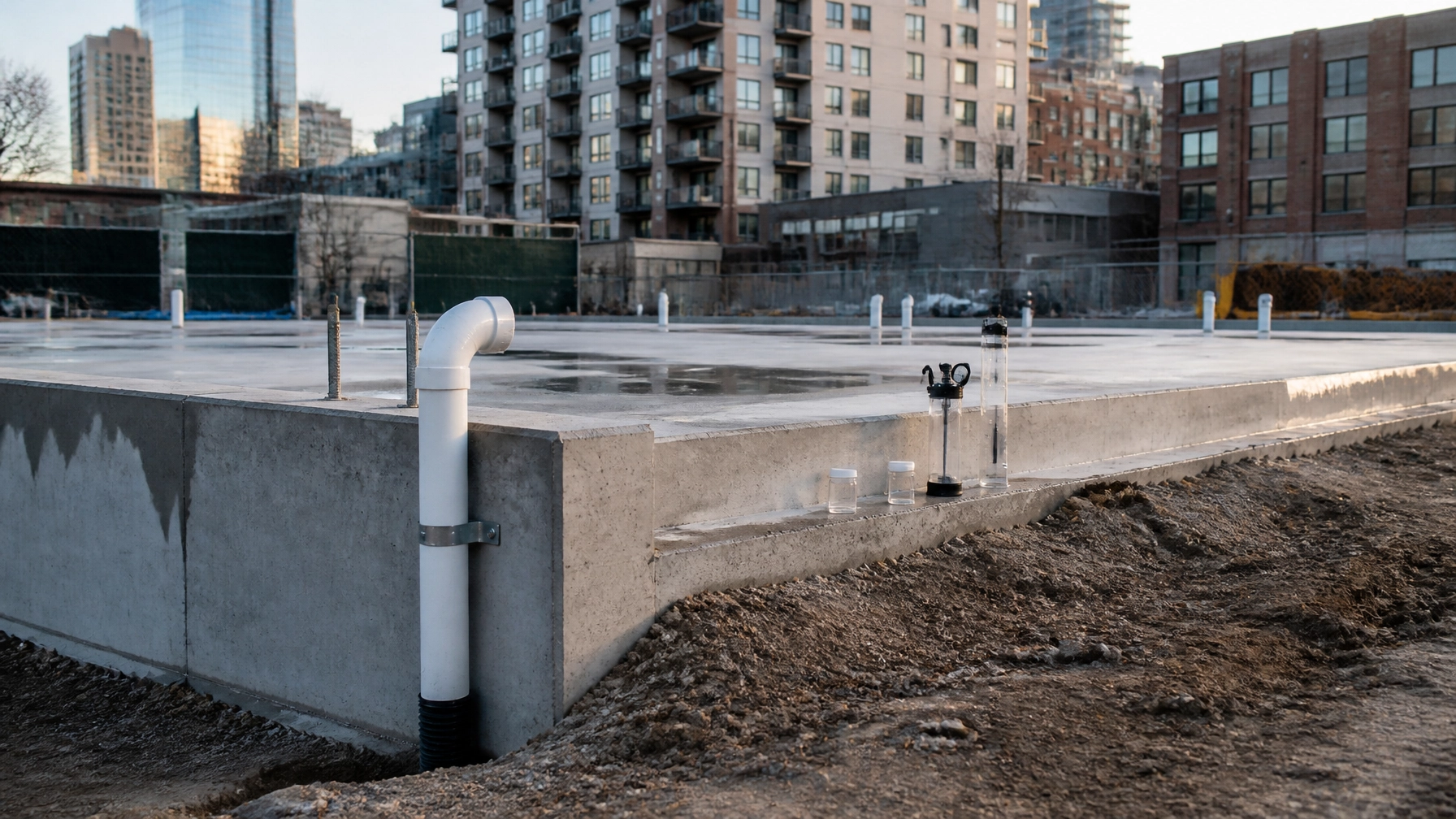
- A sub-slab depressurization system or another vapor mitigation system remains necessary.
- Indoor air or sub-slab vapor monitoring must continue.
- A building or property remains subject to a long-term vapor intrusion monitoring plan.
- A system is installed as part of a soil or groundwater remedy and needs to be added to the RAP.
The IANA is not a substitute for sampling or mitigation. It is the formal notification and control mechanism that helps keep the exposure pathway visible over the life of the property.
IANA institutional control Newark and Jersey City owners need to manage
An IANA should be treated as an operating obligation, not a document filed once and forgotten.
For owners in Newark and Jersey City, the control typically requires coordination among:
- The property owner and current operator.
- Tenants and occupants within affected structures.
- The municipality and county.
- The LSRP responsible for the remediation.
- Building managers and maintenance contractors.
- Environmental counsel and transaction teams.
- NJDEP reviewers and the CSRR GIS unit.
The owner must maintain current information about the affected buildings, units, monitoring points, mitigation systems, and notified parties. A change in ownership, tenant configuration, building use, slab condition, or access can affect the protectiveness evaluation.
The current NJDEP IANA guidance and forms should control the site-specific process.
Sampling and mitigation are only the beginning
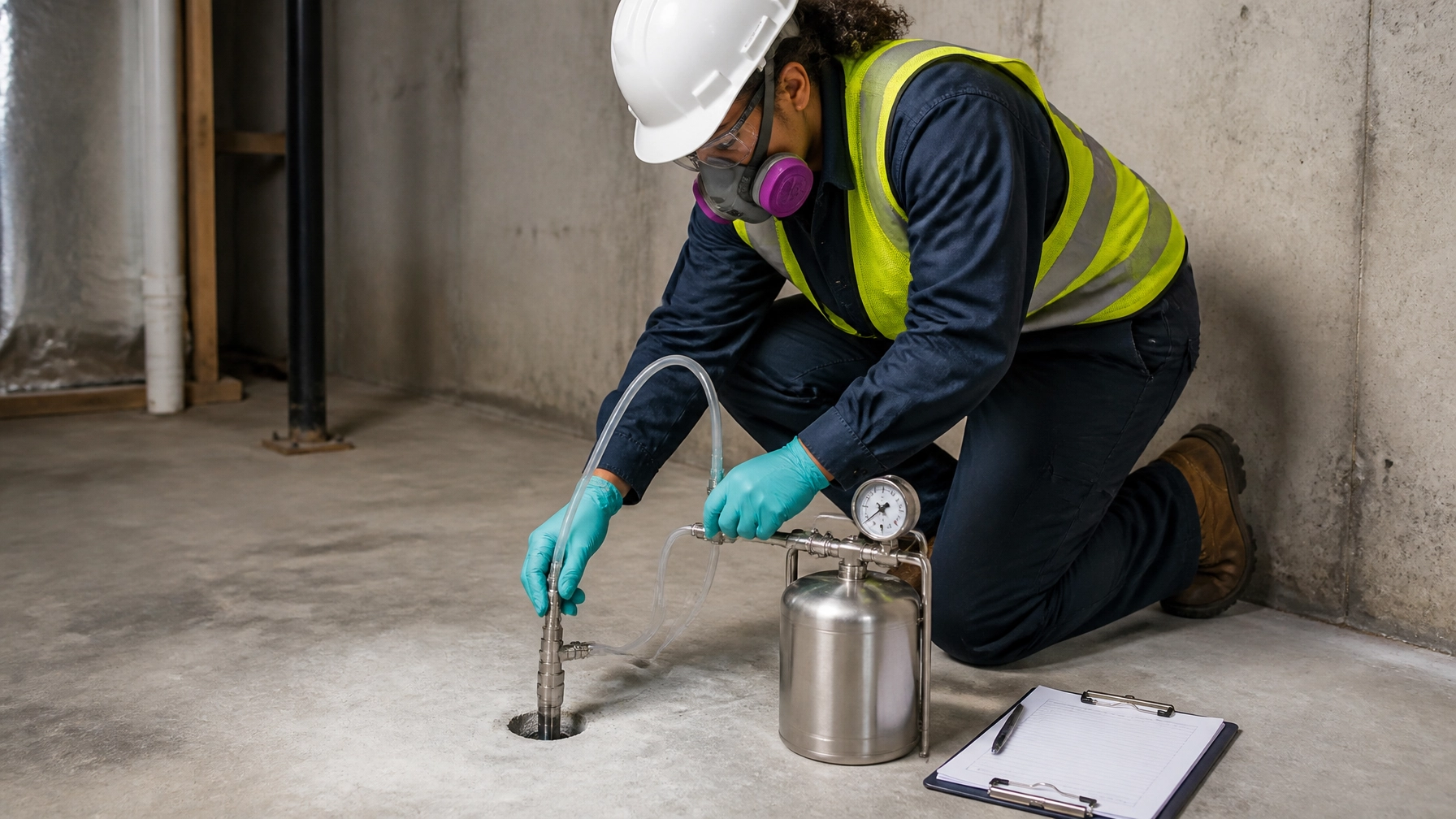
A vapor intrusion assessment usually starts with a building survey, historical review, and sampling plan. Depending on the site, the investigation may include:
- Sub-slab soil gas samples.
- Indoor and outdoor air samples.
- Building envelope inspections.
- Utility and preferential pathway review.
- Laboratory analysis for volatile organic compounds.
- Comparison to NJDEP screening levels and Indoor Air Remediation Standards.
- Evaluation of background sources such as solvents, cleaners, fuels, or dry-cleaned materials.
If the pathway is confirmed, the remedy may include a sub-slab depressurization system, vapor barrier, soil vapor extraction, HVAC modification, or another engineering control.
Envicon’s Vapor Intrusion Assessment service combines sampling, regulatory evaluation, mitigation design, and post-installation verification. The objective is not to produce another report that sits in a file. It is to define what the building needs, what the RAP must contain, and what the owner must maintain.

GIS deliverables and the NJDEP GIS IANA map
The IANA boundary must be represented accurately. NJDEP requires GIS deliverables to be submitted concurrently with the related remedial report, form, or key document.
For most CSRR GIS submissions, NJDEP accepts:
- Esri shapefiles with, at minimum,
.shp,.shx,.dbf, and.prjfiles. - Georeferenced DWG or DXF files using NAD 83 New Jersey State Plane feet.
- Required metadata identifying the site, PI number, LSRP, GIS professional, and submission type.
The NJDEP GIS FAQs identify IANA as a formal deliverable type and explain that only the required boundary should be included in the shapefile. Do not add unrelated parcels, streets, or extra map layers to the required IANA shape.
NJDEP also states that an IANA boundary may need a revised GIS submission when:
- The boundary changes.
- The posted boundary is incorrect.
- The institutional control is being reestablished.
- New affected buildings or units are identified.
- The vapor intrusion pathway expands or contracts.
The NJDEP GIS IANA map is a useful reference, but it should not replace the approved RAP, current IANA Fact Sheet, or site-specific records.

O&M and biennial certification requirements
Owners with an indoor air RAP must maintain records that demonstrate the remedy remains protective.
The current NJDEP biennial certification instructions identify indoor air documentation that may include:
- Annual system diagnostic measurements compared with commissioning values.
- Vapor Intrusion Mitigation Monitoring and Maintenance Checklists.
- Indoor Air Building Survey and Sampling Forms for each sampling round.
- Updated vapor intrusion spreadsheets.
- Scaled maps showing sampling locations.
- Documentation of system repairs, recommissioning, or modifications.
- Monitoring point inspection and replacement records.
- Updated notifications where names or addresses have changed.
The certification must be signed by the permittee and the LSRP. The form is submitted electronically to NJDEP at the address identified in the current instructions.
A failed fan, inaccessible monitoring point, damaged slab, new tenant use, or building renovation can change the exposure pathway. Do not wait until the next biennial certification to address a known problem.

Property transfer, tenant notice, and municipal notice
A vapor intrusion property sale in New Jersey requires more than a Phase I ESA update. Buyers, lenders, attorneys, and municipalities will want to know:
- Whether an active RAP covers indoor air.
- Whether an IANA has been established and mapped.
- Whether the mitigation system operates as designed.
- Whether biennial certifications are current.
- Whether required notices were sent.
- Whether the property has changed use.
- Whether the building envelope or slab has been altered.
- Whether the O&M records are complete.
- Whether the current owner and tenant contacts are accurate.
A transaction can stall when the permit exists but the maintenance history is incomplete. The same problem occurs when the IANA boundary in the GIS record does not match the actual building footprint or when the notification list still names a former owner.
Before a sale, refinance, lease, or redevelopment, have the LSRP review the RAP, IANA Fact Sheet, GIS boundary, sampling history, O&M records, and current forms together.
Lifecycle checklist for Newark and Jersey City owners
Use this checklist to identify gaps before NJDEP or a transaction team finds them:
- Confirm whether indoor air is included as a RAP media component.
- Locate the current IANA Fact Sheet and approved boundary.
- Verify the IANA boundary against current tax lots and building footprints.
- Check the NJDEP GIS record and correct any boundary discrepancy.
- Confirm that owners, tenants, occupants, municipalities, and counties received required notices.
- Maintain annual vapor mitigation inspection and diagnostic records.
- Complete indoor air or sub-slab sampling required by the OMMP or RAP.
- Update the VI spreadsheet and scaled sampling maps.
- Document repairs, outages, recommissioning, and replacement monitoring points.
- Use the current NJDEP forms before filing a RAP modification or biennial certification.
- Coordinate property transfers with the LSRP, attorney, lender, and buyer early.
- Do not shut down or remove a mitigation system until NJDEP approves the required termination or media removal process.
Can an IANA be removed?
Possibly, but removal requires evidence. NJDEP’s current certification instructions identify conditions for evaluating whether a vapor mitigation system or engineering control is no longer required.
In general, the evaluation may require:
- Two rounds of sub-slab soil gas and indoor air sampling.
- Results at or below applicable standards.
- Sampling events at least four months apart.
- At least one sampling round during the heating season.
- The active mitigation system capped or shut down for at least 30 days before sampling, where required.
- An approved RAP termination or media removal application.
Do not permanently disable a system based on one clean sample or an informal consultant recommendation. The system should remain in operation until NJDEP approves the appropriate termination or modification.
For sites pursuing an RAO or NFA, the closure strategy should address the entire remedy. An indoor air component, IANA, engineering control, or unresolved monitoring obligation can remain a long-term compliance issue even after other portions of the site are complete.
Why owners use Envicon for NJDEP indoor air RAP work
Large firms often separate the sampling team, regulatory team, GIS group, and transaction team. That creates handoffs. Handoffs create gaps.
Envicon keeps the work coordinated under direct senior oversight. Our NJ LSRP services include vapor intrusion investigation, mitigation planning, RAP support, institutional control documentation, ongoing compliance, and closure strategy.
We work with owners, developers, attorneys, lenders, architects, contractors, and municipalities across Newark, Jersey City, Hoboken, Bayonne, Hudson County, Bergen County, and Essex County.
You get:
- A practical scope tied to your building and transaction.
- Direct access to licensed professionals.
- NJDEP-facing documentation.
- GIS coordination and boundary review.
- Clear O&M responsibilities.
- A defined path toward modification, transfer, RAO, or NFA.
The point is not to maintain a permit for its own sake. The point is to keep the building safe, the record accurate, and the property usable.
Frequently asked questions
What is the NJDEP Indoor Air Notification Area?
It is an institutional control used to identify and manage an area affected by a vapor intrusion or indoor air condition that requires notification, monitoring, mitigation, or long-term oversight.
Does every vapor mitigation system require an IANA?
Not necessarily. The requirement depends on whether the system is part of the remedial action and whether the indoor air component must be included in the RAP. An LSRP should evaluate the site-specific facts and current NJDEP requirements.
Does an IANA affect a property sale in New Jersey?
Yes. Buyers, lenders, attorneys, and municipalities may request the IANA boundary, notices, RAP, sampling results, O&M records, and current biennial certification.
Where can I find the NJDEP GIS IANA map?
NJDEP provides institutional control mapping through its CSRR GIS resources and related NJ GeoWeb and Site Remediation Profile tools. The public map should be checked against the approved RAP and current site records.
How often must a vapor mitigation system be inspected?
The inspection and monitoring schedule comes from the RAP, OMMP, and applicable NJDEP requirements. The current biennial certification instructions identify annual monitoring and maintenance documentation for applicable systems.
Can Envicon help with an IANA in Jersey City or Newark?
Yes. Envicon provides vapor intrusion assessment, NJ LSRP oversight, sampling, mitigation coordination, GIS support, RAP documentation, and ongoing compliance services.
Takeaway
The February 2026 NJDEP RAP modernization made indoor air a formal part of the remedial action framework. For Newark and Jersey City owners, maintaining an IANA means maintaining more than a map.
You need current notices, accurate GIS boundaries, functioning mitigation systems, documented O&M, complete sampling records, current forms, and a defensible path toward continued protectiveness or closure.
If your RAP, IANA, or vapor system records have not been reviewed since the 2026 changes, now is the time to do it.
Start with Envicon
- Call Envicon now at (917) 764-2171
- Get a free quote for your project
- Review vapor intrusion assessment services
- See Envicon’s Jersey City environmental consulting team