Published September 21, 2026 at 2:00 PM ET
If you are searching for UST closure cost NJ, the first number you need is not a contractor’s flat price. It is the cost of the full closure pathway.
A tank may require removal, excavation, confirmation sampling, groundwater assessment, disposal documentation, NJDEP reporting, or full site remediation. The right budget depends on the tank’s condition, the property layout, the depth to groundwater, and what the soil results show.
For planning purposes, Envicon’s current preliminary ranges are:
- Closure-in-place: approximately $3,000 to $5,000
- Tank removal and closure: approximately $5,000 to $8,000
- UST closure with initial remediation: approximately $8,000 to $15,000
These are planning ranges, not guaranteed quotes. NJDEP does not set contractor prices. Site conditions determine the actual cost.
“The NJDEP does not set or control prices. Prices are set by the individual contractor.”
NJDEP Homeowner’s Guide to the Unregulated Heating Oil Tank Program
What a New Jersey UST closure includes
A compliant closure is more than pumping out an old tank.
Depending on the tank and property, the scope can include:
- Historical records and site review
- Local permit coordination
- NJDEP notification, when required
- Certified UST closure contractor
- Tank cleaning and product removal
- Tank excavation or approved abandonment in place
- Piping removal
- Soil excavation and stockpile management
- Confirmation soil sampling
- Laboratory analysis for petroleum-related contaminants
- Groundwater assessment, when triggered
- NJDEP discharge reporting
- Closure documentation
- LSRP or certified subsurface evaluator oversight
- Remediation and final closure documentation, if contamination is identified
For regulated USTs, the closure process must follow N.J.A.C. 7:14B. Residential heating oil tanks and certain smaller heating oil systems may fall under New Jersey’s Unregulated Heating Oil Tank, or UHOT, program. UHOT projects still require certified closure work and must address any confirmed discharge under N.J.A.C. 7:26F.
NJDEP closure notification requirements
The notification requirements depend on whether the tank is a regulated petroleum UST or an unregulated heating oil tank.
For regulated USTs, owners and operators generally must submit notice of intent to close through NJDEP Online before field work begins. NJDEP guidance requires advance notice, commonly at least 14 calendar days before the planned closure date. Local construction, demolition, health, and fire officials may also require permits or copies of the NJDEP notification.
The closure contractor must be properly certified for the work. NJDEP maintains lists of certified UST firms by county.
A written contract should clearly identify:
- The work to be performed
- The tank closure method
- Anticipated personnel and equipment
- Sampling and laboratory work
- Disposal and transportation costs
- Permit and agency fees
- The maximum contract price
- Estimated schedule
- Services that exceed minimum regulatory requirements
That last point matters. A low initial price can become an expensive project if excavation, laboratory analysis, groundwater work, reporting, or disposal costs appear later as change orders.
Tank removal versus closure-in-place
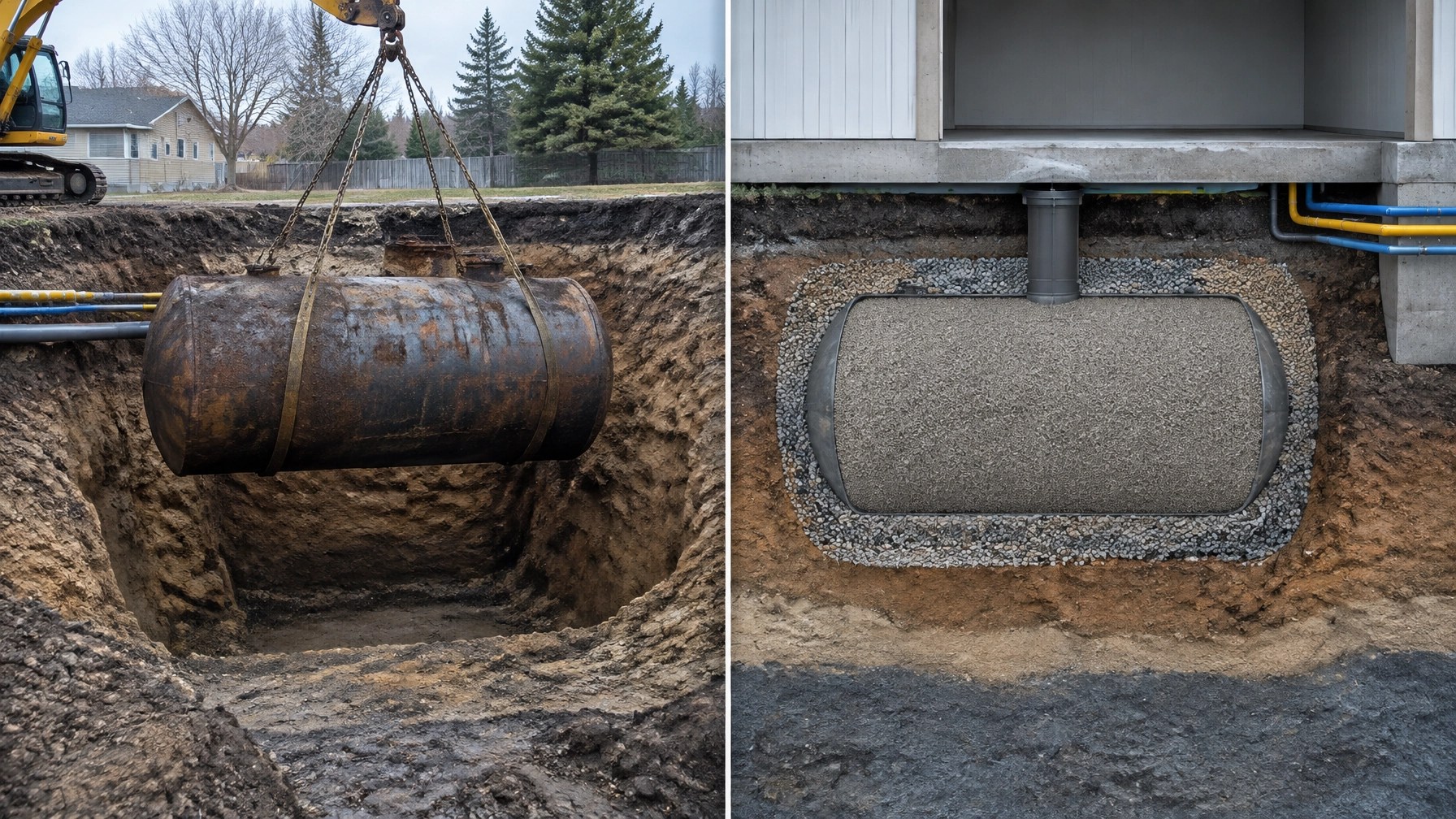
Tank removal
Tank removal is usually the preferred option for buyers, lenders, and developers because it eliminates the physical tank and gives the project team direct access to the underlying soil.
The basic sequence is:
- Empty and clean the tank.
- Excavate around the tank and connected piping.
- Remove the tank.
- Inspect the tank for holes, corrosion, and other evidence of release.
- Collect confirmation soil samples from the tank basin and piping corridors.
- Dispose of the tank and impacted material properly.
- Complete the closure report.
Tank removal often costs more than closure-in-place because it requires excavation, heavier equipment, transportation, tank disposal, backfill, and restoration. It can still be the better financial decision when a property transaction requires clear documentation or when future construction would otherwise be restricted by a tank left underground.
Closure-in-place
Closure-in-place may be considered when removal is not feasible. Examples include:
- A tank directly beneath a building foundation
- A tank beside a fragile masonry wall
- Limited access for excavation equipment
- Structural or utility conflicts
- A location where removal would create disproportionate risk
The tank must be emptied, cleaned, inspected, and filled with an approved inert material. Closure-in-place does not eliminate the need for soil sampling. It also does not erase contamination that already exists around the tank.
For regulated USTs, abandonment in place is restricted and may require professional engineering documentation demonstrating why removal is not feasible. A property owner should not assume that foam filling or sand filling automatically closes the environmental issue.
When a buyer or lender is involved, confirm the acceptance requirements before selecting closure-in-place. Some parties will accept it only with clean samples, detailed photographs, and a regulator-ready closure report.
Confirmation sampling drives the next cost decision
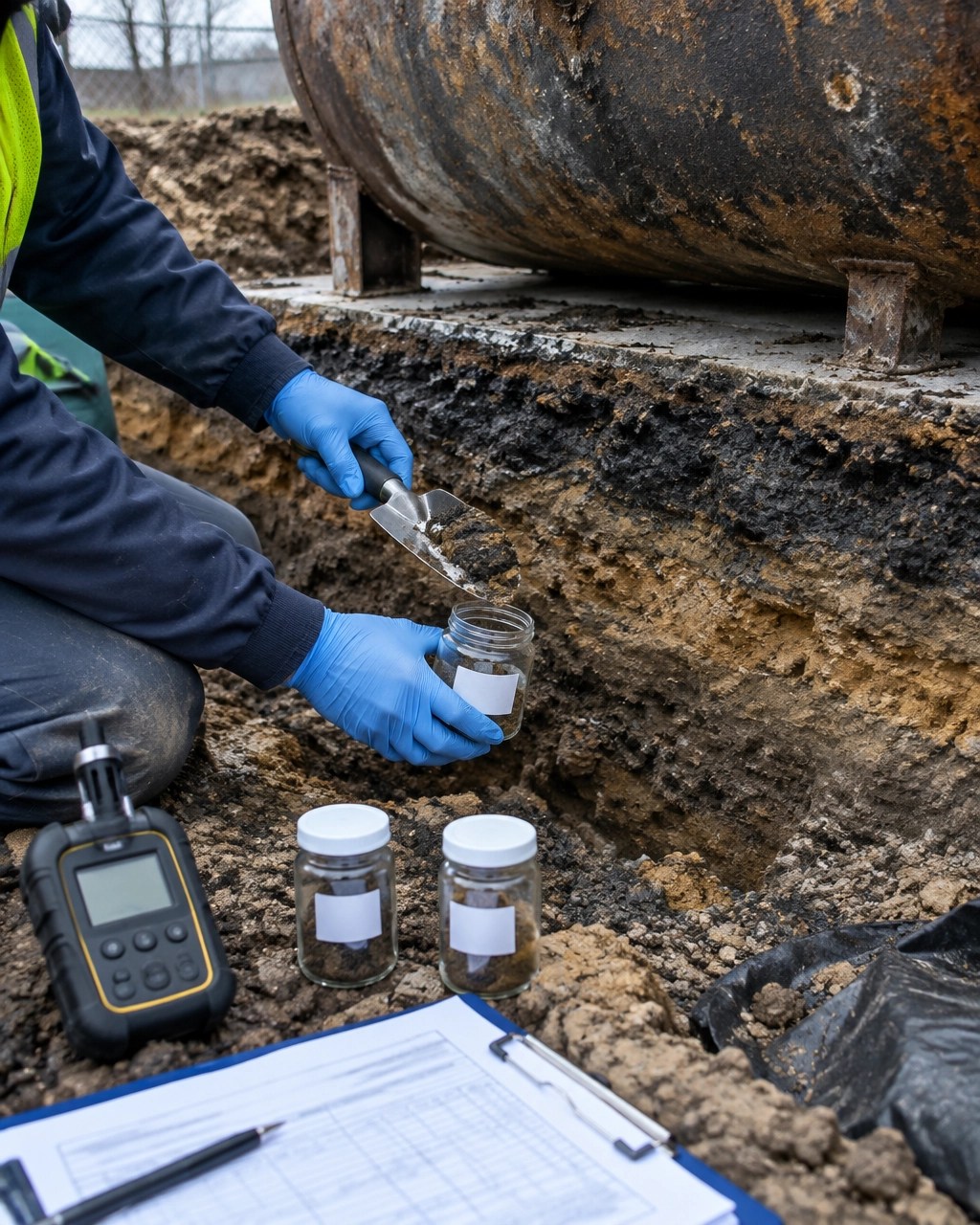
The tank itself is only part of the investigation. The most important question is whether petroleum reached the surrounding soil or groundwater.
Sampling usually focuses on:
- Soil beneath the tank
- Soil around the tank ends
- Piping trenches and dispensers
- Areas with staining or petroleum odor
- The downgradient side of the excavation
- Soil near the water table or bedrock
For UHOT remediation, NJDEP guidance generally calls for at least five soil samples analyzed by a New Jersey Certified Laboratory for Extractable Petroleum Hydrocarbons, or EPH. If EPH exceeds 1,000 mg/kg, additional analysis for naphthalene and 2-methylnaphthalene may be required. Sampling requirements can change based on the excavation and site conditions.
The laboratory results are compared with applicable NJDEP remediation standards. Clean results can keep the project within a defined tank closure scope. Results above standards can trigger additional excavation, delineation, disposal profiling, groundwater sampling, or a formal remediation case.
When groundwater assessment becomes necessary
Groundwater work adds cost because it requires more field time, specialized sampling equipment, laboratory analysis, and technical interpretation.
A groundwater assessment may be necessary when:
- The excavation reaches within two feet of groundwater
- The excavation reaches bedrock
- Free product or petroleum sheen is observed
- Soil results indicate a potential migration pathway
- The tank is located near a shallow water table
- The property has a history of petroleum use
- Contamination may have migrated beyond the tank basin
- Nearby basements, utilities, wetlands, or surface water could act as receptors
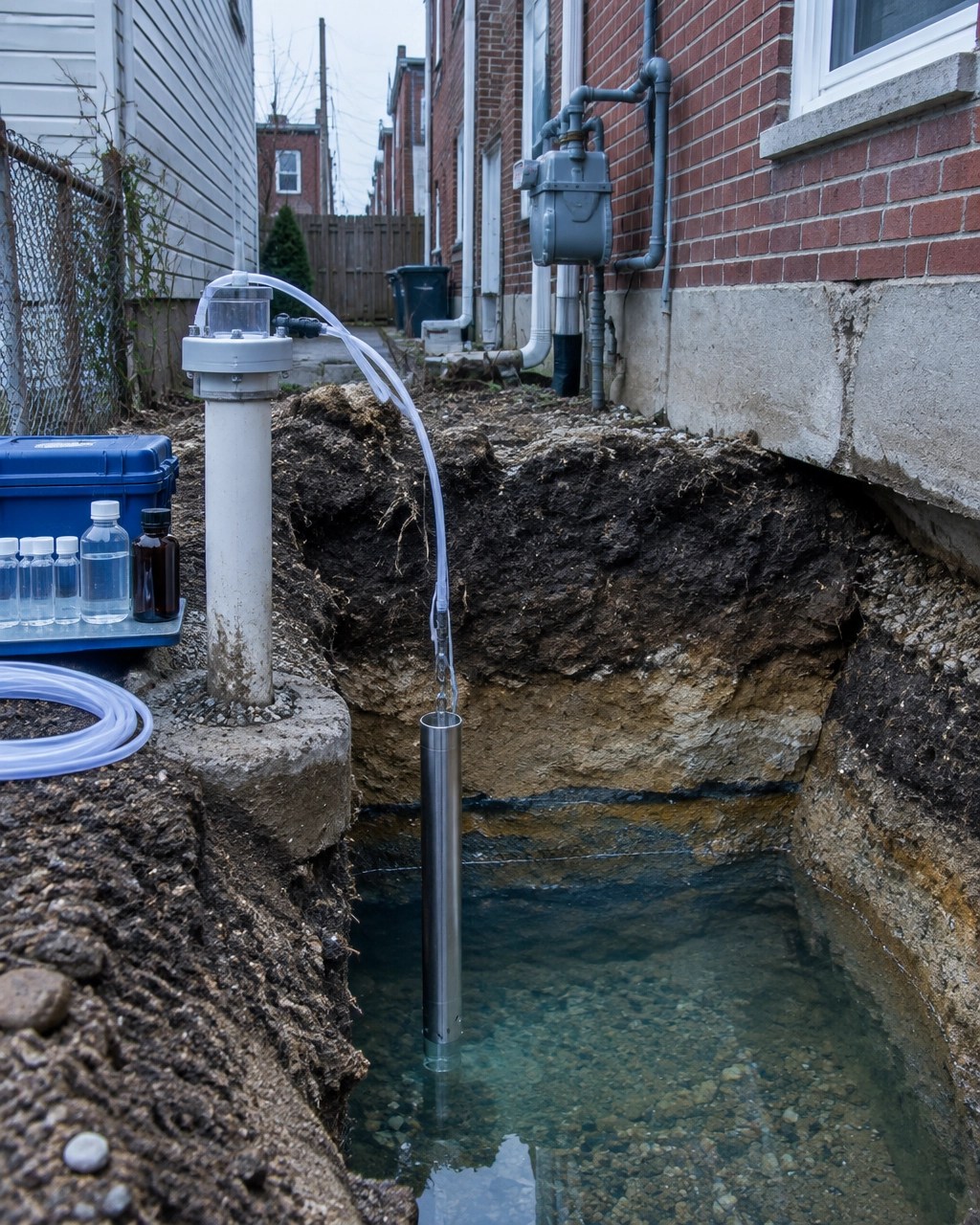
Groundwater contamination can change a short closure project into a longer investigation. The project may require monitoring wells, a site investigation, delineation, interim remedial measures, a groundwater remedial action permit, or long-term monitoring.
The cost is not driven only by the number of samples. It is driven by the number of decisions those samples must support.
Discharge reporting and the 24-hour issue
A tank closure contractor should contact the NJDEP Hotline when field conditions indicate a discharge. NJDEP identifies conditions such as:
- Holes in the tank
- Petroleum staining
- Oil in contact with soil or groundwater
- Fuel odor in the excavation
- Elevated field instrument readings
- Detectable EPH in laboratory results
A suspected or confirmed discharge should be reported promptly. In many situations, the report must be made within 24 hours. The NJDEP Hotline is 1-877-WARNDEP.
Do not wait for the final laboratory report if the field evidence already indicates a release. Delayed reporting can create regulatory and transaction problems.
For a UHOT case, NJDEP’s process may lead to a Remedial Action Report and a No Further Action letter. NJDEP states that a UHOT NFA submission generally includes the required form, remediation documents, and a $400 review fee. The agency estimates a typical technical review period of two to four weeks after an administratively complete submission.
How Newark, Jersey City, and Hoboken change the budget
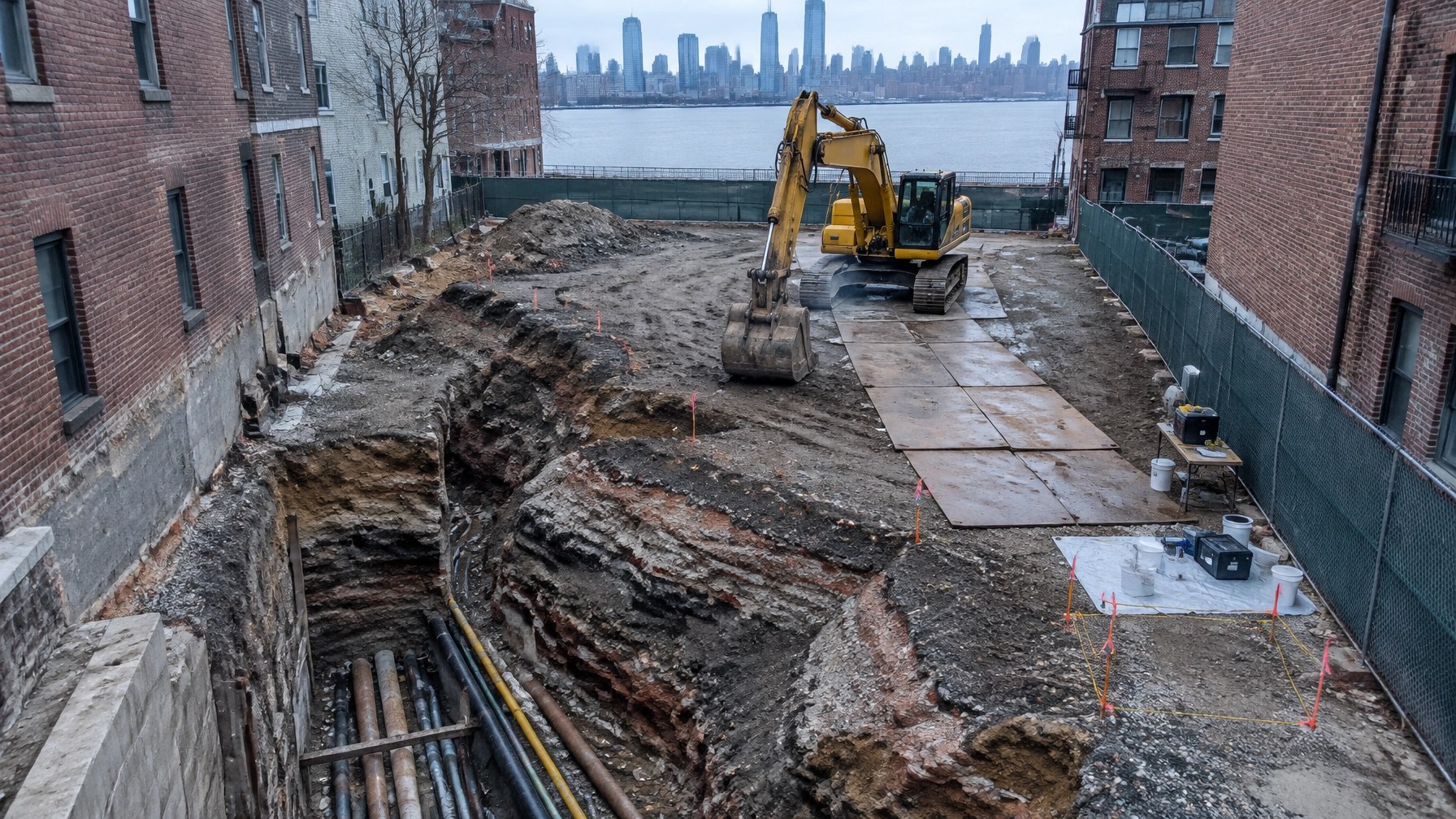
Urban New Jersey properties require more planning than a rural site with open access.
In Newark, historic industrial uses, buried utilities, old foundations, and historic fill can affect both excavation and sampling. The tank may not be the only environmental concern.
In Jersey City and Hoboken, narrow lots and dense construction can restrict equipment access. A crew may need smaller excavation equipment, temporary steel plates, hand excavation, utility coordination, traffic control, or additional shoring.
Historic fill can also introduce metals, PAHs, and other contaminants that are unrelated to the heating oil tank. If tank-related petroleum is clean but historic fill remains, the closure may still require careful documentation within the broader environmental assessment.
Common urban cost drivers include:
- Limited truck and excavator access
- Work beneath or beside occupied buildings
- Utility congestion
- Concrete and asphalt removal
- Imported clean fill
- Soil characterization and disposal
- Temporary water management
- Vapor concerns
- Additional samples to distinguish tank impacts from historic fill
- Coordination with municipal officials and construction teams
When a tank closure becomes a Phase II ESA or LSRP case
A tank closure often becomes part of a larger Phase II Environmental Site Assessment, especially during a property acquisition.
The closure findings can:
- Confirm or rule out a recognized environmental condition
- Define the Phase II sampling area
- Support lender and buyer diligence
- Identify a need for groundwater or vapor investigation
- Document whether petroleum impacts remain after tank removal
- Establish whether other areas of concern require investigation
If a discharge is confirmed, an LSRP may need to evaluate the entire area of concern, not just the tank pit. That includes the nature and extent of contamination, migration pathways, receptors, groundwater conditions, and potential off-site impacts.
Envicon’s NJ LSRP services connect the tank closure, field investigation, regulatory reporting, remediation strategy, and final case documentation. That continuity matters. You do not want one contractor to remove the tank, another consultant to interpret the samples, and a third professional to explain the results to NJDEP.
How to budget a UST closure in New Jersey
Before requesting a quote, gather:
- Tank size and product type
- Residential or commercial use
- Tank location and approximate depth
- Whether the tank is active, abandoned, or unknown
- Available tank records
- Property survey or site plan
- Access photographs
- Known groundwater depth
- Any prior environmental reports
- Planned sale, refinancing, demolition, or redevelopment date
Ask the contractor to separate the base closure cost from potential additional work. The proposal should identify the assumed number of samples, laboratory parameters, disposal allowances, restoration, reporting, and the conditions that trigger a change in scope.
The cheapest quote is not always the lowest project cost. A complete scope with direct technical oversight can prevent duplicate mobilization, rejected documentation, and delays to your closing or construction start.
The practical takeaway
A simple UST closure in New Jersey may cost several thousand dollars. A leaking tank in a tight urban site can become a full environmental remediation project.
Budget for the decision points:
- Removal or closure-in-place
- Confirmation soil sampling
- Groundwater assessment
- Discharge reporting
- Soil disposal
- Phase II ESA integration
- LSRP oversight and case closure
Envicon Group handles UST closure, tank removal, confirmation sampling, soil management, Phase II investigations, and NJDEP coordination across New Jersey. We solve environmental and engineering challenges with precision, speed, and trust.
Call to Action
- Call Envicon now at (917) 764-2171
- Get a free UST closure quote
- Use our proprietary UST closure cost estimator
- Use our project risk screener