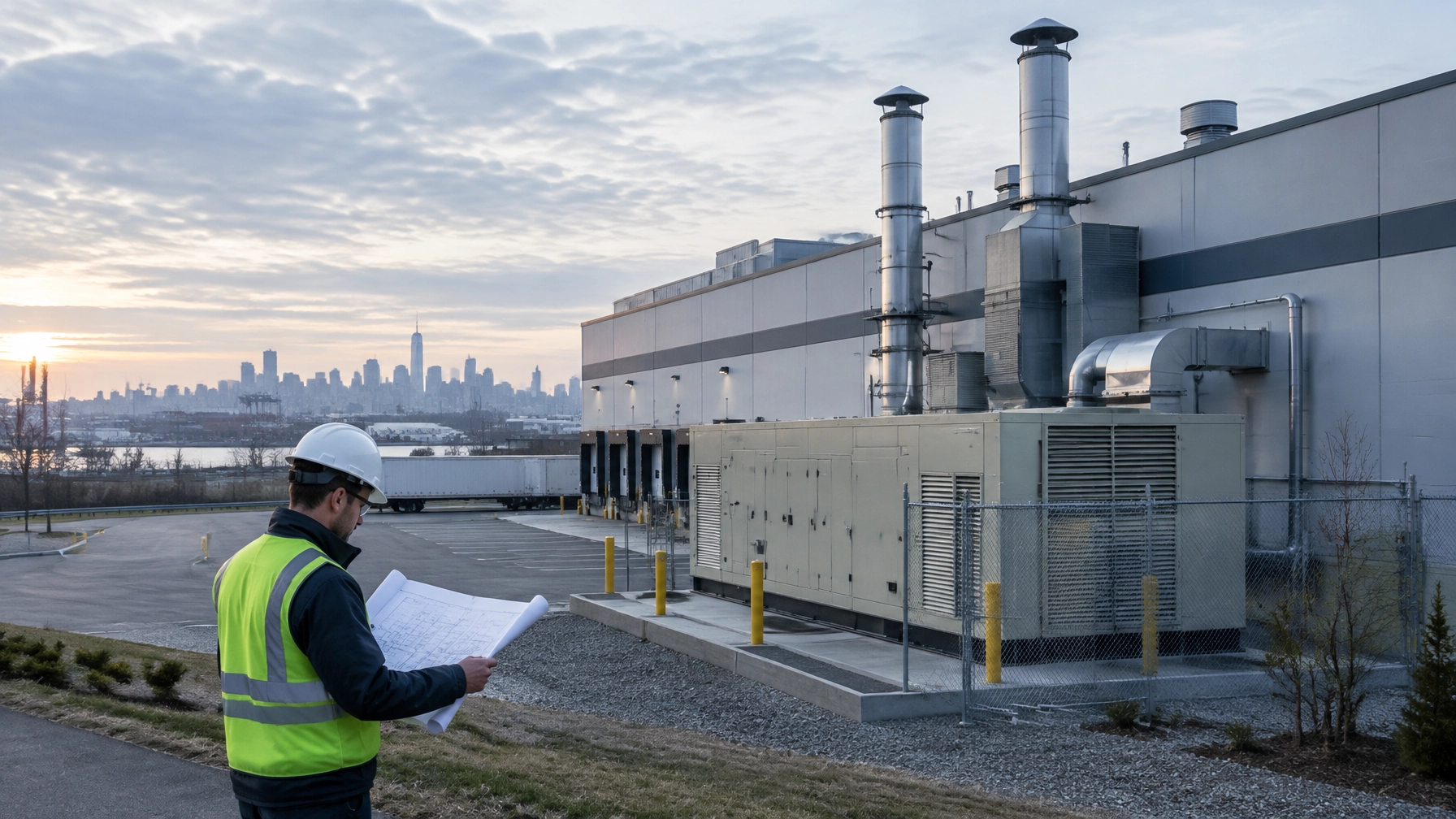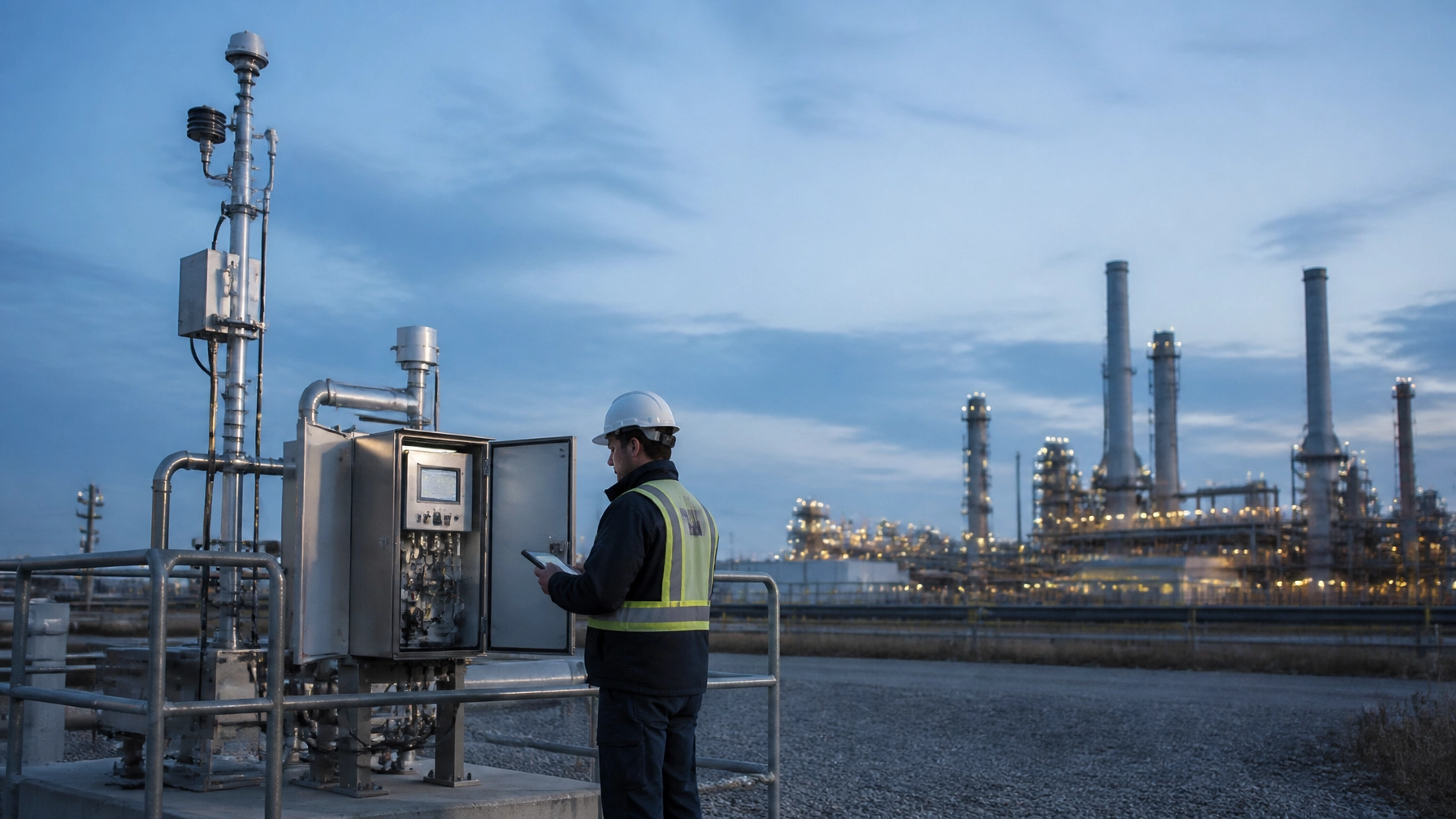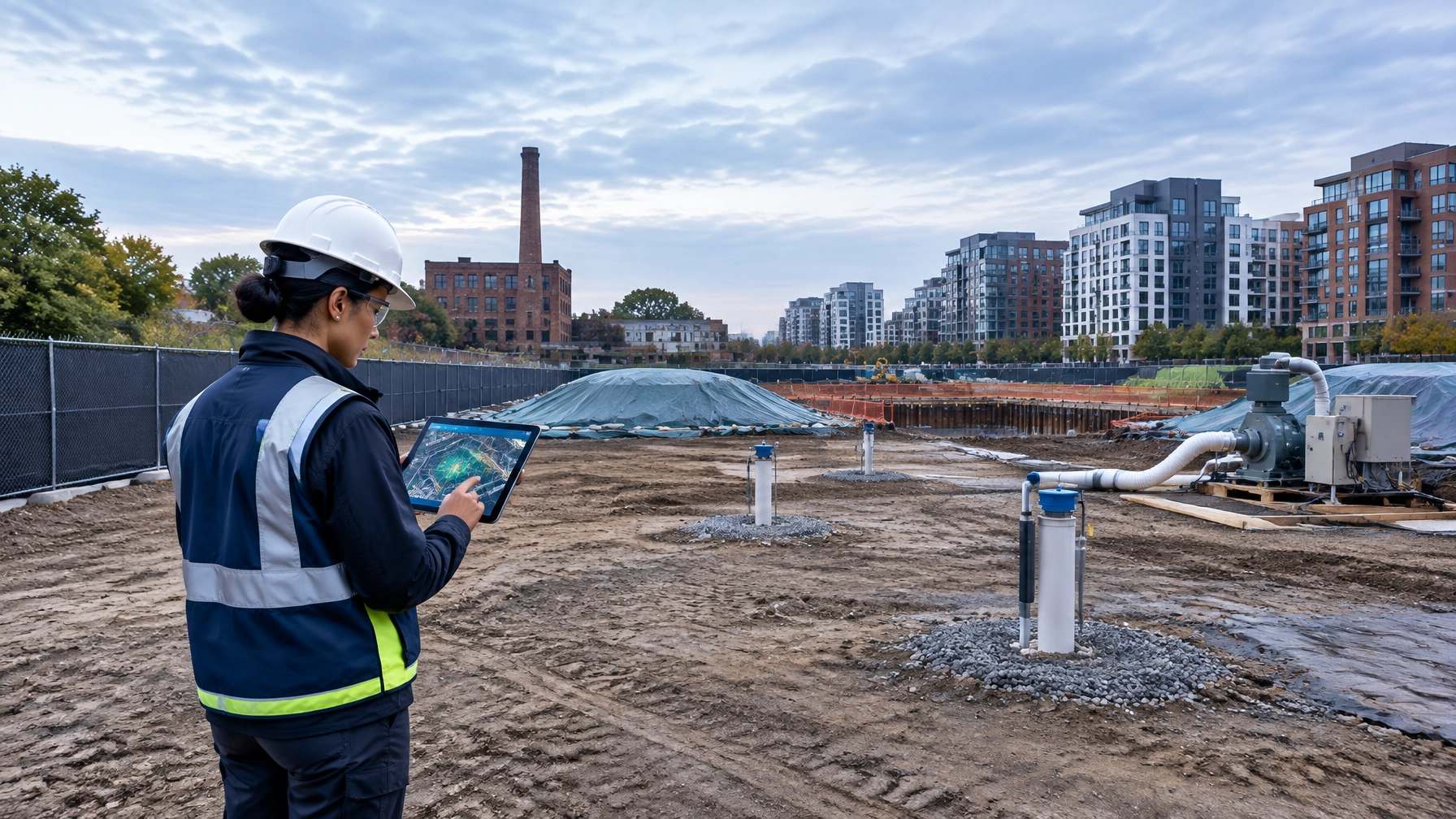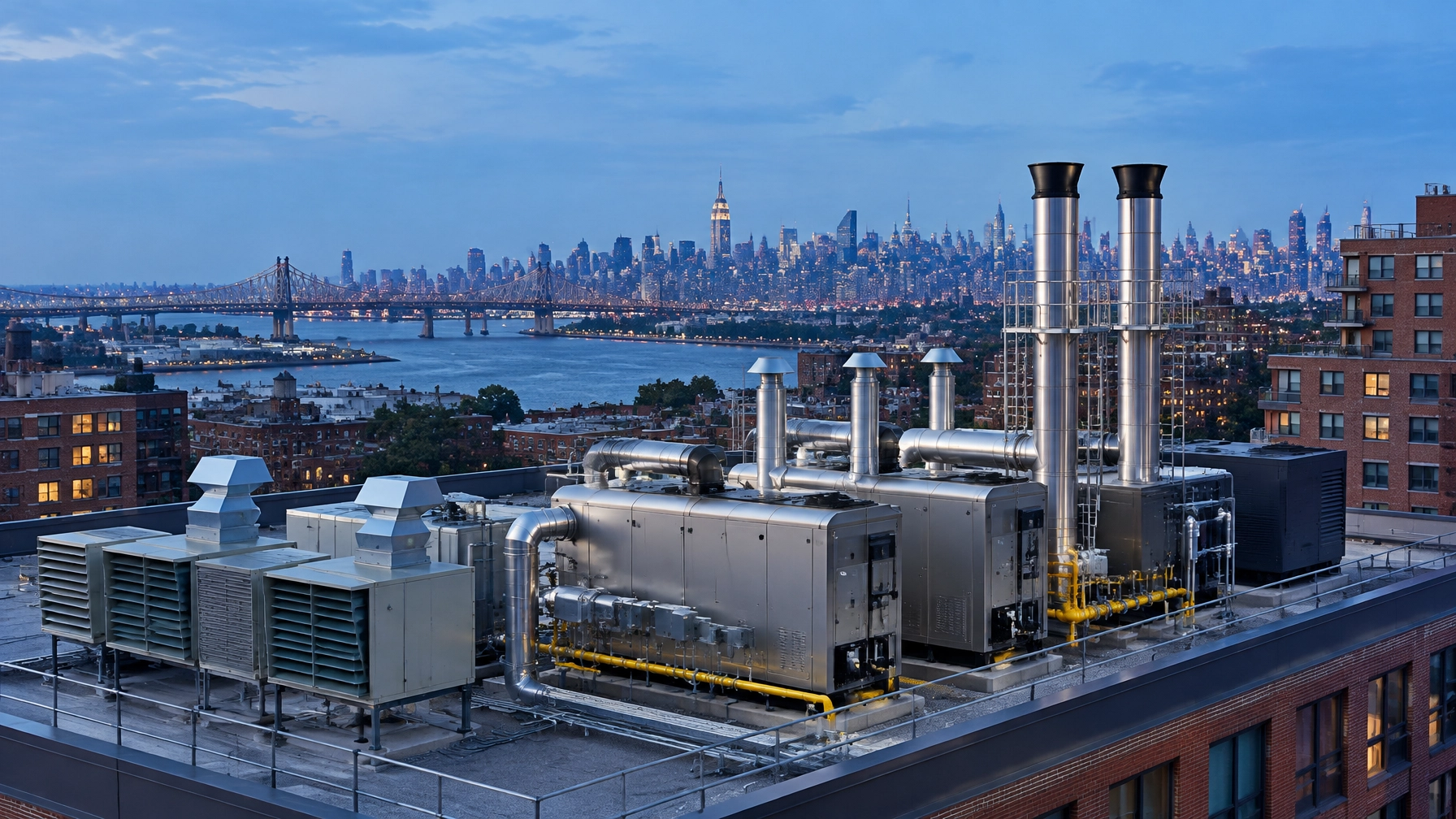
A proposed boiler, generator, or mechanical system can change the air quality conclusion in an Environmental Impact Statement before construction begins.
Under the 2025 CEQR Technical Manual, New York City projects must evaluate both the project’s effect on ambient air quality and the effect of existing air pollution sources on the proposed project. That review generally separates mobile sources, such as traffic, from stationary sources, such as boilers, generators, and fixed exhaust stacks.
The distinction matters in Queens, New York. It also matters in Newark and Monmouth County, New Jersey, where NJDEP permitting follows a separate pathway.
The core issue is simple. Mechanical design decisions made during planning can become environmental commitments. A later change to fuel, equipment size, stack height, stack location, or generator operating profile can require additional analysis, permit revisions, or supplemental environmental review.
What the CEQR air quality chapter must answer
The air quality chapter of a CEQR EIS typically answers five questions:
- Will the project add mobile sources or change traffic conditions?
- Will the project add stationary combustion or process sources?
- Will new residents, workers, or visitors be exposed to existing sources?
- Will the project create significant adverse air quality impacts?
- What mitigation measures must be designed, permitted, and maintained?
The analysis compares future conditions with the project to future conditions without the project. It considers emissions, stack parameters, traffic conditions, meteorology, building geometry, receptor locations, and background concentrations.
The CEQR Technical Manual Chapter 17, Air Quality identifies carbon monoxide, nitrogen dioxide, sulfur dioxide, PM10, PM2.5, ozone precursors, lead, and noncriteria pollutants as potential concerns depending on the project.
As the manual states, “air quality assessment determines both a proposed project’s effects on ambient air quality as well as the effects of ambient air quality on the project.”
Mobile source analysis in Queens and other NYC projects

Mobile source analysis usually focuses on vehicles, parking facilities, roadways, and other moving sources. In Queens, traffic conditions around Long Island City, Flushing, Jamaica, airport corridors, and major arterials can affect the scope.
A detailed analysis may be required when a project:
- Adds substantial peak-hour auto trips.
- Adds heavy-duty diesel truck or bus traffic.
- Changes traffic patterns or diverts vehicles.
- Creates a parking garage or large parking facility.
- Places sensitive uses near a highway, bridge, garage vent, or other mobile source.
- Adds operable windows, balconies, or air intakes near an atypical roadway source.
The CEQR manual identifies a threshold of 160 or more peak-hour auto trips in areas of concern in Long Island City and downtown Brooklyn. It identifies 170 or more peak-hour auto trips in many other areas of New York City. Heavy-duty diesel vehicle thresholds also apply and vary by roadway classification.
The technical workflow generally includes:
- Traffic assignments and vehicle classifications.
- Emission estimates using the current version of EPA’s MOVES model.
- Selection of affected intersections and roadway links.
- Receptor placement at sidewalks, property lines, air intakes, operable windows, and other publicly accessible locations.
- Dispersion modeling using accepted methods such as CAL3QHC or CAL3QHCR.
- Addition of background concentrations.
- Comparison with NAAQS and CEQR impact criteria.
A traffic engineer cannot complete this work in isolation. The transportation analysis must supply the traffic volumes, vehicle mix, speeds, delays, and roadway geometry needed for air modeling.
Stationary source analysis for boilers and generators
Stationary sources remain fixed in place. Under CEQR, that includes:
- Heating and hot water boilers.
- Building HVAC combustion equipment.
- Emergency and non-emergency generators.
- Cogeneration equipment.
- Industrial process exhaust.
- Laboratory and medical exhaust.
- Nearby manufacturing or power generation sources.
- Parking garage exhaust vents.
For a new building, the stationary source analysis may begin with a screening review. The CEQR screening approach considers development size, fuel type, stack height, and distance to nearby buildings of similar or greater height.
A detailed analysis may be needed when the project includes multiple buildings, large combustion sources, industrial processes, sensitive uses near existing sources, or stacks located close to taller buildings.
The main pollutants for fossil-fuel combustion often include nitrogen dioxide, sulfur dioxide, PM10, and PM2.5. Natural gas systems generally reduce sulfur dioxide concerns, but nitrogen dioxide remains a key issue for large combustion sources and generators.
Refined modeling may use AERMOD, with building downwash evaluated through BPIP or comparable preprocessing. The model requires accurate information about:
- Stack height.
- Stack diameter.
- Exhaust temperature.
- Exhaust velocity.
- Emission rates.
- Building dimensions.
- Operating loads.
- Receptor elevations.
- Five years of representative meteorological data.
A stack is not just a line on a mechanical plan. It is a model input that can change predicted concentrations at nearby windows, balconies, air intakes, and rooftops.
NYC DEP’s role in CEQR air review
The lead agency manages the CEQR process, but the NYC Department of Environmental Protection often provides technical review, recommendations, and approval related to air quality.
DEP may review:
- Mobile and stationary source methodologies.
- Background concentrations.
- Nearby permitted sources.
- Receptor selection.
- Dispersion modeling assumptions.
- Cumulative source inventories.
- Proposed mitigation.
- Boiler and generator permit information.
For existing facilities, the CEQR Technical Manual directs analysts to identify relevant air permits and use permitted maximum emissions when developing a conservative analysis. DEP’s Clean Air Tracking System, known as CATS, provides information for many NYC air permits and registrations.
For large or complex projects, coordination should occur before detailed modeling begins. If the analysis predicts a potential violation of an ambient standard or an exceedance of applicable impact criteria, DEP coordination becomes particularly important.
How the EIS locks in mechanical design
The EIS conclusion depends on the project evaluated. It does not automatically approve every future mechanical design.
The following decisions can materially affect the air quality analysis:
Boiler type and fuel
A natural gas boiler, dual-fuel boiler, oil-fired boiler, and electric heating system have different emission profiles. Fuel switching can change nitrogen dioxide, sulfur dioxide, particulate matter, and annual emission calculations.
If the EIS relies on natural gas as a mitigation measure, that restriction may need to appear in the project’s approvals, environmental commitments, restrictive declaration, or NYC E Designation requirements.
Stack height and location
A higher stack may improve dispersion. A stack placed near a taller building, operable window, or outdoor terrace can create a worse receptor condition.
Moving a stack from one side of a building to another can change the downwash pattern. The change may require the design team to revisit the air model.
Generator sizing and operation
A generator’s electrical output, fuel consumption, emission factor, stack arrangement, and operating hours all affect the analysis.
A project modeled with two emergency generators may not be able to install four larger units later without reviewing the total emission increase. Testing assumptions also matter. Emergency operation, routine testing, maintenance, demand response, and non-emergency use are not interchangeable regulatory scenarios.
Building geometry
A taller building, new rooftop bulkhead, changed parapet, or nearby structure can alter plume behavior. That can affect both the project’s impact on surrounding properties and the effect of nearby sources on the project.
EIS mitigation is not the same as an air permit
An EIS evaluates environmental impacts. An air permit authorizes equipment construction or operation under applicable air regulations. They work together, but one does not replace the other.
A typical sequence is:
- The CEQR EIS evaluates the proposed equipment and emissions.
- The lead agency identifies significant impacts or required mitigation.
- The project commits to controls, fuel restrictions, stack requirements, or operating limits.
- NYC DEP or another agency reviews the equipment permit or registration.
- The final mechanical design must remain consistent with the environmental commitments.
- Construction and operation records demonstrate compliance.
For NYC projects, an E Designation may require OER review of boiler and HVAC specifications, fuel usage, stack locations, and related documentation before building permits or certificates of occupancy proceed.
This is where projects often lose time. The EIS team, mechanical engineer, permit consultant, and construction team must work from the same equipment schedule. A report that says one thing while the permit application says another is a preventable problem.
New Jersey: NJDEP permitting is a separate pathway

New Jersey does not use CEQR. A project in Newark or Monmouth County may be subject to state, local, or other environmental review requirements, but NJDEP air permitting follows New Jersey’s own regulatory framework.
Under N.J.A.C. 7:27-8, significant sources generally require a preconstruction permit before construction, installation, reconstruction, or modification. Operation also requires the applicable operating authorization.
For data centers and other facilities, potential permitting issues include:
- Emergency generators above applicable heat input thresholds.
- Non-emergency stationary engines.
- Multiple generators aggregated at one facility.
- General Permits such as GP-005A or GP-005B.
- Case-by-case preconstruction permits.
- State-of-the-art control requirements.
- Demand response or load-shaving operations.
- Major source or Title V requirements under N.J.A.C. 7:27-22.
The data center issue is direct. A facility may describe each generator as an emergency unit, but NJDEP can still evaluate the combined facility configuration and ownership or operational relationship. Multiple buildings and generator banks may be treated as one source for permitting purposes.
An NJDEP LSRP may manage site remediation and contamination obligations, but air permitting is a separate technical and regulatory workstream. The LSRP, mechanical engineer, air consultant, and project counsel should coordinate early.
Why early permitting coordination matters
A developer should not wait until equipment procurement to ask whether the project can be permitted.
Before the EIS or environmental review is finalized, confirm:
- Boiler fuel and maximum heat input.
- Generator count, size, fuel, and operating profile.
- Stack height, diameter, velocity, and location.
- Nearby sensitive receptors.
- Building geometry and rooftop equipment.
- Existing permitted sources within the study area.
- Whether the equipment is emergency, non-emergency, or demand-response capable.
- Whether NYC DEP registration, a work permit, NJDEP GP, PCP, or Title V pathway applies.
- How mitigation commitments will be carried into construction documents.
Envicon provides air quality permitting and regulatory coordination across New York and New Jersey. We also support broader compliance and permitting programs and local projects in Queens, Newark, and Monmouth County.
The advantage is practical. We connect the EIS assumptions, mechanical design, dispersion model, permit application, and agency comments before those pieces drift apart.
Takeaway
An air quality chapter is not a formality. It can determine which boiler, fuel, generator, stack, and operating profile a project can use.
In Queens, CEQR and NYC DEP review shape the analysis. In Newark and Monmouth County, NJDEP determines the permitting pathway. Data centers face additional scrutiny because large generator banks can create significant emissions and facility-wide permitting consequences.
The safest approach is to design the air analysis and permitting strategy together.
Solve environmental and engineering challenges with precision, speed, and trust.
Sources and regulatory references
- NYC CEQR Technical Manual, Chapter 17: Air Quality
- NYC DEP Clean Air Tracking System
- NYC DEP Air Pollution Regulations
- NJDEP N.J.A.C. 7:27 Subchapter 8
- NJDEP General Permit GP-005B
- NJDEP Air Permit Applicability Guidance