Meta description: Learn how New Jersey developers and contractors can characterize historic fill, complete TCLP profiling, secure facility approval, and keep soil disposal moving before excavation starts.
Publish date: October 5, 2026 at 2:00 PM ET
In Newark, Jersey City, Elizabeth, and Kearny, soil leaving a development site is usually a documentation problem before it becomes a trucking problem.
The excavator may be ready. The trucks may be scheduled. The receiving facility may have an open slot. None of that matters if the soil profile, waste classification, or paperwork does not support the load.
A rejected load creates more than a disposal issue. It can trigger remobilization, reloading, re-sampling, replacement trucks, standstill time, and a construction schedule that starts slipping by the hour.
The practical answer is simple: characterize soil before excavation, not after the first truck is turned away.
Historic fill changes the soil disposal strategy
NJDEP historic fill is common across northern New Jersey, especially in former industrial and waterfront areas. Historic fill can include ash, brick, construction debris, dredge material, demolition debris, and other non-indigenous material placed to raise site grades.
Under N.J.A.C. 7:26E-1.8, historic fill is treated as an area of concern when a site enters the Site Remediation Program. The NJDEP Historic Fill Material Technical Guidance explains how to confirm, delineate, and manage that material.
NJDEP’s historic fill guidance allows an investigator to:
- Assume historic fill is contaminated above residential soil remediation standards.
- Collect data to demonstrate that the fill does not exceed applicable standards.
- Evaluate the fill separately from other areas of concern.
- Select containment, engineering controls, institutional controls, excavation, or another protective remedy based on site conditions.
That decision affects the entire soil management plan. It determines whether material stays on site, moves within the redevelopment footprint, goes to an approved recycling or disposal facility, or requires additional regulatory review.
At a typical Newark or Kearny brownfield, the historic fill may not be uniform. One excavation area may contain ash and brick. Another may contain petroleum-impacted soil. A third may contain relatively clean native material. Treating all three as one soil type creates avoidable cost and regulatory risk.
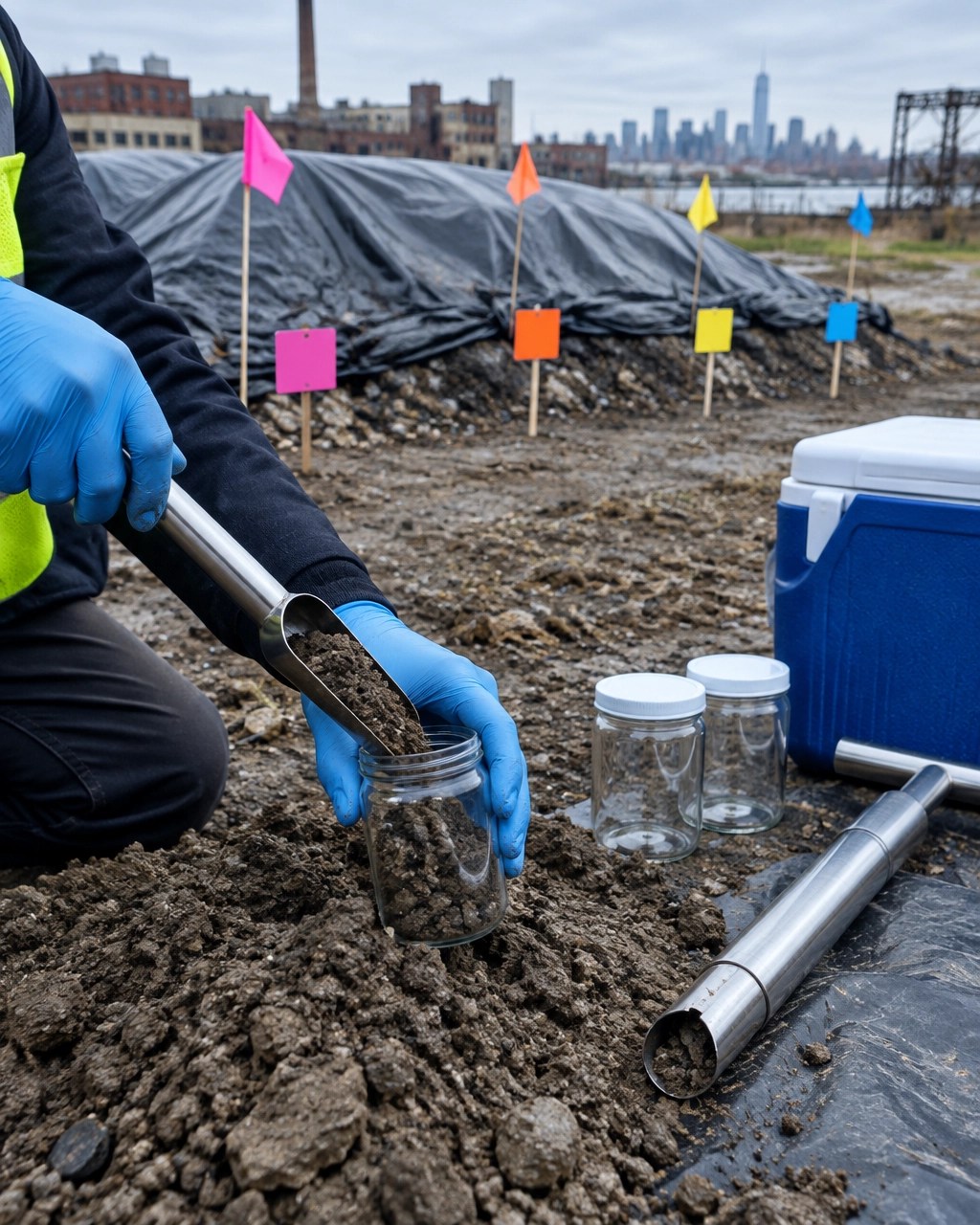
The first decision: clean fill, alternative fill, solid waste, or hazardous waste?
Before assigning a truck or disposal facility, classify the material.
Clean fill
NJDEP’s Fill Material Guidance for SRP Sites defines clean fill as material that:
- Meets applicable soil remediation standards or approved site-specific standards.
- Contains no extraneous debris or solid waste.
- Contains no free liquids.
- Meets applicable criteria for contaminants without established standards.
There is an important distinction here. NJDEP does not issue a universal clean fill certificate for ordinary clean fill used at an SRP site.
“Unlike the certification for quarry material, there is no certification for clean fill. All clean fill requires sampling.”
The proof is the data package. That package should identify the source, volume, sampling approach, laboratory results, bills of lading, and placement location.
Alternative fill
Alternative fill may contain contaminants above the most stringent applicable standards, but it can be acceptable for use at an SRP receiving area when the placement is protective and complies with NJDEP requirements.
The main concepts include:
- Like-on-like: The receiving area already contains the contaminants proposed for placement.
- 75th percentile evaluation: Donor material concentrations remain below the applicable comparison values for the receiving area.
- No hazardous waste: Hazardous waste cannot be used as alternative fill.
- No free product or prohibited free liquids.
- Tracking: Bills of lading, manifests, analytical data, source information, and placement records must be maintained.
Alternative fill that does not meet the default requirements may need written NJDEP pre-approval under N.J.A.C. 7:26E-5.2(c). This can apply when the material contains a contaminant not already present at the receiving area, exceeds the 75th percentile requirement, or raises the final grade above pre-remediation topography.
Non-hazardous solid waste
Soil that exceeds applicable cleanup standards and is managed for disposal may be regulated as non-hazardous solid waste. It still needs a defensible profile and an approved destination.
Do not assume that a soil load is acceptable because it is not hazardous waste. A non-hazardous load can still be rejected because of:
- Debris.
- Unacceptable contaminant concentrations.
- Missing analytical data.
- An incomplete bill of lading.
- A mismatch between the profile and the actual soil.
- Moisture, free liquids, odor, or physical characteristics outside the facility’s permit.
Hazardous waste
The generator remains responsible for determining whether excavated soil is hazardous waste under N.J.A.C. 7:26G.
The determination may include:
- Process knowledge and site history.
- Listed waste evaluation.
- Ignitability, corrosivity, and reactivity testing.
- TCLP analysis for the toxicity characteristic.
- Waste codes D004 through D043, where applicable.
The NJDEP waste classification guidance and HWM-009 materials explain sampling, quality assurance, laboratory documentation, and classification request requirements.

TCLP profiling is not a substitute for site investigation
Site investigation data and waste characterization data answer different questions.
Site investigation determines whether contaminants are present, where they are located, and how they affect the remedial strategy.
Waste characterization determines how excavated material must be managed once it is being treated as waste.
For example, total lead in soil does not by itself establish whether the soil is hazardous waste. TCLP evaluates the leachable concentration against the applicable toxicity characteristic threshold. A soil profile can therefore show elevated total concentrations while remaining non-hazardous, or it can fail TCLP and require hazardous waste management.
That distinction must be resolved before excavation whenever possible.
A defensible TCLP profile should account for:
- The source area and historical operations.
- Soil type and physical appearance.
- Known contaminants.
- Whether the material is homogeneous.
- Excavation depth and volume.
- Stockpile configuration.
- Facility-specific acceptance criteria.
- Laboratory certification and quality assurance.
- Chain of custody and sample preservation.
NJDEP waste sampling guidance commonly uses grids and volume-based sampling for stockpiled material. For smaller waste volumes, the HWM-009 guidance uses grids of no more than 20 cubic yards, with representative samples collected from each grid. The actual approach must match the waste type, volume, homogeneity, and requested classification.
Do not combine unlike materials simply to reduce the number of samples. Mixing ash-rich fill, petroleum-impacted soil, and native soil can produce a profile that represents none of them well.
Facility pre-approval happens before the truck leaves
A facility profile is not a formality. It is a technical acceptance decision.
Before excavation, confirm that the proposed facility can accept:
- The waste category.
- The contaminant profile.
- The anticipated volume.
- The moisture and physical condition.
- The required documentation.
- The planned shipping method.
- Any special restrictions for historic fill, PCBs, asbestos, or other constituents.
Obtain written confirmation of acceptance. Identify the facility contact. Confirm the profile number or approval reference. Document the approved transporter and the receiving address.
For hazardous waste, the shipment must be properly containerized, labeled, and managed with the required hazardous waste manifest under N.J.A.C. 7:26G-6.1.
For non-hazardous solid waste, the project still needs the correct bills of lading, transporter credentials, facility documentation, and required origin and destination records. The receiving facility may also require its own profile form, analytical package, and pre-approval letter.
For beneficial reuse, the pathway must be established before transportation. Depending on the material and receiving site, this may involve LSRP approval for alternative fill, NJDEP pre-approval, or a Certificate of Authority to Operate and Beneficial Use Determination through the Division of Solid and Hazardous Waste.
Clean fill does not automatically require a CAO/BUD at an SRP site, but clean fill still requires sampling and documentation. Restricted-use material proposed for beneficial use outside the standard SRP pathway may require formal approval before it leaves the generator’s site.
A sequence that keeps excavation moving
Use this sequence for a New Jersey soil disposal project.
1. Review the site history
Identify historic fill, former industrial operations, tanks, ash, demolition areas, petroleum use, solvent use, rail activity, and imported material.
2. Match the investigation to the excavation plan
Overlay the proposed foundation, utility, and grading limits with the environmental data. Characterize the soil that will actually be excavated, not only the soil that was convenient to sample during an earlier investigation.
3. Separate soil by source and physical condition
Use distinct stockpile areas for different soil categories. Keep ash, debris-rich fill, petroleum-impacted soil, native soil, and suspected hazardous material separate.
4. Build the analytical package
Use discrete samples where needed. Add TCLP, reactive, ignitability, corrosivity, EPH, PCBs, or other analyses based on site history and facility requirements.
5. Secure facility acceptance
Send the profile, analytical data, estimated volume, physical description, and proposed schedule to the receiving facility. Get written acceptance before mobilizing trucks.
6. Prepare the paperwork
Finalize bills of lading, manifests where required, transporter information, truck logs, load tickets, and chain-of-custody records. Assign one person to control the documentation.
7. Brief the excavator and trucking team
The field team should know which soil goes into which truck. The operator should not blend stockpiles because a truck is waiting. If the soil changes, stop and confirm the next action.
8. Track every load
Record the source area, truck, quantity, destination, time, driver, documentation, and acceptance status. Keep the record current while excavation is active.
What a rejected load really costs
A rejected soil load rarely costs only the original trucking charge.
The project may also pay for:
- A second mobilization.
- Reloading or off-loading.
- New sampling and laboratory analysis.
- Disposal facility standby time.
- Excavator and labor downtime.
- Replacement trucks.
- Additional stockpile management.
- Revised profiles and paperwork.
- Schedule impacts to foundations, utilities, or concrete placement.
- Potential disputes between the owner, contractor, transporter, and consultant.
The most expensive part is often the standstill. A crew that cannot excavate cannot advance the project.
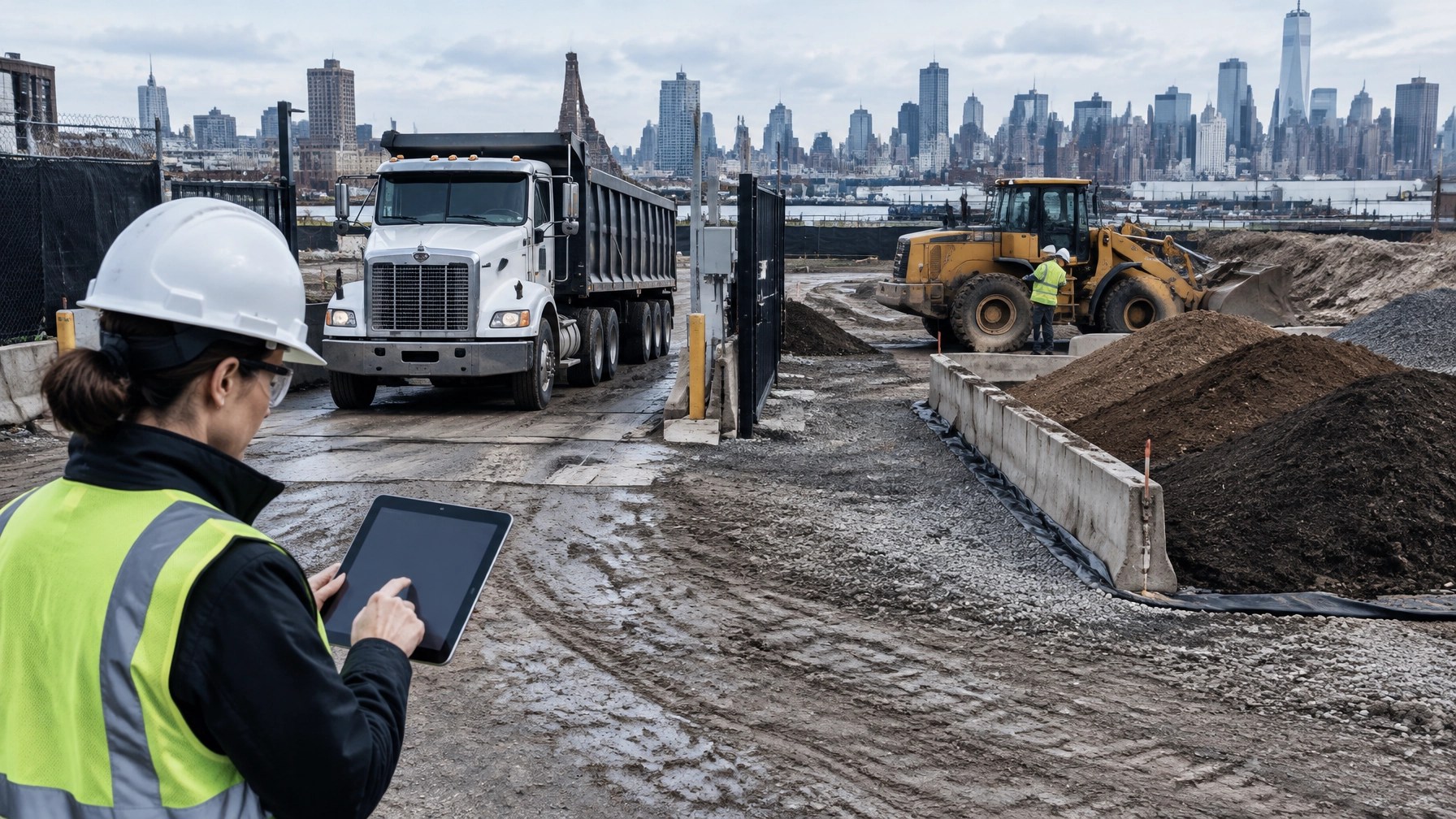
Envicon profiles soil before the excavator arrives
Envicon supports soil disposal, waste characterization, and clean fill certification for New Jersey redevelopment projects.
Our approach is field-first and regulator-facing:
- We review the excavation plan before sampling.
- We profile soil by source and expected disposal pathway.
- We coordinate with receiving facilities before trucks are scheduled.
- We identify TCLP and other waste characterization needs early.
- We maintain one point of contact from characterization through manifests and load tracking.
- We provide transparent disposal pricing instead of leaving facility assumptions buried in a change order.
That matters on projects in Newark, Jersey City, Elizabeth, Kearny, and across the New Jersey environmental consulting market.
Large consultants often separate the person who sampled the soil from the person who manages disposal. That creates handoffs. Handoffs create missed details. Envicon keeps the technical profile, facility coordination, and field execution connected.
The takeaway
NJDEP soil disposal begins before excavation.
Historic fill must be understood. TCLP profiling must match the waste stream. Clean fill must be supported by sampling and records. Alternative fill must follow the correct reuse pathway. Facilities must approve the profile before the first truck leaves.
The reliable sequence is:
- Characterize the source.
- Separate the soil.
- Classify the material.
- Secure facility acceptance.
- Prepare the documents.
- Track every load.
When the paperwork is ready before the excavator arrives, the trucks have somewhere to go and the project has a clear path forward.
Start with a soil management plan