A lead result on a Phase II report can change more than a remediation table. It can change the sampling plan, soil reuse strategy, excavation controls, disposal profile, construction schedule, and project budget.
That is why developers, lenders, attorneys, and contractors need to separate three issues:
- The NYSDEC Part 375 amendments that became effective December 31, 2025.
- The lead soil cleanup objectives currently in effect.
- Additional 2026 amendments planned for lead and PFOA/PFOS that are not yet enforceable.
For a New York City or New Jersey redevelopment project, the distinction matters. A consultant who treats proposed values as adopted standards can create unnecessary scope. A consultant who ignores the direction of travel can create avoidable cost and delay.
What changed under NYSDEC Part 375?
NYSDEC adopted comprehensive revisions to 6 NYCRR Part 375, Environmental Remediation Programs, effective December 31, 2025.
The revisions affect the Brownfield Cleanup Program, State Superfund, Environmental Restoration Program, and related remediation requirements. They also update the soil cleanup objective framework and program procedures.
NYSDEC’s 2026 regulatory agenda identifies a separate future rulemaking that would:
- Add soil cleanup objectives for PFOA and PFOS.
- Revise lead soil cleanup objectives to align with EPA lead values referenced by NYSDEC.
- Update the Part 375 contaminant tables after formal proposal, public comment, and adoption.
Those planned values are not the same as current enforceable Part 375 standards. Until NYSDEC completes that rulemaking, project teams should use the adopted Part 375 tables, approved decision documents, and any site-specific requirements issued by the agency.
Current NYSDEC lead soil cleanup objectives
The current lead values appear in 6 NYCRR 375-6.8. NYSDEC reports soil concentrations in parts per million. For soil, ppm is numerically equivalent to milligrams per kilogram, or mg/kg.
| Soil use category | Current lead SCO |
|---|---|
| Unrestricted use | 63 ppm |
| Residential use | 400 ppm |
| Restricted-residential use | 400 ppm |
| Commercial use | 1,000 ppm |
| Industrial use | 3,900 ppm |
| Protection of ecological resources | 63 ppm |
| Protection of groundwater | 450 ppm |
The same lead result can therefore produce very different project decisions depending on the selected use, remedial track, groundwater conditions, ecological setting, and agency program.
This is the point many generic reports miss. The number alone does not determine the remedy. The number must be evaluated against the site’s future use and the requirements of the applicable regulatory program.
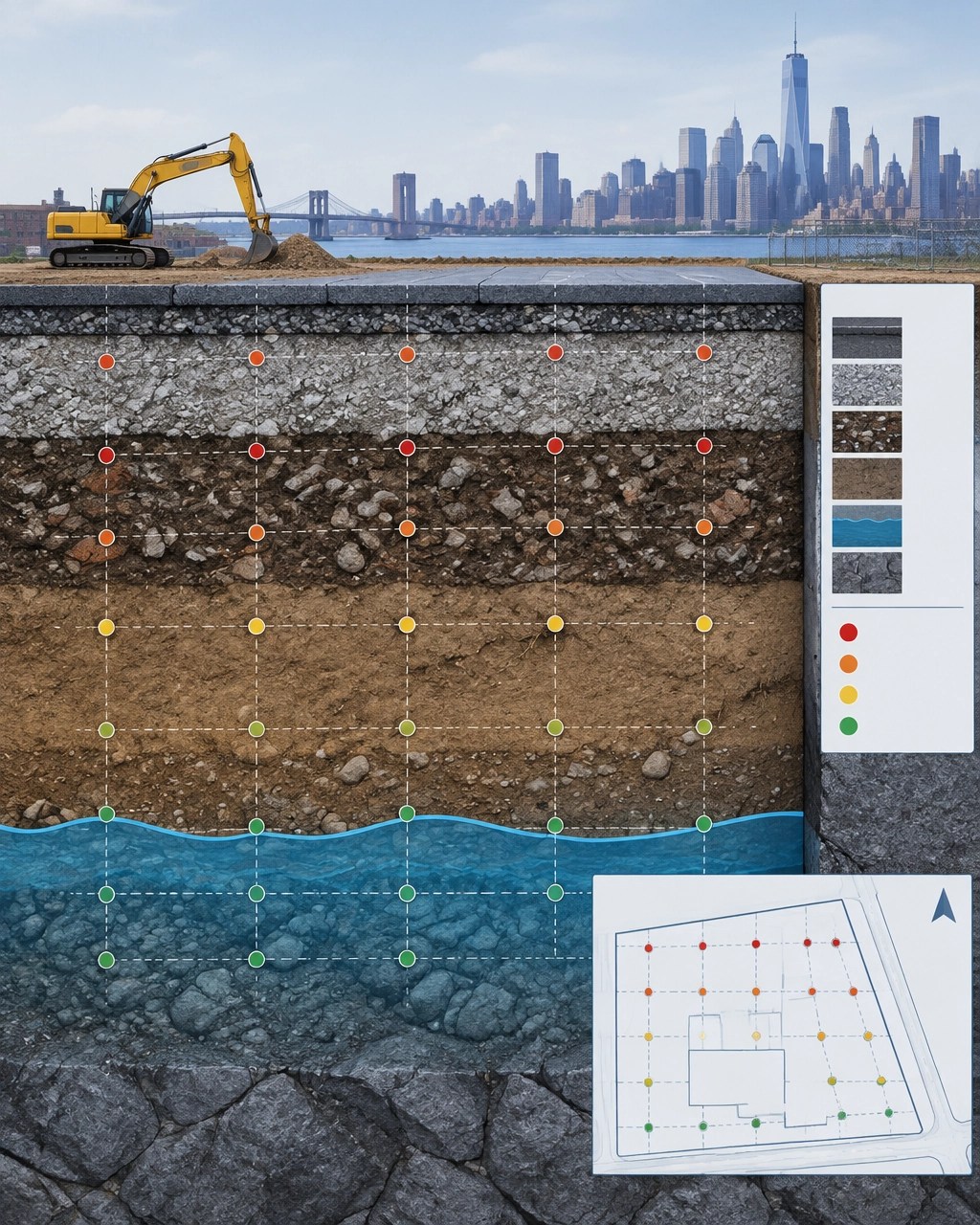
Unrestricted, residential, restricted-residential, commercial, and industrial SCOs
Unrestricted use
Unrestricted use is the most protective soil cleanup scenario. A Track 1 remedy generally requires the site to meet the unrestricted use SCOs in Table 375-6.8(a).
The objective is simple. The property should be suitable for any future use without environmental restrictions related to residual soil contamination.
For lead, the current unrestricted value is 63 ppm. That is substantially lower than the residential value of 400 ppm.
A project pursuing unrestricted use may therefore need:
- More extensive horizontal and vertical delineation.
- Additional excavation beyond the initial hot spots.
- More off-site disposal.
- More imported clean fill.
- Confirmation sampling across excavation bottoms and sidewalls.
- Stronger documentation that no engineering or institutional control is needed.
Residential use
Residential SCOs assume regular soil contact and include exposure scenarios relevant to homes, yards, children, and other sensitive receptors.
The current NYSDEC residential lead SCO is 400 ppm. This is not the same as an unrestricted use cleanup. A site can meet the residential value while still requiring controls, covers, or other conditions depending on the remedy.
Restricted-residential use
Restricted-residential use applies to a more controlled residential setting. The exposure assumptions differ from a typical single-family residential property.
For lead, the current restricted-residential SCO is also 400 ppm. That does not mean restricted-residential and residential remedies are interchangeable for every contaminant. Other contaminants may have different values under the two columns, and the selected remedy must address groundwater, ecological, vapor, and site-management requirements.
Commercial use
The current commercial lead SCO is 1,000 ppm. Commercial redevelopment may include offices, retail, parking, institutional uses, and other settings where soil exposure is more limited than in a conventional residential scenario.
The project still needs a defensible soil cover and soil management strategy. A commercial designation does not eliminate worker protection, dust controls, waste characterization, or agency review.
Industrial use
The current industrial lead SCO is 3,900 ppm. Industrial land use assumes a more limited exposure profile, but it is not a waiver from cleanup obligations.
Industrial properties often involve active excavation, utility installation, grading, and heavy equipment. Those activities can create short-term exposure risks that require a Construction Health and Safety Plan, air monitoring, dust suppression, and controlled handling procedures.
How revised lead criteria affect a Phase II sampling plan
A Phase II investigation should be designed around the likely decision path, not just a standard list of analytes.
If a developer is considering a residential or unrestricted-use outcome, the sampling plan should account for:
- Historic fill and documented fill placement.
- Former industrial operations.
- Lead-based paint, ash, slag, coal storage, and vehicle or rail activity.
- Surface soil exposure areas.
- Proposed building footprints, courtyards, play areas, landscaped zones, and utility corridors.
- Soil horizons that may be disturbed during excavation.
- Groundwater and ecological pathways where applicable.
A shallow composite sample may not define the problem. Lead can vary sharply over short distances in urban fill. A strong investigation uses a conceptual site model to determine where discrete samples, composites, borings, and step-out locations are needed.
The plan should also preserve flexibility. If proposed lead amendments move the applicable cleanup objective, an investigation that only targets the current threshold may not provide enough data to support the next remedial decision.
That does not mean every project should immediately sample every square foot. It means the team should understand the future land use, likely excavation limits, and regulatory pathway before mobilizing a drill rig.
Soil reuse, import fill, and the management plan
Lead results directly affect whether soil can remain on site, move within the site, be reused under an engineered cover, or leave the property as regulated material.
A practical soil management plan should identify:
- Soil that can be reused in a defined location.
- Soil that requires segregation and additional characterization.
- Soil that must be transported off site.
- Clean fill specifications for replacement material.
- Cover thickness and material requirements.
- Stockpile locations and cover procedures.
- Truck routing and tracking documentation.
- Imported fill sampling and certification requirements.
- Confirmation sampling and field screening procedures.
A soil result of 350 ppm lead may be manageable for one future use and unacceptable for another. A result of 1,200 ppm may require excavation from a residential area but could be evaluated differently in a commercial or industrial remedy, subject to the approved program and other contaminants.
Import fill decisions also need discipline. “Clean” does not mean visually clean. Imported material must meet the project’s approved criteria and be supported by documentation that satisfies NYSDEC, NYC OER, the owner, and the receiving facility.
This is where soil disposal certification and field oversight protect the budget. The goal is to avoid sending soil to a higher-cost facility when a documented reuse or lower-cost disposal pathway is available.
Lead changes and the disposal budget
Lead affects project economics in three ways.
First, a lower cleanup objective can increase the volume of soil that must be excavated. Second, higher concentrations can limit disposal options. Third, mixed contamination can control the final waste profile even when lead alone would not.
A credible budget should separate:
- Excavation and loading.
- Soil staging and handling.
- Laboratory analysis.
- Waste characterization.
- Transportation.
- Disposal tipping fees.
- Imported fill.
- Compaction and replacement.
- Dust suppression and air monitoring.
- Confirmation sampling.
- Agency review and reporting.
Do not budget from a single average concentration. Build a soil balance by area and depth. A lead hotspot under a future courtyard is not equivalent to a deeper result beneath a building footprint that will be isolated by a slab and engineered cover.
Envicon approaches these decisions in the field and in the spreadsheet. We connect Phase II data to excavation limits, disposal profiles, construction sequencing, and regulator expectations. That is how a report becomes a path forward.
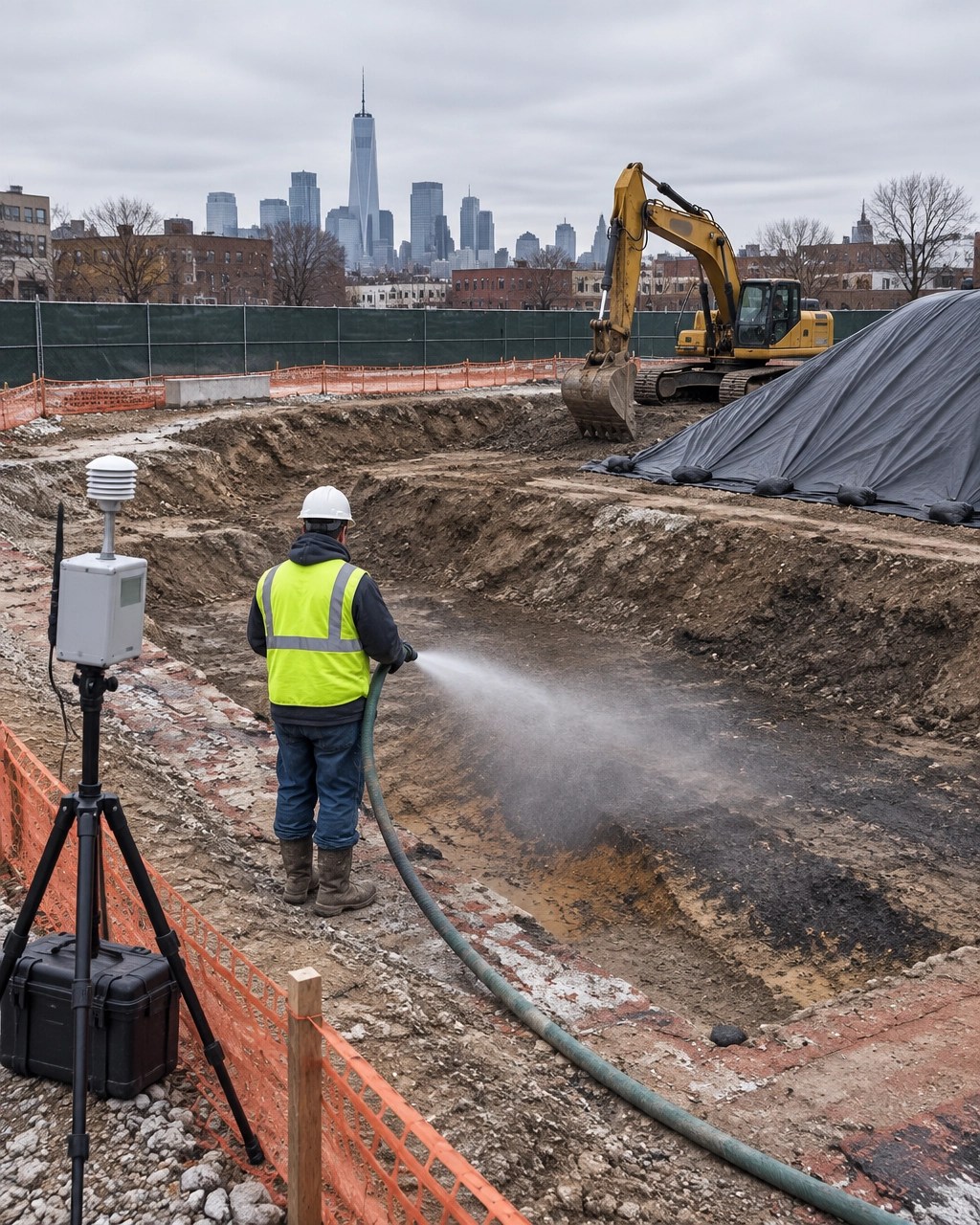
Dust and worker protection during excavation
Lead-contaminated soil becomes a construction-phase issue as soon as equipment begins grading, loading, or hauling.
The remedial work plan and CHASP should address:
- Worker training and appropriate PPE.
- Decontamination procedures.
- Wet methods and dust suppression.
- Covered or stabilized stockpiles.
- Truck and equipment decontamination.
- Work-zone control.
- Perimeter particulate monitoring.
- Community air monitoring where required.
- Weather and wind limitations.
- Procedures for unexpected contamination.
- Documentation of soil movement and daily field conditions.
EPA’s Regional Screening Levels guidance distinguishes screening levels from cleanup standards and emphasizes the importance of site-specific exposure pathways. Construction worker exposure is different from long-term residential exposure, but it still requires direct control during active disturbance.
Field oversight should not be an afterthought. The same environmental professional who understands the sampling data should be available when the excavator encounters a different soil layer, an unexpected odor, a buried structure, or a stockpile that does not match the approved profile.
How this interacts with NYC OER E-Designation sites
An NYC hazardous materials E-Designation creates an additional regulatory coordination requirement. According to NYC OER, an E-Designation requires soil testing and, when contamination is confirmed, an OER-approved Remedial Action Plan before development can proceed.
For an E-1 site, the lead question does not stop with NYSDEC Part 375. The project team must reconcile:
- The applicable Part 375 SCOs.
- OER’s Phase II requirements.
- The approved OER sampling and analysis plan.
- The proposed future land use.
- The RAP and CHASP.
- Soil disposal and import fill documentation.
- NYC construction sequencing.
- OER closure requirements before occupancy.
A lead result can therefore affect both the environmental remedy and the building permit schedule. A project that treats OER review as a separate administrative step may discover too late that the soil management plan, excavation limits, or cover design does not support the Notice of Satisfaction pathway.
Envicon’s NYC E-Designation and OER compliance team coordinates the investigation, RAP, CHASP, field implementation, and closure documentation with the development schedule.

What developers should do now
If your project involves lead, historic fill, or a New York brownfield program, take these steps before finalizing the 2026 budget:
- Confirm whether the project falls under BCP, State Superfund, ERP, NYC OER, or another program.
- Identify the proposed future use and remedial track.
- Use the current adopted Part 375 tables for present compliance decisions.
- Track the 2026 NYSDEC rulemaking for lead and PFOA/PFOS.
- Review whether the existing Phase II data support the current and reasonably foreseeable cleanup objectives.
- Build a soil balance by contaminant, area, depth, and destination.
- Obtain import fill documentation before material arrives.
- Price dust control, CAMP, worker protection, and confirmation sampling.
- Coordinate NYSDEC and OER requirements before excavation begins.
The takeaway
NYSDEC Part 375 is already revised and effective. The additional lead and PFOA/PFOS changes identified for 2026 are planned, not yet adopted.
The practical answer is not to guess at future numbers. It is to design a flexible investigation, connect the cleanup objective to the actual land use, and make soil movement decisions before construction starts.
We solve environmental and engineering challenges with precision, speed, and trust. Collaboration is not a buzzword. It is how a contaminated site becomes a buildable asset.
Work with Envicon Group
Need a clear path for a New York or New Jersey brownfield, lead soil issue, or NYC E-Designation?