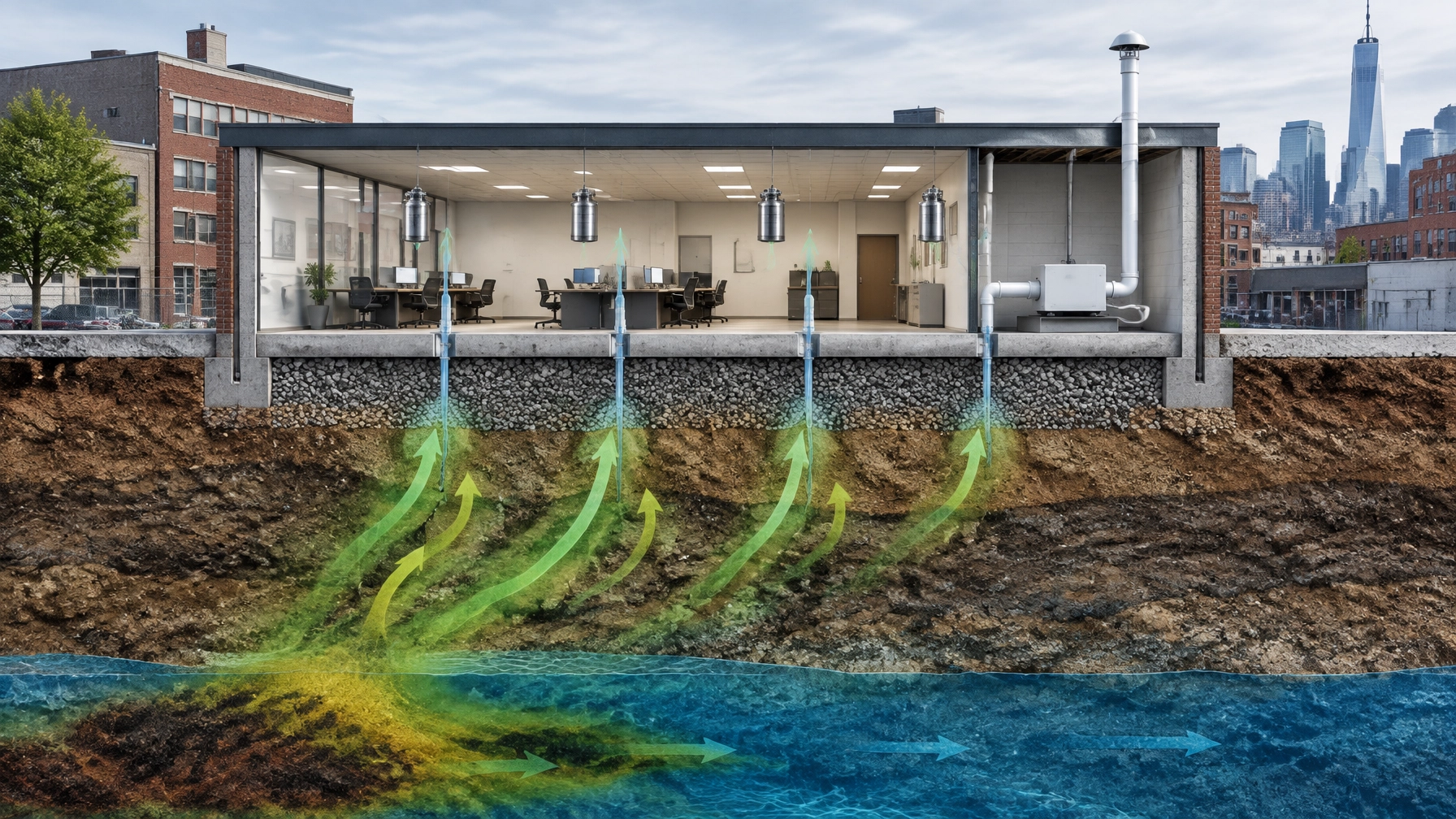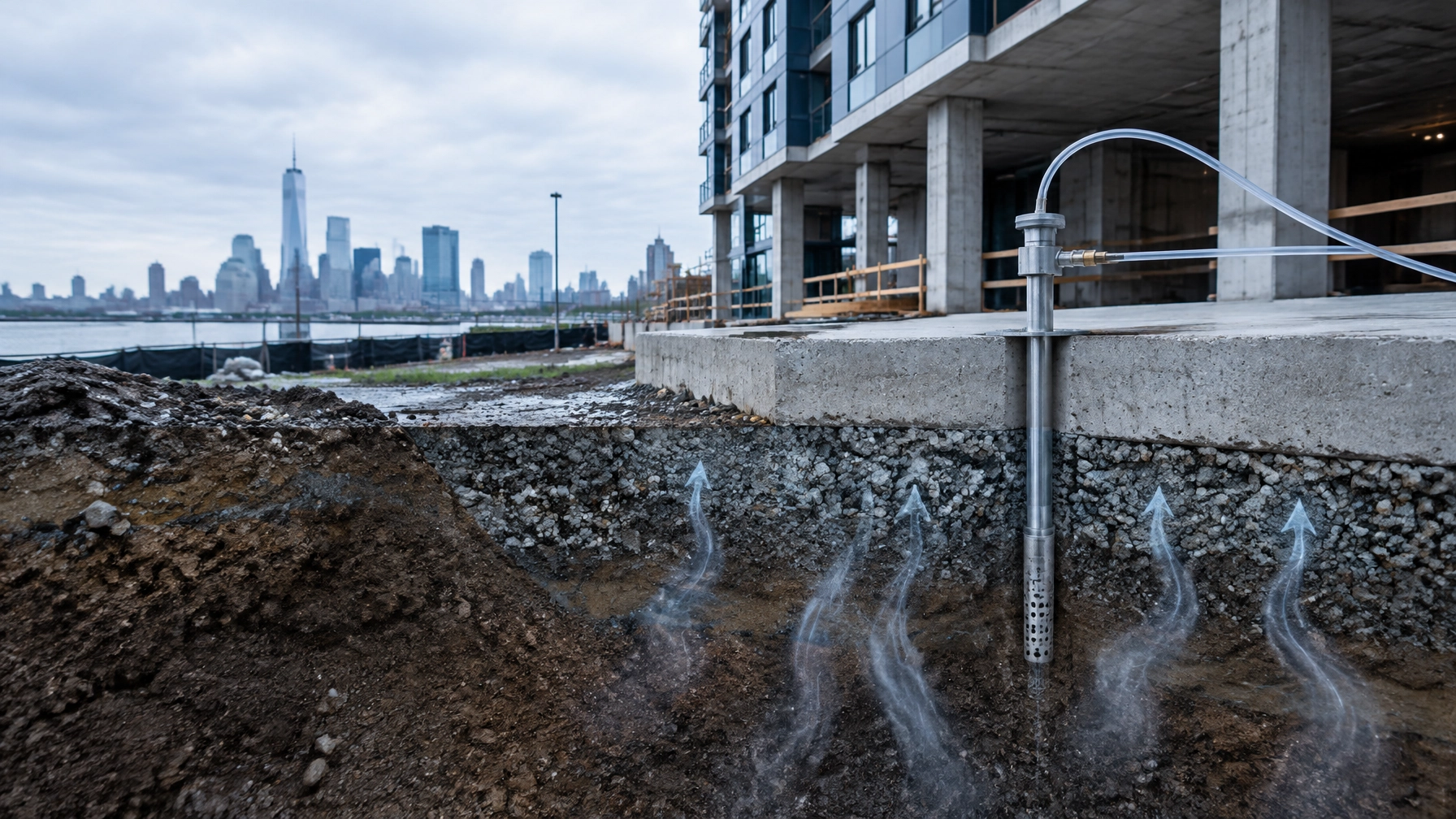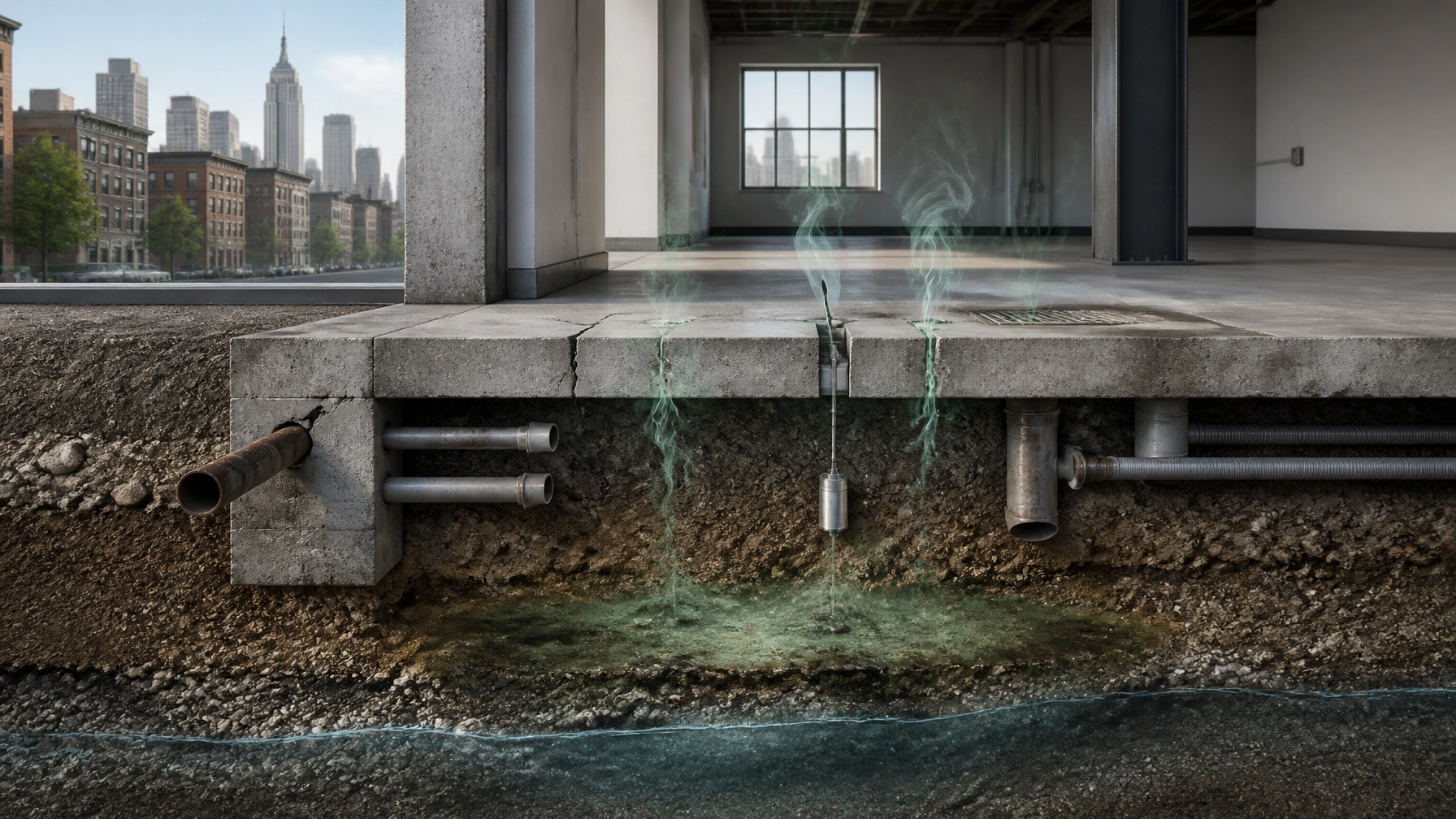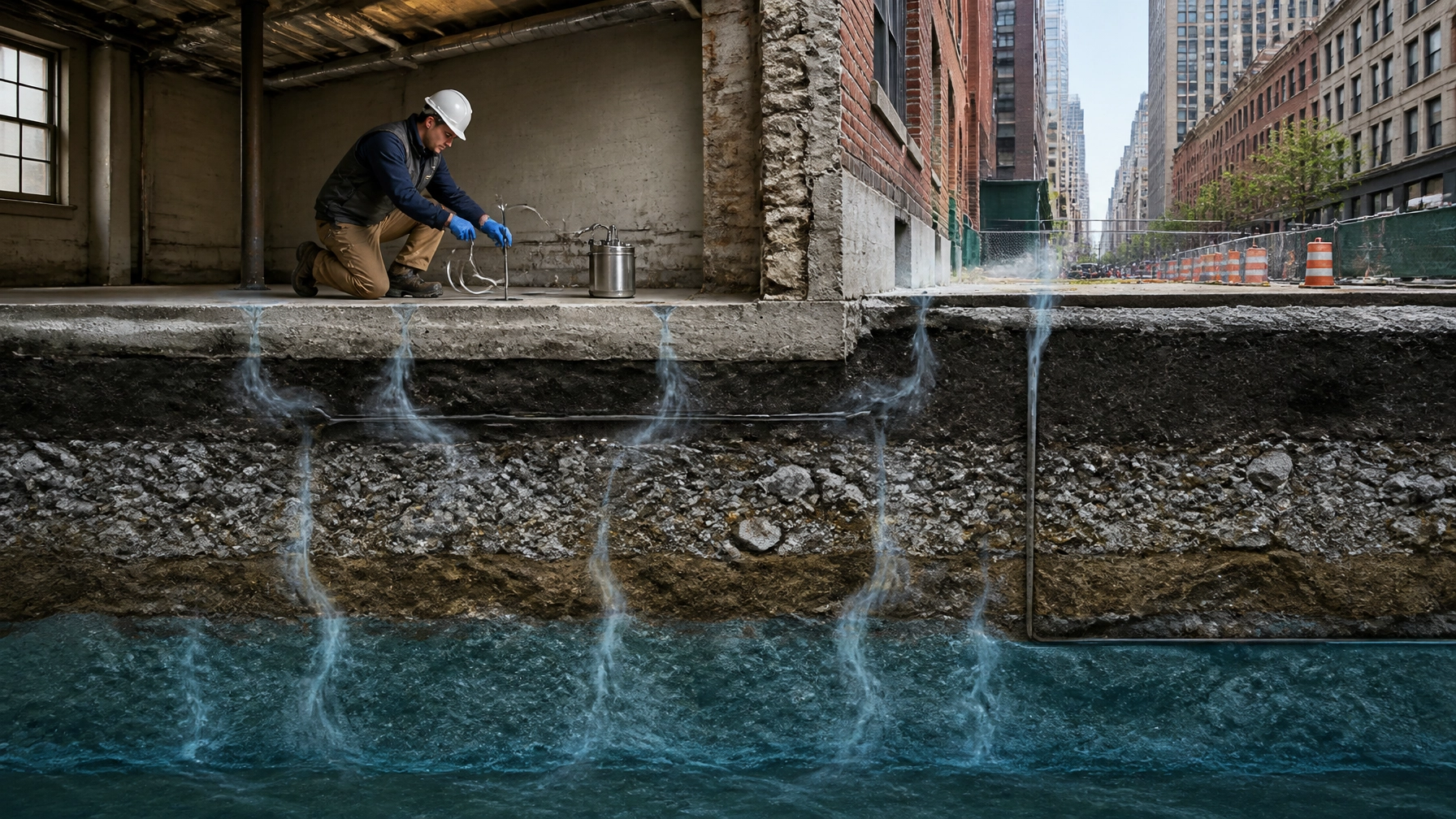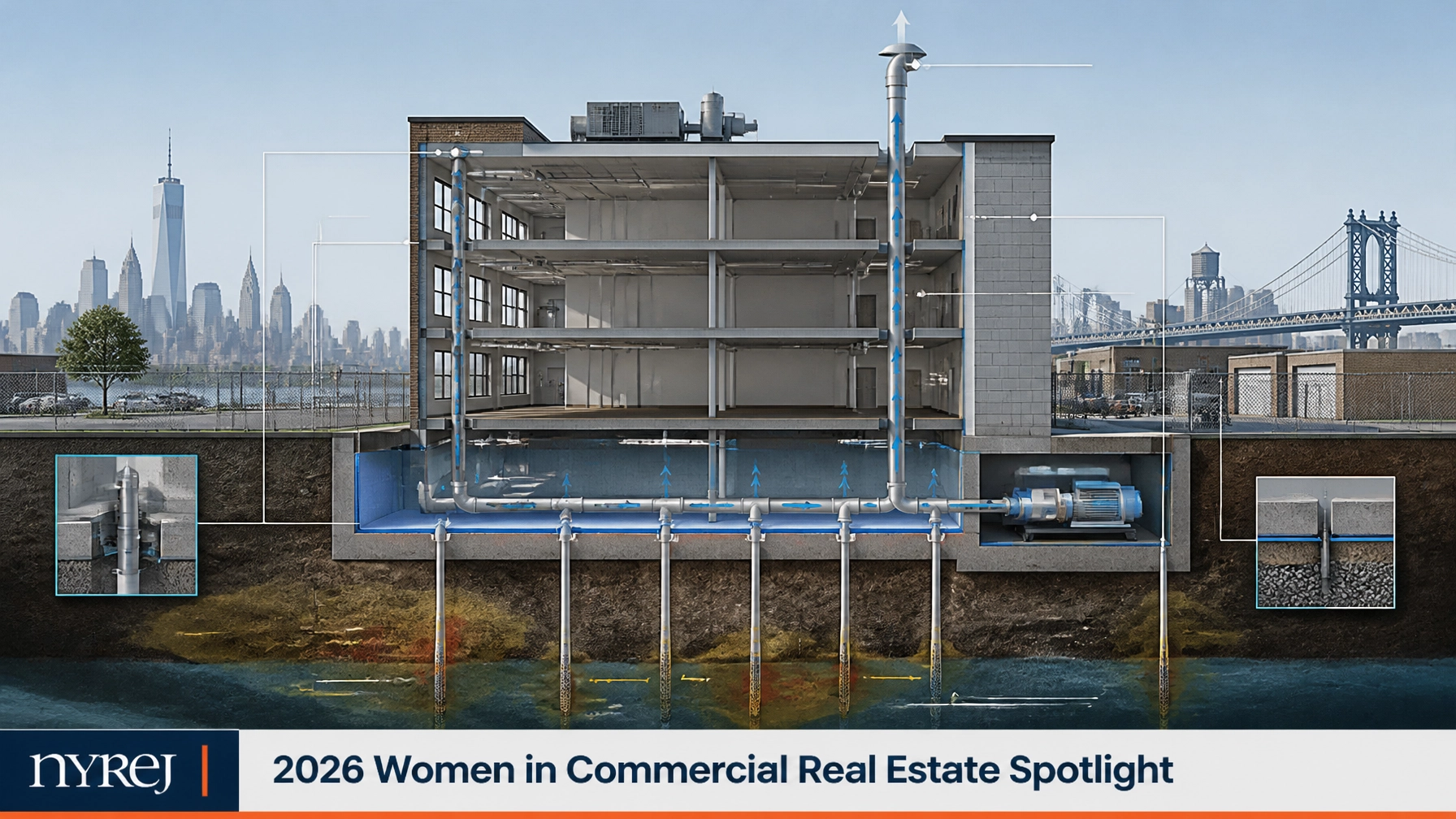
A vapor intrusion investigation and a Remedial Action Permit are not the same thing.
The investigation evaluates whether contaminants in soil gas, groundwater, or indoor air can reach building occupants. A Remedial Action Permit, or RAP, governs the controls and obligations that remain after the remedy relies on institutional or engineering controls.
That distinction matters for property owners, developers, lenders, attorneys, and buyers in Newark, Jersey City, Hoboken, Bayonne, Bergen County, Hudson County, and Essex County.
On February 17, 2026, the New Jersey Department of Environmental Protection modernized the RAP framework. Indoor air now appears as a formal permit media component alongside soil and groundwater. NJDEP also introduced a consolidated permit approach, updated forms, an Indoor Air Notification Area, and revised protectiveness certification requirements.
You can review the current NJDEP Site Remediation Program forms and NJDEP vapor intrusion guidance before making a transaction or redevelopment decision.
What changed on February 17, 2026?
The 2026 RAP modernization affects how New Jersey sites are permitted, maintained, modified, and closed.
The main changes include:
- A single RAP can address soil, groundwater, and indoor air.
- Indoor air is now a formal media component under the RAP structure.
- Indoor-air engineering and institutional controls must be incorporated into the permit when they are part of the remedy.
- NJDEP created the Indoor Air Notification Area, or IANA, as an institutional control for vapor intrusion conditions.
- Updated RAP applications and protectiveness certification forms support electronic submissions.
- Biennial certification requirements now include indoor-air monitoring, system maintenance, building surveys, and diagnostic measurements.
- NJDEP established five Focused RAP categories for certain less complex remedial scenarios.
The result is a more consolidated process. It is not a blanket approval for every vapor intrusion condition. NJDEP and the project LSRP still determine the appropriate pathway based on site conditions, contaminants, building use, sampling data, and the selected remedy.
Indoor air is now part of the permit conversation, not an issue to address separately after the RAP is submitted.
Investigation versus permit: the distinction property owners need
A vapor intrusion investigation answers a technical question:
Is there a completed or potentially completed pathway for contaminants to migrate from soil or groundwater into indoor air?
The investigation may include:
- Soil gas or sub-slab soil gas sampling
- Indoor-air sampling
- Groundwater sampling
- Building inspections
- Evaluation of preferential pathways
- Review of building use and occupancy
- Assessment of background sources such as solvents, cleaners, fuels, or dry-cleaning chemicals
- Comparison of results with current NJDEP screening levels and remediation standards
A RAP answers a different question:
What controls, monitoring, maintenance, notifications, and reporting obligations are necessary to keep the remedy protective over time?
A RAP may become necessary when the remedy relies on controls such as:
- Sub-slab depressurization
- Vapor barriers
- Soil vapor extraction
- HVAC modifications
- Building sealing
- Long-term indoor-air monitoring
- An Indoor Air Notification Area
- Other institutional or engineering controls
Not every vapor investigation leads to a RAP. A site with no complete pathway, no continuing control, and appropriate documentation may follow a different closure path. Conversely, installing a mitigation system without adding the indoor-air component to the RAP can create a compliance problem.
The correct determination depends on the project record. Do not assume that an old NFA letter, a prior report, or a completed sampling event resolves the current permit obligation.
Five Focused RAP categories
The February 17, 2026 RAP framework also includes five Focused RAP categories intended to streamline review for defined remedial scenarios.
These categories generally include:
| Focused RAP category | General application |
|---|---|
| Focused RAP I | Restricted-use soil remedy without engineering controls where concentrations fall within the applicable non-residential and migration-to-groundwater framework but remain above residential standards |
| Focused RAP II | Voluntary use of a presumptive soil remedy at a non-sensitive site |
| Focused RAP III | A presumptive or alternative presumptive remedy that NJDEP has already approved |
| Focused RAP IV | Historic-fill-only sites |
| Focused RAP V | Groundwater monitored natural attenuation where the CEA remains within the property boundary and no off-site receptors are affected |
Indoor air is not a separate sixth Focused RAP category. It is a media component that can be included in the consolidated RAP when the vapor intrusion remedy requires ongoing controls.
The Focused RAP categories do not eliminate the need for site-specific review. A Newark warehouse with a sub-slab system, a Jersey City mixed-use building, and a vacant industrial parcel in Bayonne may have different permit requirements even when the same contaminant is present.
Vapor intrusion sampling and mitigation
A technically defensible RAP begins with a technically defensible investigation.
Sampling should be planned around the building, the contaminant source, the likely migration pathway, and current or proposed property use. A typical evaluation may include sub-slab soil gas points, indoor-air samples, outdoor-air samples, groundwater data, and a detailed building survey.
The building survey matters. Cracks, sumps, utility penetrations, floor drains, foundation walls, recent construction, and changes in HVAC operation can affect vapor entry and indoor-air results.
Residential and commercial sampling requirements are not always identical. NJDEP guidance generally uses 24-hour indoor-air samples for residential settings. Commercial and industrial sampling may use shorter durations when technically justified and consistent with the approved investigation approach.
Potential mitigation systems include:
- Active sub-slab depressurization
- Passive vapor mitigation systems
- Vapor barriers
- Sealing of preferential pathways
- HVAC adjustments
- Soil vapor extraction
- Supplemental monitoring points
- Building-specific operation, maintenance, and monitoring plans
After installation, the system must be commissioned and shown to perform as designed. Confirmation sampling and ongoing monitoring should follow the approved work plan and RAP requirements.

The Indoor Air Notification Area and property sales
The Indoor Air Notification Area is one of the most important changes for property transactions.
An IANA identifies the geographic area associated with an indoor-air or vapor intrusion control. It functions similarly to a groundwater Classification Exception Area, but it addresses the indoor-air pathway.
An IANA may require:
- A defined geographic boundary
- Maps and GIS deliverables
- Sampling information
- Notification to affected municipalities and counties
- Notification to owners, tenants, and occupants of occupied structures
- Continuing compliance with the RAP
- Updates when building conditions or the vapor pathway change
For a property sale in an NJ indoor air notification area, the buyer, lender, title company, and counsel need to understand more than the existence of the IANA. They need to confirm:
- Which buildings and units fall within the boundary
- Whether a mitigation system is operating
- Who owns and maintains the system
- Whether monitoring is current
- Whether biennial certifications are complete
- Whether financial assurance is required
- Whether a RAP modification is pending
- Whether the proposed use or building changes could alter the pathway
An IANA does not automatically prevent a sale. It does create a documented compliance obligation that must be understood before closing.

The consolidated RAP pathway for Newark and Jersey City
The following sequence provides a practical planning framework. The actual requirements remain subject to NJDEP review and the LSRP’s professional judgment.
| Project stage | Key action | Transaction or redevelopment concern |
|---|---|---|
| 1. Records review | Review prior reports, NFA or RAO documents, deed notices, RAPs, and DataMiner records | Older documents may not reflect the 2026 indoor-air framework |
| 2. Site investigation | Evaluate soil, groundwater, soil gas, indoor air, building conditions, and occupancy | A previous Phase II may not address current vapor intrusion conditions |
| 3. Pathway determination | Determine whether the pathway is incomplete, complete, indeterminate, or requires rapid action | Results can affect construction sequencing and lender conditions |
| 4. Remedy selection | Select monitoring, mitigation, engineering controls, institutional controls, or additional investigation | The remedy must match current and planned use |
| 5. RAP application | Submit the consolidated RAP application or new indoor-air media component application | A missing indoor-air component can delay approval or closing |
| 6. IANA documentation | Define the area, prepare GIS materials, and complete required notifications | Boundary and notice issues can create title and occupancy concerns |
| 7. System commissioning | Document installation, diagnostic measurements, and baseline operating conditions | Buyers and lenders need evidence that the system works |
| 8. Ongoing compliance | Complete annual VI mitigation monitoring and maintenance checks and biennial certification | Missed reporting can undermine protectiveness and transaction readiness |
| 9. Closure evaluation | Coordinate RAO, RAP termination, or removal of a media component where appropriate | System shutdown requires documented criteria and NJDEP approval |
Biennial certification and electronic submissions
A RAP is not finished when NJDEP issues the permit.
The permittee must demonstrate that the remedial action remains protective. NJDEP’s Remedial Action Protectiveness and Biennial Certification instructions identify indoor-air documentation that may include:
- Indoor-air and sub-slab sampling results
- Historical results in tabular form
- Scaled sampling location maps
- Indoor Air Building Survey and Sampling Forms
- Building envelope inspections
- Annual system diagnostic measurements
- Vapor Intrusion Mitigation Monitoring and Maintenance checklists
- Operation, maintenance, and monitoring information
- Updated GIS or IANA information
- Financial assurance documentation when an engineering control applies
For vapor mitigation systems, VI monitoring and maintenance checklists are required annually for each building or unit. At least two checklists should support a two-year biennial certification period.
The current instructions also identify electronic submission procedures. The latest NJDEP form should always control because forms, instructions, standards, and submission requirements can change.
Post-NFA, RAO, and RAP coordination
A post-NFA property requires careful review.
A limited restricted-use or restricted-use NFA may leave continuing obligations that require a RAP. The fact that a property received an NFA does not necessarily mean that all future vapor intrusion requirements are resolved.
An RAO for a vapor intrusion area of concern also does not automatically terminate every RAP or IANA obligation. If the owner believes a mitigation system is no longer necessary, the supporting data must meet the applicable requirements. NJDEP’s current instructions identify conditions that may include:
- Two sampling events
- Results at or below the applicable standards
- Sampling events separated by at least four months
- At least one event during the heating season
- The active system capped or shut down for the required period before sampling
- A RAP termination or media-component removal application
- NJDEP approval before permanent system shutdown
Do not shut down a mitigation system permanently simply because one sampling event looks favorable. Coordinate the evaluation with the LSRP, lender, counsel, and NJDEP requirements.
What lenders and title teams should request
For a Newark or Jersey City acquisition, request a focused RAP and vapor review early in due diligence.
At minimum, obtain:
- The current RAP and all modifications
- The latest biennial certification
- The current IANA map and fact sheet
- Recent indoor-air and sub-slab results
- Mitigation system commissioning records
- Annual VI monitoring and maintenance checklists
- Operation and maintenance plans
- Financial assurance records, when applicable
- Deed notices or other institutional controls
- The current LSRP status
- Any pending NJDEP correspondence or corrective action
At Envicon, we coordinate the technical record with the transaction team. That means the developer, attorney, lender, title company, architect, and contractor understand the same compliance path before the closing date becomes the schedule driver.
Our team provides vapor intrusion assessments, NJ LSRP services, and direct project support for Jersey City properties. We focus on clean documentation, direct communication, and decisions that move the property toward a buildable, financeable outcome.
What to do before your next closing
If your property is in Newark, Jersey City, Hoboken, Bayonne, Bergen County, Hudson County, or Essex County:
- Review the existing RAP, NFA, RAO, deed notice, and DataMiner record.
- Confirm whether indoor air is already included as a RAP media component.
- Determine whether an IANA applies.
- Verify that mitigation systems are operating and documented.
- Check whether annual monitoring and biennial certification are current.
- Identify proposed construction or occupancy changes that could alter the vapor pathway.
- Have an LSRP evaluate whether a RAP modification, new media component, or closure application is necessary.
- Give the lender and title team a clear compliance package before they raise conditions.
The 2026 RAP modernization creates a clearer framework, but it also makes incomplete documentation easier to identify. The right response is not to order another generic report. It is to connect the investigation, permit, mitigation system, IANA, ongoing certification, and transaction schedule into one defensible plan.
Request a vapor and RAP review
If you are buying, selling, refinancing, designing, or redeveloping a property with a vapor concern, contact Envicon for a project-specific review.
- Request a vapor intrusion and RAP review
- Call Envicon at (917) 764-2171
- Use the proprietary project risk screener
We solve environmental and engineering challenges with precision, speed, and trust. Collaboration is not a buzzword. It is how we keep complex New Jersey projects moving.