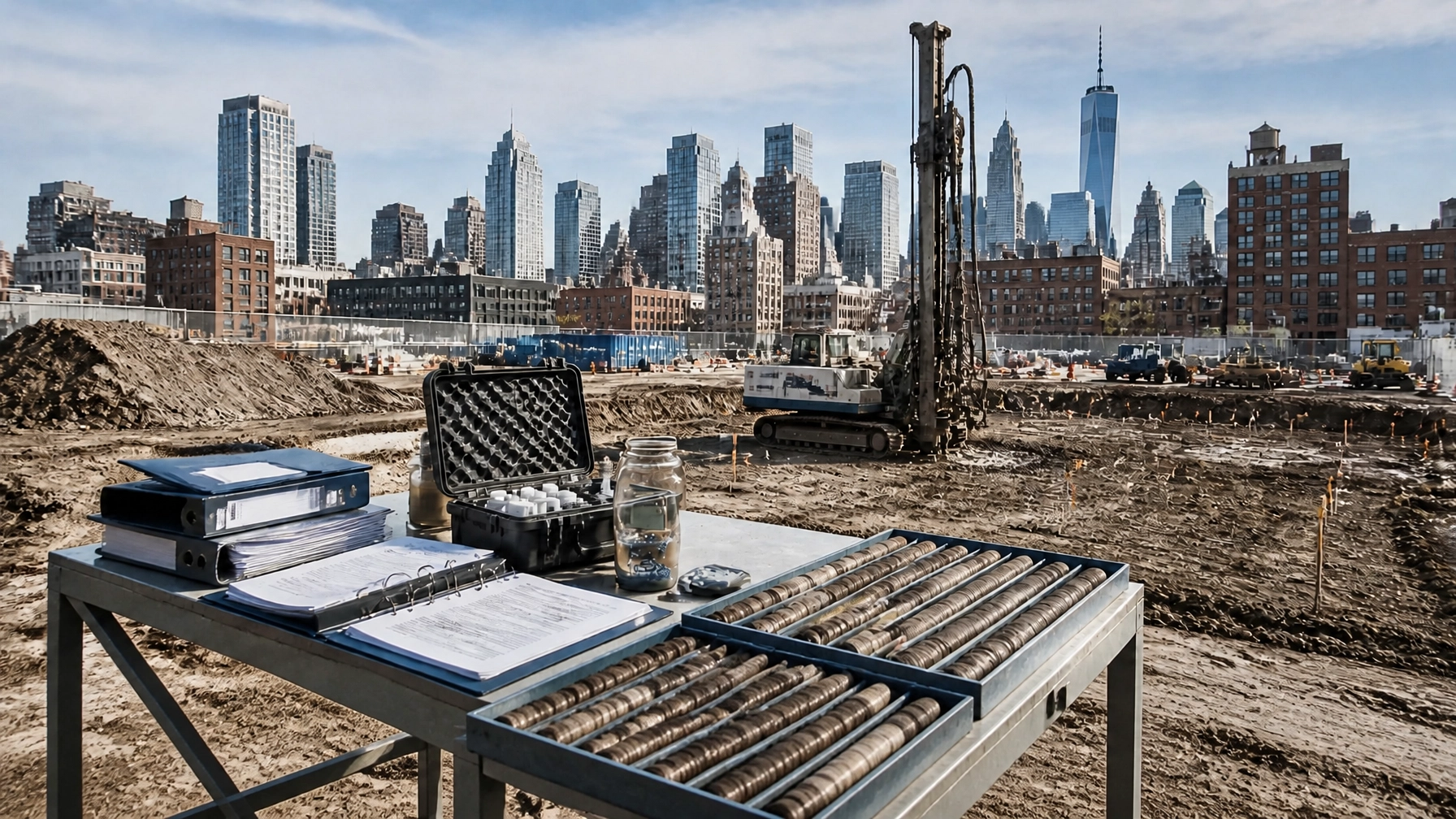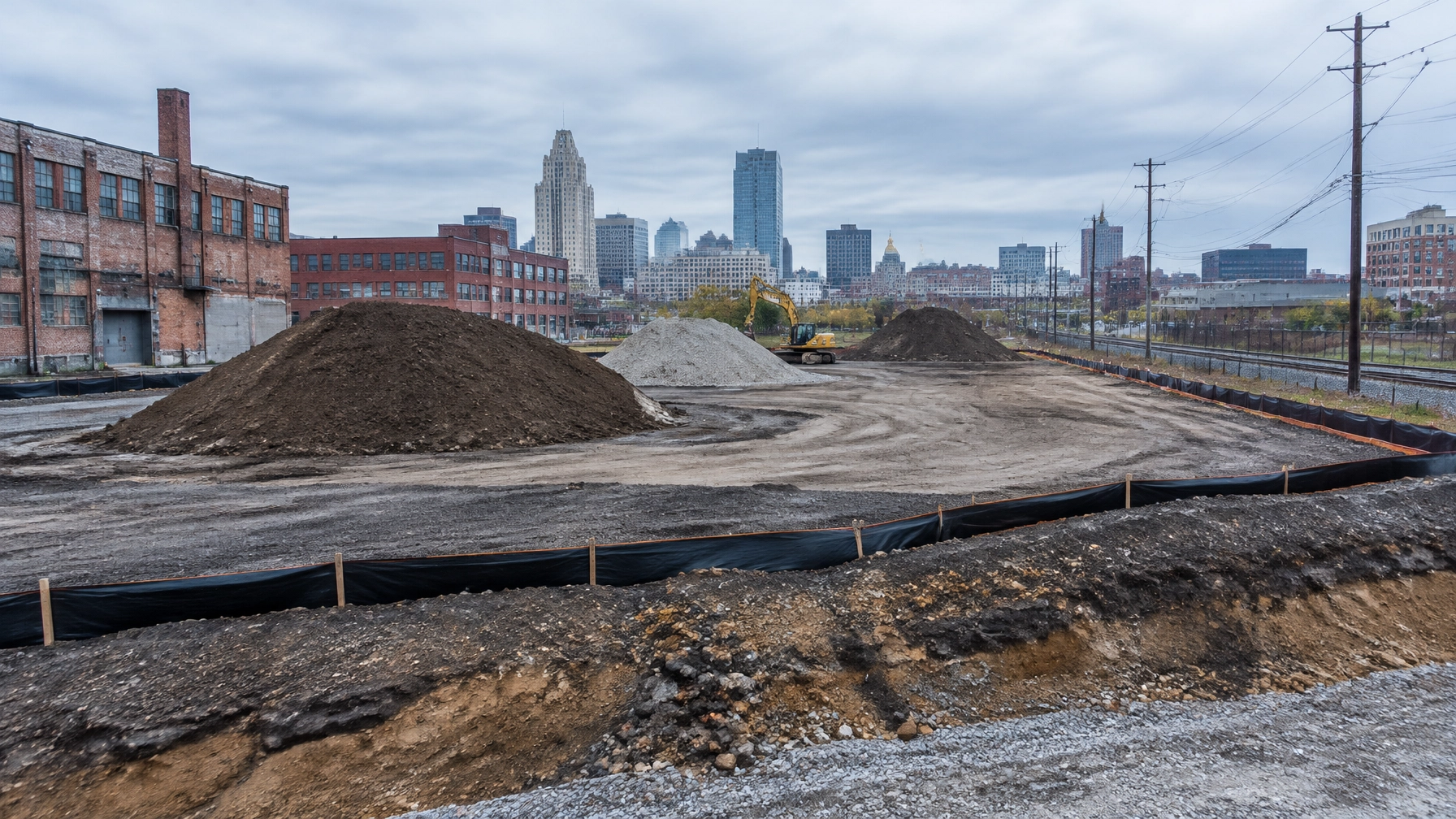
A Newark brownfield does not automatically need an Environmental Justice Impact Statement (EJIS). The proposed facility and permit determine that. But if your project falls under New Jersey’s Environmental Justice rules, N.J.A.C. 7:1C, an incomplete EJIS or late public process can hold up the permit path.
The rules were affirmed by the New Jersey Appellate Division in January 2026. NJDEP also revised its EJIS Guidance on July 1, 2026. For developers, lenders, attorneys, and LSRPs, the practical move is to check applicability early, then coordinate the EJIS with the remediation and permitting schedule.
First question: Does the rule apply to this Newark project?
The rules apply to permit applications for a new or expanded covered facility, or renewal of an existing major-source permit, when the facility is located or proposed to be located, in whole or in part, in an overburdened community (OBC). The permit must be an individual permit, registration, or license covered by the rule.
Covered facility types include major air-pollution sources; landfills; scrap-metal facilities; certain solid-waste, transfer, and recycling facilities; resource-recovery facilities and incinerators; certain sludge facilities; sewage-treatment plants with permitted flows over 50 million gallons per day; and specified medical-waste incinerators. The NJDEP rule, N.J.A.C. 7:1C, defines the facilities and permits in detail.
An OBC is a census block group meeting at least one statutory threshold: 35% or more of households are low-income, 40% or more of residents identify as minority or as members of a State-recognized tribal community, or 40% or more of households have limited English proficiency. Check the actual facility footprint and block group. A citywide label is not a project-specific determination.
The rule also excludes an authorization or approval necessary to perform remediation from its definition of a covered permit. That exclusion matters for brownfield redevelopment NJ projects, but it does not automatically exempt later permits for a covered operating facility.

For screening, confirm the parcel boundary and municipal block and lot. A nearby OBC boundary is not a substitute for checking which block group the facility occupies.
Use the right EJMAP version for the application date
EJMAP is not just a map showing OBCs. It helps identify OBC and adjacent block-group designations and the environmental and public-health stressors used in screening.
As of 2026, NJDEP’s updated designations use 2024 American Community Survey (ACS) data for census-based factors. The March 2026 update notice states that the revised EJMAP stressor data became the default for relevant permit applications received on or after March 31, 2026. Earlier applications in process continue to use the archived layer corresponding to their submission date. Some stressor layers rely on ACS data; others draw from agency, air-quality, traffic, water, and contaminated-site datasets.
This distinction can affect the OBC designation and the stressor picture used in an EJIS. NJDEP advises applicants to select the EJMAP version by the permit application’s submission date, not simply by the date the property was investigated. Review the NJDEP EJMAP update notice and the NJDEP EJMAP community mapping page.
What the EJIS has to analyze
The EJIS is a project-specific assessment, not a generic environmental report. It uses NJDEP’s initial screening information to identify stressors, determine which are adverse relative to the applicable geographic point of comparison, and establish whether the OBC has adverse cumulative stressors.
The comparison uses the lower of the State or county’s 50th-percentile value for each stressor, excluding other OBCs from that comparison. The screening then considers the combined total of adverse stressors. If the community has adverse cumulative stressors, or if the facility cannot demonstrate that it will avoid creating a disproportionate impact, supplemental information is required.
The July 1, 2026 EJIS Guidance recommends obtaining screening information from EJMAP or NJDEP before preparing the statement. It specifically advises using facility boundaries and municipal block and lot numbers to identify the correct census block group. NJDEP reviews the EJIS in the NJDEP Online portal and must authorize the applicant to proceed with the public process.
For a Newark redevelopment, the analysis can require coordination between the facility plan and existing project records, including site history, contamination and remediation information, air quality, stormwater, traffic, utilities, and proposed operations. Prepare the material around the actual site and proposed use. Do not treat the EJIS as a repackaging of the Phase I, Phase II, or remedial action report.
The public hearing is a schedule item, not a box to check
Once NJDEP authorizes the applicant to proceed, the rule sets a substantial notice and participation process. The public hearing must generally take place in the OBC on a weekday no earlier than 6 p.m. It must include a virtual component, which must be recorded and available online through at least the end of the comment period.
Applicants must provide notice at least 60 days before the hearing. Notice includes publication in at least two newspapers circulating in the OBC, including a representative local non-English-language newspaper if applicable; certified-mail notice to owners and residents within 200 feet of the facility; notice to municipal officials and NJDEP; and a site sign. The written-comment period must last at least 60 days total and remain open for at least 30 days after the hearing. Afterward, the applicant submits the hearing transcript and responds to comments. A material project change can require an amended EJIS and additional public notice and hearing.
Those are minimum procedural requirements, not a guaranteed overall permit schedule. The project also needs time for NJDEP review, hearing preparation, public comments, written responses, and the Department’s decision. Under the rule, NJDEP cannot issue its decision until at least 45 days after the public hearing. A permit application subject to the rules is not considered complete for review before NJDEP issues its decision.

The impact review needs to connect the proposed facility’s construction and operations to the surrounding conditions, not just list map layers.
Do not let EJ coordination derail ISRA or the RAP
For a brownfield, keep the regulatory tracks distinct and coordinated. An approval necessary to perform remediation is excluded from the EJ rule’s permit definition. That does not decide whether a later operating-facility permit triggers an EJIS. Applicability depends on the facility category, the permit type, and the OBC location.
A practical sequence for Newark environmental due diligence for developers is:
- Confirm the proposed use and facility category. Do this before assuming an EJIS is required or not required.
- Check the footprint against current OBC mapping. Use the correct EJMAP version for the permit-submission date, and verify the parcel and census block group.
- Identify the NJDEP permits and the applicable path. Ask NJDEP for a determination if coverage is uncertain.
- Map the EJIS schedule against ISRA and the Remediation Action Permit (RAP) track. Carry remediation work forward while the separate EJIS applicability and public-process questions are resolved.
- Coordinate the technical record. Align project descriptions, proposed operations, control measures, site maps, and schedules across the EJIS and related submittals.
- Plan the hearing before the permit deadline becomes urgent. Budget for required notices, the comment period, response documents, and NJDEP’s decision.
This is where a consultant’s role should extend beyond producing a report. Our regulatory compliance and permitting team coordinates permit requirements and agency communication. For Newark environmental projects, we work with the project team to connect the EJ work with the site’s investigation, ISRA and RAP obligations, and construction sequence. The goal is a clear path through each review, with no avoidable gaps between disciplines.
What the 2026 court decision means for applicants
In January 2026, the Appellate Division affirmed NJDEP’s Environmental Justice rules. The court’s decision means applicants should plan against the rule as an active permitting requirement, not assume its provisions are on hold.
For a new covered facility, if NJDEP determines the applicant cannot avoid a disproportionate impact, the Department must deny the application unless the applicant demonstrates a compelling public interest in the OBC. That is a narrow showing. It must establish an essential environmental, health, or safety need for OBC residents, why the facility is necessary to meet that need, and why reasonable alternatives outside the OBC are unavailable. The rule says economic benefits do not count toward that showing.
Expansion and major-source renewal applications follow different provisions and may result in permit conditions. The precise consequences depend on the type of facility and application. Do not assume the same test applies to every project.

The hearing is a formal part of the NJDEP review. Clear notices, accessible presentation materials, and a complete record help keep the process orderly.
Key takeaway for Newark developers
An EJIS is not automatic for every contaminated parcel. The trigger is a covered facility, a covered NJDEP permit, and a location in an OBC. When the rules do apply, screening, analysis, hearing logistics, public comments, and NJDEP’s decision all belong on the project schedule.
Check applicability before finalizing the permit path. Use the correct EJMAP layer. Keep the ISRA and RAP work coordinated, but do not confuse remediation authorization with a later operating permit. NJDEP’s Environmental Justice law and rules and the July 2026 guidance are the controlling references for planning.
Frequently asked questions
Does every Newark brownfield redevelopment need an EJIS?
No. A brownfield designation alone does not trigger an EJIS. The rule applies to specified facility and permit categories in an OBC. A remediation authorization necessary to perform remediation is excluded from the covered-permit definition.
Does an EJIS replace ISRA or a RAP?
No. The EJIS process does not replace ISRA compliance or a Remediation Action Permit. Where applicable, coordinate the separate tracks and their schedules.
Which EJMAP data should a 2026 permit application use?
NJDEP’s 2026 update notice says relevant applications received on or after March 31, 2026 use the updated default stressor data. Applications already in process use the archived layer associated with their submission date. Confirm the applicable version with NJDEP for the specific project.
Can NJDEP deny a new facility permit?
Yes. If a new covered facility cannot avoid a disproportionate impact, NJDEP must deny the application unless the applicant demonstrates a compelling public interest under the rule’s criteria. Economic benefits alone do not meet that standard.
Plan the permitting path before the hearing clock starts
If you’re evaluating a Newark project, we can help determine whether EJ coordination belongs in the permit schedule and how it fits alongside remediation and redevelopment milestones. We’re a regional team that works directly with project stakeholders and regulators. You get clear answers, coordinated deliverables, and an accountable point of contact.