An NYC OER E-designation is not a footnote in a zoning report. It is a development condition tied to a specific tax lot. It can affect your acquisition budget, construction schedule, building design, lender approvals, permits, and certificate of occupancy.
If you are buying an environmentally challenged property in New York City, review the E-designation before you sign the contract. Do not wait until the architect is preparing DOB filings or the excavator is mobilized.
The governing framework includes Zoning Resolution Section 11-15 and Title 43, Chapter 14 of the Rules of the City of New York. NYC’s Office of Environmental Remediation, or OER, administers the requirements.
“A property with an E-designation means that, as a consequence of a zoning action, a property has environmental requirements relating to air, noise or hazardous materials.”
Source: NYC Office of Environmental Remediation
What an NYC E-Designation Means for a Buyer
An E-designation is placed on a tax lot through a zoning action or other land use action reviewed under the City Environmental Quality Review process, commonly called CEQR.
The environmental requirements appear in the applicable CEQR determination and are reflected in the City’s zoning records. A related Environmental Restrictive Declaration, or ERD, may also be recorded against the property.
An E-designation may address one or more of three conditions:
- Hazardous materials
- Air quality
- Noise
The designation does not always mean contamination is confirmed. It means the City identified a potential environmental concern that must be investigated or addressed before certain development actions can proceed.
The specific obligations depend on the language attached to the block and lot. Check the designation itself, the CEQR document, title records, and the proposed development plan.
Under Zoning Resolution Section 11-15, DOB generally needs an OER notice before issuing a building permit, temporary certificate of occupancy, or final certificate of occupancy for covered work.
How an E-Designation Gets Placed
The process usually begins during a zoning amendment, special permit, variance, authorization, or other land use action.
As part of CEQR, the lead agency evaluates potential environmental impacts. For hazardous materials, the review may include:
- Historical Sanborn maps
- City directories
- Regulatory database records
- Petroleum storage and spill records
- Existing or former industrial uses
- Dry cleaners, auto repair facilities, filling stations, and manufacturing
- Site inspections
- Potential contamination on adjacent properties
For air and noise, the CEQR review may identify conditions such as nearby emission sources, boiler stack impacts, major roadways, rail activity, or other significant noise sources.
If the review identifies a concern, the City may establish an E-designation for the affected tax lot. The designation is then listed with the applicable zoning requirements. An ERD may be recorded in the land records to bind current and future owners.
That is why the designation should be treated as a title and development issue, not just an environmental issue.
The Three E-Designation Components
1. Hazardous Materials E-Designation
A hazardous materials E-designation focuses on contamination in soil, groundwater, soil vapor, or other environmental media.
The standard path includes:
- Phase I ESA and historical review
- OER-approved Phase II Investigative Work Plan
- Phase II sampling and laboratory analysis
- OER review and determination
- Remedial Action Plan, if required
- Construction Health and Safety Plan
- Remediation and field oversight
- Remedial Closure Report
- OER notice of satisfaction or notice of no objection
The NYC OER E-designation rules require the applicant to complete a Phase II Environmental Site Assessment before receiving a building permit for covered development, unless OER accepts evidence that a Phase II is not required.
What the Phase I does
The Phase I establishes the site history and identifies recognized environmental conditions or other concerns. It may review former uses, tanks, spills, waste handling, adjacent properties, and regulatory records.
For an E-designation, the Phase I is usually submitted with a proposed soil and groundwater testing protocol. The protocol identifies:
- Sampling locations
- Sampling depths
- Analytical parameters
- Field methods
- Laboratory methods
- Potential chemicals of concern
Do not start sampling simply because the protocol appears reasonable. OER approval is required before field sampling begins when the applicable E-designation requires it.
Envicon supports this early due diligence through Phase I Environmental Site Assessments and project-specific investigation planning.
What the Phase II does
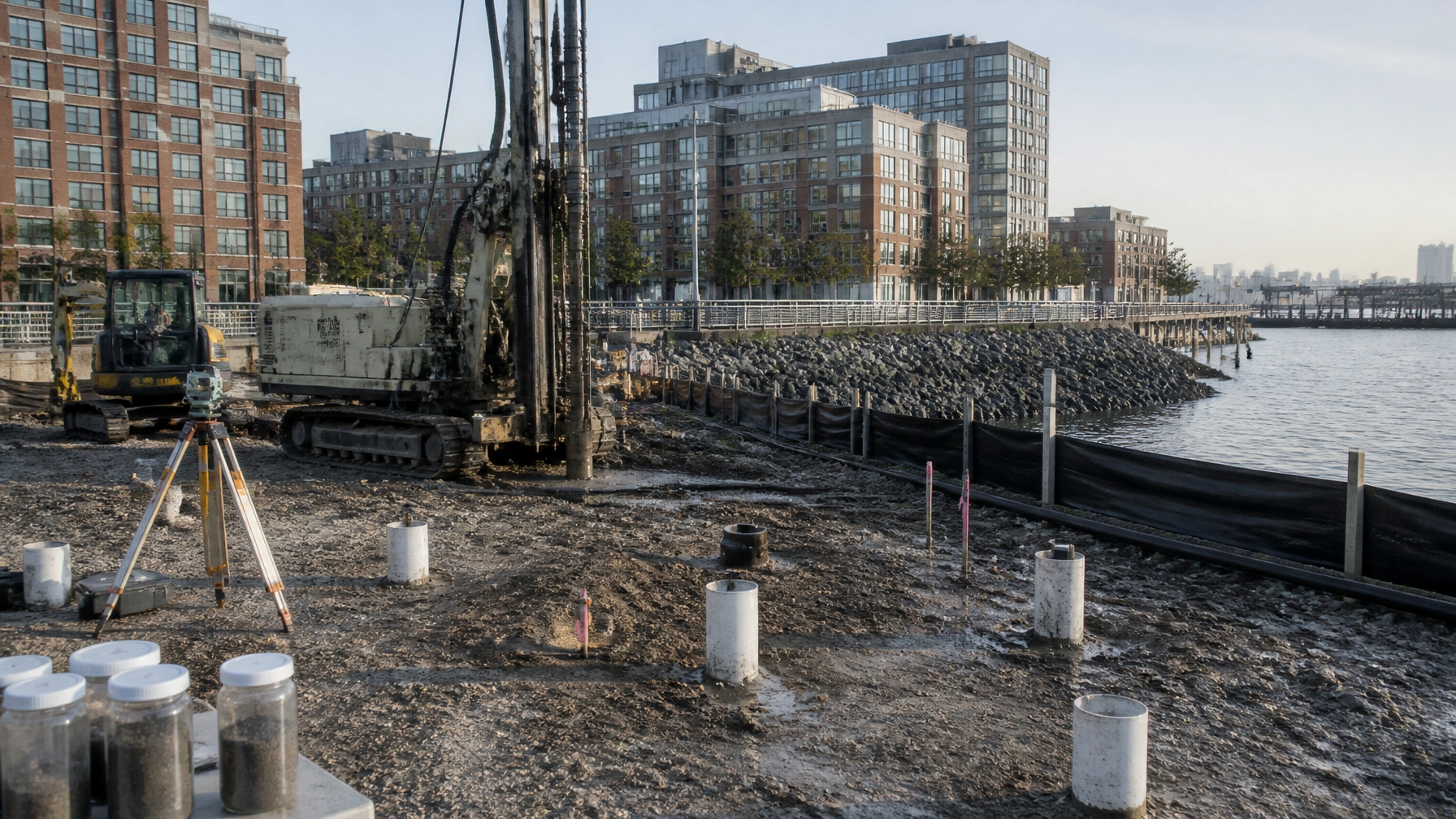
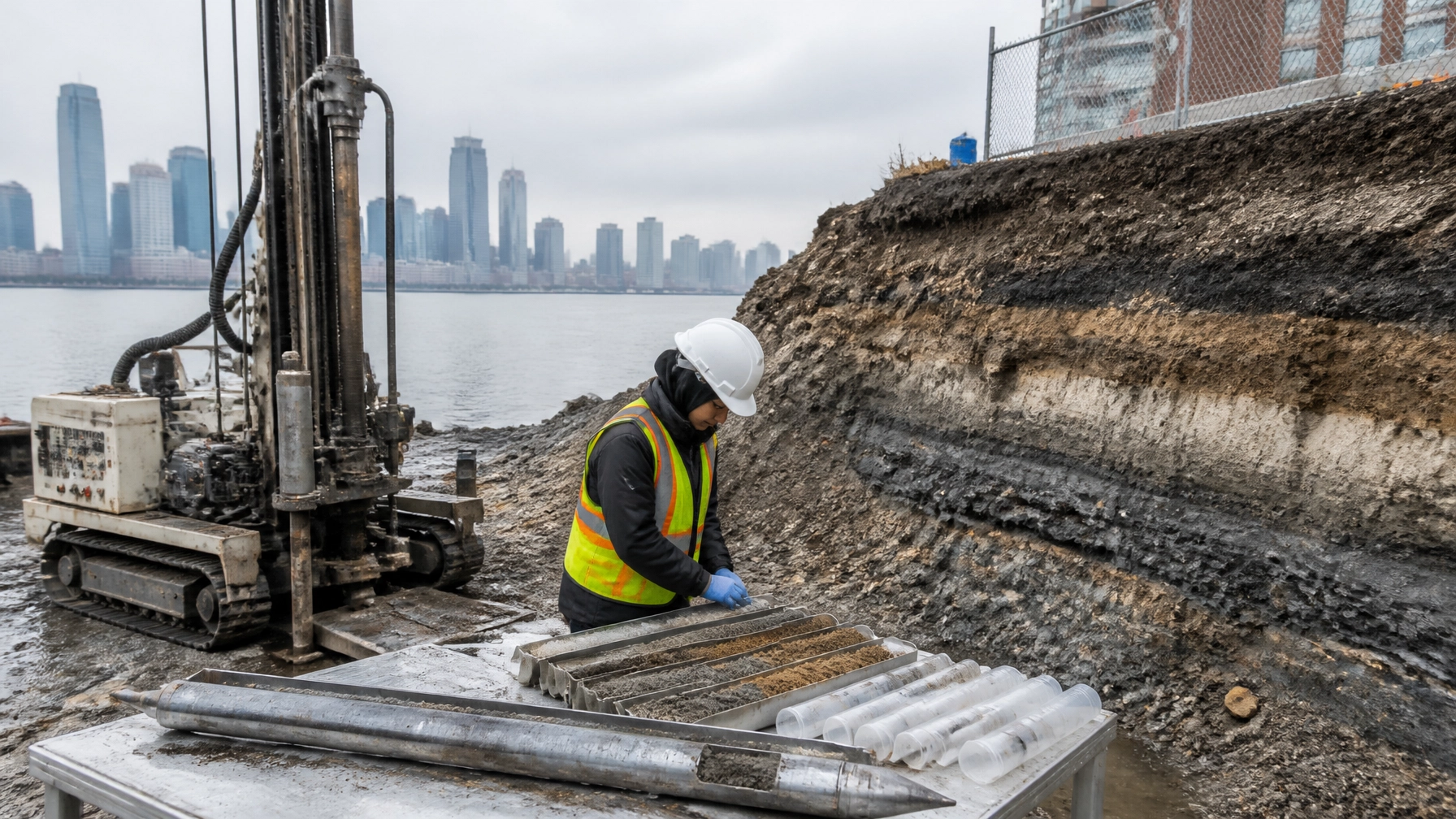
The Phase II determines the type, concentration, and extent of contamination. Depending on site history and the proposed construction, the investigation may include:
- Soil borings
- Groundwater monitoring wells
- Soil and groundwater samples
- Soil vapor or sub-slab vapor samples
- Indoor air sampling
- Tank and source-area investigation
The OER rules identify common analytical requirements for VOCs, SVOCs, PCBs, pesticides, metals, and other potential contaminants. Samples must be analyzed by an appropriately certified laboratory, including New York State Department of Health ELAP certification where required.
A Phase II report should not be treated as a generic laboratory package. It must connect the data to the proposed foundation, utility corridors, landscaped areas, courtyards, excavation limits, and exposure pathways.

2. Air Quality E-Designation
An air quality E-designation does not use a conventional Phase I and Phase II ESA as its primary compliance path.
The requirement usually relates to building mechanical design. It may control:
- Boiler fuel type
- Boiler stack location
- Stack height
- Exhaust discharge
- Ventilation design
- Proximity to windows, fresh-air intakes, or adjacent buildings
The project team typically prepares a remedial or compliance plan with architectural and engineering drawings. A New York licensed professional engineer or registered architect must certify that the design meets the E-designation requirements.
For air quality, the due diligence question is not only “Is there contamination?” It is also “Can the proposed mechanical system satisfy the mapped requirement without redesign?”
Review these items before contract execution:
- Existing E-designation language
- Proposed boiler capacity and fuel
- Stack location and elevation
- Mechanical room location
- Fresh-air intake locations
- Rooftop and adjacent-building conditions
- Whether the design requires an OER modification
After installation, OER generally requires an Installation Report. DOB cannot issue the applicable certificate of occupancy until OER provides the required notice.
3. Noise E-Designation
A noise E-designation addresses exterior noise levels and the building’s ability to maintain acceptable interior conditions.
Requirements may include:
- Specific window and wall attenuation
- OITC-rated window assemblies
- Double-glazed or laminated glazing
- Alternate means of ventilation
- Closed-window operation
- Mechanical heating, cooling, and ventilation
Noise compliance also does not follow a conventional Phase I and Phase II contamination model.
Instead, the project team may need an acoustical evaluation, approved noise monitoring protocol, building envelope calculations, and design certifications. If the owner seeks to modify the required attenuation, OER may require a 24-hour noise monitoring study using descriptors such as Leq(1), L10(1), and Ldn.
The practical concern is cost. Window, wall, and mechanical changes made late in design can affect the entire building envelope. Confirm the requirement before your architect completes the construction documents.

How E-Designation Obligations Run With the Property
An E-designation and a recorded ERD are not personal obligations that disappear when the property changes hands.
The restrictions follow the tax lot. The recorded declaration can bind successors and assigns. If OER requires ongoing site management, the owner may need to maintain engineering controls, institutional controls, vapor systems, barriers, or other measures after construction.
The rules may also require periodic certifications. These obligations can continue after a temporary or final certificate of occupancy.
Before signing, confirm:
- Whether an ERD is recorded against title
- Which party must satisfy the E-designation
- Whether the seller has completed any OER work
- Whether a Phase I, Phase II, RAP, or closure report already exists
- Whether OER has issued a notice of satisfaction or notice of no objection
- Whether ongoing reporting or site management remains
- Whether the proposed development matches the approved environmental work
- Whether a change in design could invalidate an approved plan
A completed project does not automatically mean the E-designation has been removed. OER may issue a final notice of satisfaction when the requirements are fully complete. DCP can then administratively remove the affected lot from the applicable list.
For hazardous materials, complete removal may depend on the cleanup achieving a standard that does not require ongoing engineering or institutional controls. Air and noise requirements may require full build-out and documented installation.

Contract Protections to Address Before Closing
An E-designation should appear in the purchase agreement’s environmental diligence and closing conditions.
At minimum, negotiate clarity on:
- Access for environmental investigations
- Responsibility for OER fees and consultant costs
- Responsibility for remediation and disposal
- Soil and groundwater management costs
- Construction health and safety requirements
- Schedule extensions for OER review
- Seller delivery of prior reports and correspondence
- Cooperation with OER and DOB
- Allocation of costs if contamination exceeds assumptions
- Indemnities and survival periods
- Closing conditions tied to permits, approvals, or notices
Do not rely on a seller’s statement that “the property has an E-designation but it is routine.” The scope depends on the exact tax lot, the designation component, and your planned work.
A Phase I may identify the issue. A properly scoped Phase II, design review, and OER coordination tell you what it will cost to clear the path.
The Envicon Approach
Envicon works with developers, attorneys, architects, contractors, and lenders across New York City. We connect environmental due diligence to the actual development plan.
That means we do not stop at a report. We review how the E-designation affects excavation, foundations, utilities, building systems, facade design, construction sequencing, and the certificate of occupancy.
Our team brings direct field experience, regulator-facing coordination, and clear documentation. We use practical project controls so the client can see what is complete, what is pending, and what could affect the schedule.
Collaboration is not a buzzword. It is how E-designation work gets done.
Key Takeaway
An NYC OER E-designation can be manageable, but only when you understand the obligation before you commit to the property.
Read the restrictive declaration. Confirm the exact block and lot. Separate hazardous materials requirements from air and noise requirements. Budget for Phase I, Phase II, design controls, remediation, OER review, and ongoing obligations. Then align the contract, design, and construction plan around that reality.
The objective is not simply to satisfy a designation. It is to turn a restricted property into a buildable asset with a clear path to permits and occupancy.
CTA: Get Ahead of the E-Designation
Before you sign a purchase contract, use Envicon’s proprietary project risk screener to identify environmental and regulatory risks.
Explore more guidance on the Envicon blog.
Need to discuss a New York City property with an E-designation? Call Envicon at (917) 764-2171.