If you’re asking, “how much does E-designation removal cost NYC?” the honest answer is that there’s no universal price.
An E-designation is not a single service. It can involve hazardous materials, air quality, noise, or a combination of requirements. The final budget depends on the number of affected tax lots, the required investigation, site conditions, remediation, vapor controls, construction documentation, and the number of OER review cycles.
That matters whether your project is in Queens, Brooklyn, the Bronx, Manhattan, or Staten Island. The regulatory framework is citywide. The site conditions are not.
What E-designation removal actually requires
The NYC Office of Environmental Remediation, or OER, uses E-designations to identify properties with environmental requirements tied to zoning actions. Those requirements must be investigated and addressed before redevelopment can move through building permitting and occupancy.
OER manages three primary E-designation categories:
- Hazardous materials: Soil testing, subsurface investigation, remedial planning, and cleanup if contamination is confirmed.
- Air quality: Requirements related to fuel types, boiler systems, stack locations, or other air emission concerns.
- Noise: Window, wall, ventilation, or other building design requirements.
According to NYC OER, a hazardous materials E-designation may require an OER-approved remedial action plan before development proceeds. The remedy must then be implemented and documented to OER’s satisfaction.
OER states that all E-designations may be removed when the site achieves a high level of cleanup, does not require an active soil vapor management system, is built to full development potential, and the applicable environmental requirements are complete. See OER’s E-designation removal guidance.
NYC E-designation removal cost: the main planning categories
The right way to build an NYC OER closeout budget is to separate the work into planning categories. Do not rely on a single online price or a consultant proposal that combines every possible task into one vague number.
| Budget category | What may be included | Main cost drivers |
|---|---|---|
| Records review and initial scoping | E-designation review, CEQR documents, zoning records, prior reports, project plans, and tax lot confirmation | Number of E-designation components, missing records, project changes |
| Phase I and Phase II investigation | Site history, field reconnaissance, soil borings, groundwater sampling, soil vapor, indoor air, and laboratory analysis | Site size, historical use, sampling density, contaminants, access |
| OER program management | Applications, work plans, agency coordination, comment responses, and submission tracking | Number of phases, tax lots, review cycles, agency comments |
| Remediation | Excavation, disposal, treatment, confirmation sampling, waste characterization, and construction oversight | Contaminant type, depth, quantity, disposal classification, access |
| Engineering controls | Vapor barriers, sub-slab depressurization, caps, barriers, or institutional controls | Building design, occupancy, vapor conditions, active system requirements |
| Construction documentation | CHASP, RAP implementation records, field reports, air monitoring, manifests, photos, and as-built documentation | Construction duration, contractor coordination, soil disturbance |
| Closure and record update | Remedial Closure Report, Notices of Satisfaction, covenant documentation if required, and DCP record update tracking | Completeness of records, unresolved comments, number of tax lots |
This table is more useful than a flat estimate because it shows where the project can expand.
1. Number of E-designation components
A property with only a hazardous materials designation will follow a different path from a property with hazardous materials, air, and noise requirements.
The scope may include:
- Soil and groundwater investigation
- Soil vapor or indoor air testing
- Boiler and stack review
- Window and ventilation specifications
- Noise attenuation documentation
- Construction-phase verification
- Separate closure documentation for different requirements
The first step is to confirm exactly what the E-designation covers. The NYC Department of City Planning E-designation dataset is updated monthly and identifies environmental requirements associated with specific tax lots.
2. Tax lots and development boundaries
A single development may include multiple tax lots. That can affect the investigation area, sampling plan, construction documentation, agency review, and final Notices of Satisfaction.
The question is not only, “What is the E-designation removal cost for this property?”
It is also:
- How many tax lots are listed?
- Does the project cover all listed lots?
- Are neighboring lots included in the CEQR determination?
- Does one remedy address the entire development?
- Will OER require separate documentation for each lot?
For a Brooklyn project, title and recording issues may involve Kings County. For a Queens or Bronx project, the applicable county records differ. Manhattan and Staten Island projects still follow the same OER framework, but their building conditions, access constraints, and historic uses can change the work.
3. Phase I, Phase II, soil vapor, and indoor air
A Phase I ESA may help establish site history and recognized environmental conditions. It does not, by itself, close a hazardous materials E-designation.
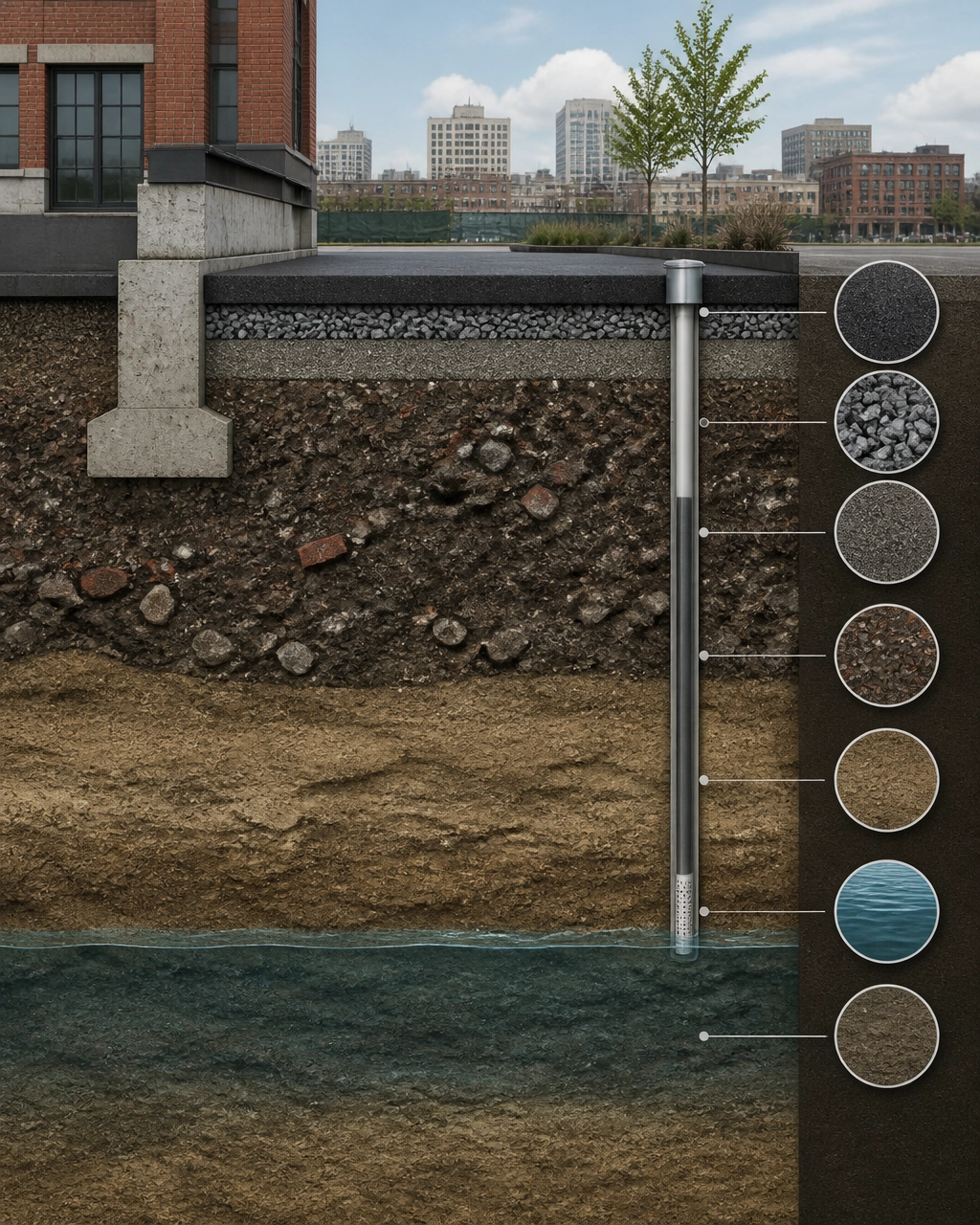
A Phase II investigation may be needed to define:
- Soil contamination
- Groundwater impacts
- Petroleum or solvent impacts
- Historic fill
- Soil vapor conditions
- Potential indoor air pathways
Soil vapor and indoor air can materially change the budget. Testing may require sub-slab probes, indoor and outdoor air samples, laboratory analysis, repeat sampling, or mitigation design.
Envicon’s vapor intrusion assessment service covers screening, sub-slab sampling, indoor air testing, laboratory analysis, and mitigation planning. The correct scope depends on the building, contaminants, occupancy, and OER requirements.

Active soil vapor management can change the closeout path
An active sub-slab depressurization system may be appropriate when contamination remains beneath or near a building and the vapor pathway requires ongoing control.
That can add:
- System design
- Installation oversight
- Electrical and mechanical coordination
- Performance verification
- Operation and maintenance documentation
- Periodic reporting
- Long-term site management
- Potential covenant or restriction documentation
OER’s removal guidance specifically distinguishes sites that require active soil vapor management from sites that achieve cleanup without it. If the active system remains necessary, full E-designation removal may not follow the same path as a site that reaches closure without ongoing operation.
This is why a low initial estimate can become a much larger project budget after vapor conditions are confirmed.
OER fees are only one part of the budget
OER publishes fixed fees for its review work. These are regulatory review fees, not the total cost of E-designation removal.
At the time of writing, OER lists:
- $475 for a Notice of No Objection application for qualifying minor alterations
- $1,325 for each phase requiring a Notice to Proceed or Notice of Satisfaction review
- $475 for additional OER review after a Notice to Proceed
- $475 for conversion of an active sub-slab depressurization system to a passive system after approval of a remedial closure report
- $275 for periodic reports on active remedial systems
Review the current OER E Fees page before submitting payment. OER instructs applicants not to submit fees until they receive a payment request with an OER project number.
These fees do not include:
- Consultant labor
- Drilling and field crews
- Laboratory analysis
- Remediation contractors
- Soil transportation and disposal
- Vapor mitigation equipment
- Construction management
- Legal or title recording costs
- Architect or mechanical engineer services
- Permit fees from other agencies
What a consultant fee should include
A clear consultant proposal should identify the specific deliverables, assumptions, exclusions, and decision points.
A well-defined scope may include:
- E-designation and CEQR record review
- Tax lot and development plan confirmation
- Phase I or Phase II ESA
- Soil vapor or indoor air assessment
- OER application preparation
- Investigation work plan
- Remedial Action Plan and CHASP
- Agency submissions and comment responses
- Field oversight and confirmation sampling
- Remedial Closure Report
- Notices of Satisfaction support
- Tracking of DCP record updates
Ask whether the proposal includes one review cycle or multiple OER comments. Ask whether laboratory work, drilling, disposal, construction oversight, and vapor system design are included or priced separately.
That distinction prevents the most common budgeting problem: a low consultant fee that excludes the field and agency work needed to reach closeout.
How Envicon approaches NYC OER closeout budgets
Envicon starts with the actual E-designation record, tax lots, development plan, and project deadline. We then separate known work from conditional work.
That gives you a usable budget structure instead of a defensive report with no path forward.
Our team supports remediation and brownfield redevelopment, vapor intrusion assessment, agency coordination, construction oversight, and regulatory closeout. We also serve all five boroughs through our NYC environmental consulting team.
The difference is direct accountability. You work with senior technical leadership instead of being handed from a partner to a junior project manager. We coordinate with OER, architects, attorneys, contractors, and owners so the investigation, design, construction, and closeout records support one schedule.
Collaboration is not a buzzword. It is how the work gets done.
FAQ: E-designation removal cost in NYC
How much does E-designation removal cost in NYC?
There is no universal price. Cost depends on the E-designation components, tax lots, investigation scope, soil and vapor conditions, remediation, engineering controls, construction documentation, OER review cycles, and whether active soil vapor management remains necessary.
What is the OER E-designation closeout cost in Queens?
Queens uses the same OER fee schedule as the other boroughs. The total project budget depends on the property-specific investigation and closeout requirements, not the borough alone.
Is E-designation remediation cost higher in Brooklyn?
Not automatically. Brooklyn properties may have complex historic industrial uses, fill, dense construction, or limited access. Those conditions can expand the investigation or remediation scope. The same issue can occur in Queens, the Bronx, Manhattan, or Staten Island.
Can OER remove an E-designation if an active vapor system remains?
OER’s removal guidance distinguishes between sites that achieve cleanup without active soil vapor management and sites that require ongoing controls. A project with an active system may require continued operation, reporting, or recorded restrictions instead of immediate full removal.
How long does DCP record updating take?
DCP updates its E-designation dataset monthly. The environmental work must be complete first, and OER must issue the applicable satisfaction documentation for the affected tax lots. Confirm the current record before relying on the designation status for a closing or permit milestone.
Request an NYC OER closeout budget review
If you’re planning an E-designation removal in Queens, Brooklyn, the Bronx, Manhattan, or Staten Island, send us the property address, tax lot information, E-designation documentation, and development plans.
Request an E-designation cost and scope review
Call Envicon at (917) 764-2171
Use the proprietary project risk screener
The goal is not to guess at a price. The goal is to define the work, expose the risk, and build a credible path to OER closeout.