A groundwater Classification Exception Area, or CEA, can determine whether a contaminated New Jersey property remains stalled or moves into construction.
In 2026, developers, lenders, attorneys, and property owners need to understand how NJDEP treats a CEA as an institutional control under N.J.A.C. 7:9C-1.6. A CEA identifies a defined area where groundwater standards or designated uses are not currently met for specified constituents.
A CEA does not erase contamination. It creates a controlled regulatory path for managing contamination that cannot be restored immediately to unrestricted groundwater standards.
For a developer, the practical questions are straightforward:
- Where is the CEA?
- Which constituents are included?
- Are potable wells restricted?
- Can the site be excavated or dewatered?
- Does vapor intrusion require additional controls?
- What must appear in the deed, site plan, and financing documents?
- Who will manage compliance after the property changes hands?
This article explains the 2026 framework and how an NJDEP LSRP should carry a CEA from investigation through long-term compliance.
What a CEA means under NJDEP rules
NJDEP uses a CEA when groundwater standards are not, or will not be, met in a localized area. The CEA applies only to the constituents and geographic boundaries identified in the applicable regulatory documents.
The current New Jersey Ground Water Quality Standards establish classifications and designated uses for groundwater across the state. Most New Jersey groundwater falls within Class II-A, which supports existing or potential potable water supply.
Under N.J.A.C. 7:9C-1.6, NJDEP can define an exception area for:
- Site-related contamination managed through the Site Remediation Program.
- A localized effect of an approved NJPDES discharge to groundwater.
- Natural groundwater quality conditions.
- An approved alternate concentration limit associated with a permitted discharge.
The rule requires NJDEP to identify the applicable CEA boundaries and the constituents covered by the exception. Other groundwater standards continue to apply.
“A ground water CEA means any such area defined by the GWQS, N.J.A.C. 7:9C-1.6 and is an institutional control pursuant to N.J.A.C. 7:26E-1.8.”
NJDEP Ground Water Remedial Action Permit Guidance
A CEA is similar in purpose to a deed notice, but the controls address different media. A deed notice manages residual soil contamination. A CEA manages groundwater contamination and groundwater use.
How a CEA gets established
1. Site Remediation Program action
For a contaminated industrial or brownfield site, the CEA usually develops through the NJDEP Site Remediation Program.
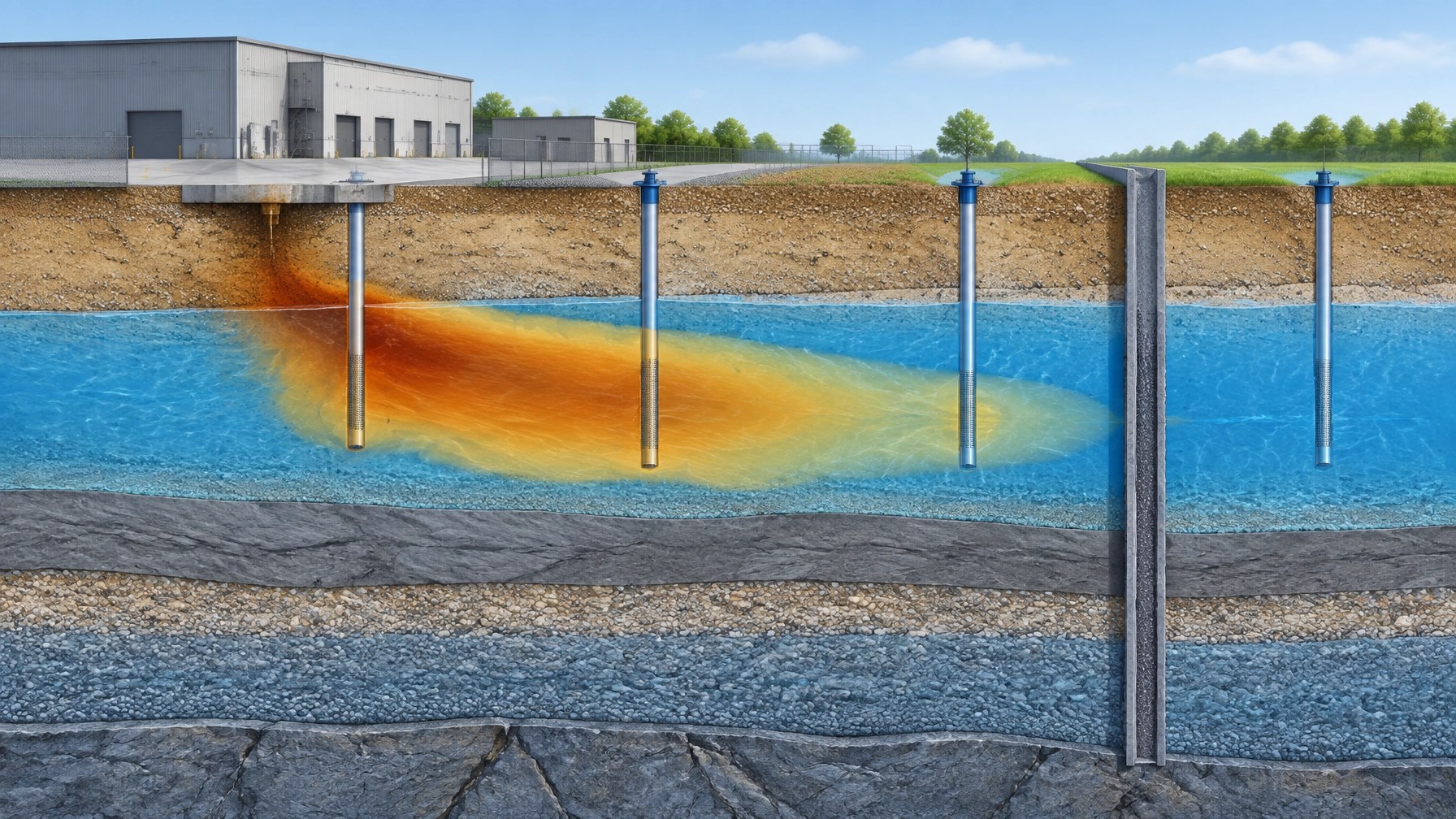
During the remedial investigation, the LSRP must characterize the groundwater plume. That means establishing horizontal and vertical delineation through monitoring wells or temporary well points. The investigation should evaluate:
- Groundwater flow direction.
- Aquifer and geologic formations.
- Source areas and preferential pathways.
- Maximum concentrations by constituent.
- Seasonal groundwater fluctuations.
- Off-site migration.
- Nearby potable, irrigation, industrial, or recovery wells.
- Vapor intrusion potential.
- Surface water or ecological receptors.
A CEA proposal can be submitted with the Remedial Investigation Report through a CEA/WRA Fact Sheet package. Establishing a CEA during the remedial investigation does not, by itself, require a Groundwater Remedial Action Permit.
If contamination remains after the selected remedy is demonstrated to be protective, the site generally moves into a Groundwater Remedial Action Permit. All Groundwater RAPs include a CEA, except for certain historic fill or historically applied pesticide situations where a separate groundwater RAP may not be required.
2. NJPDES discharge to groundwater
A CEA may also arise through the NJPDES Discharge to Groundwater program.
If NJDEP authorizes a discharge that causes localized groundwater standards or antidegradation limits to be exceeded, the permit action can establish a permit-related CEA. This CEA is different from a site-related plume CEA.
A NJPDES CEA generally covers the area affected by the permitted discharge. It does not automatically cover every contaminated area on the property. The permit identifies the discharge constituents, monitoring points, and area requiring the exception.
This distinction matters for projects involving:
- Long-term groundwater treatment.
- In-situ injections.
- Dewatering discharge.
- Industrial wastewater.
- Treated groundwater reinjection.
- Other permitted discharges to groundwater.
A CEA cannot be used to legalize an unauthorized discharge. The discharge must be permitted, characterized, monitored, and managed under the applicable NJDEP program.
How NJDEP defines CEA boundaries and constituents
A CEA is not simply a circle drawn around a property.
At the remedial action stage, NJDEP generally expects boundaries to reflect actual groundwater data. The CEA should extend to clean or compliant sampling points in the relevant directions, including downgradient, side-gradient, upgradient, and vertical intervals where applicable.
The CEA package typically includes:
- A site location map.
- A CEA plan map.
- A groundwater flow direction.
- Monitoring well and sample point locations.
- A cross-section showing the vertical plume extent.
- Geologic units and aquifer intervals.
- A GIS-compatible boundary file.
- A contaminant fate and transport description.
- The affected blocks and lots.
- Public notification documentation.
The CEA form must identify constituents that exceed, or are assumed to exceed, the applicable groundwater standards. These may include volatile organic compounds, metals, petroleum compounds, PFAS, degradation products, or synthetic organic chemical totals.
A constituent may be removed from the CEA only after supporting data demonstrate compliance. NJDEP’s current instructions generally call for two consecutive groundwater sampling rounds below the applicable standards, with the events separated by at least 90 days to account for seasonal fluctuation.
A clean sample from one well does not automatically shrink the CEA. The data must represent the full horizontal and vertical extent of the plume.
Well restrictions and N.J.A.C. 7:26C-7.9
Under N.J.A.C. 7:26C-7.9, a Groundwater Remedial Action Permit must address the well restrictions associated with each groundwater CEA at the site.
Where groundwater exceeds or will exceed Primary Drinking Water Standards in Class I or Class II-A groundwater, NJDEP requires restriction of potable groundwater use.
Typical restrictions include:
- Double-cased wells. Proposed wells within the CEA or Well Restriction Area may need double casing to prevent vertical contaminant migration. The required casing depth depends on the CEA and underlying hydrogeology.
- Potable well sampling. Any proposed potable well within the CEA may require sampling and NJDEP review.
- Production well evaluation. Proposed high-capacity wells near the CEA should be evaluated to determine whether pumping could capture or redirect the contaminant plume.
- Site-specific restrictions. NJDEP may impose additional conditions based on the contaminant, aquifer, well type, or receptor.
Local governments may also use well restriction ordinances or local health requirements to implement restrictions. The state CEA and RAP remain the controlling environmental framework.
Developers should not wait until permit review to identify these limitations. A well restriction can affect site utility planning, irrigation design, fire protection, industrial process water, and future property use.
What a CEA means for a developer’s site plan
A CEA becomes a design constraint when the proposed work interacts with groundwater.
Your civil engineer, geotechnical engineer, contractor, and LSRP should coordinate the following items early:
- Foundation depth and excavation limits.
- Seasonal groundwater elevations.
- Temporary and permanent dewatering.
- Discharge treatment and NJPDES requirements.
- Monitoring well protection and access.
- Utility trench design.
- New building footprints overlying the plume.
- Soil import, export, and cap requirements.
- Changes to site drainage and stormwater infiltration.
- Future irrigation or process wells.
- Vapor intrusion controls.
A CEA does not prohibit redevelopment. It requires the redevelopment plan to preserve the protectiveness of the remedy.
Building dewatering deserves special attention. Pumping can change groundwater flow and alter plume geometry. Discharge water may require treatment, sampling, and authorization before it leaves the site. A contractor who encounters groundwater during excavation cannot assume that the water may be discharged to a storm sewer or surface water.
Envicon’s remediation and brownfield redevelopment team coordinates the CEA, dewatering, soil management, and construction implications as one project rather than treating them as separate reports.
Deed notices, vapor intrusion, and long-term compliance
A CEA and a deed notice may apply to the same property, but they control different risks.
A deed notice generally addresses residual soil contamination and restrictions on soil disturbance or property use. The CEA addresses groundwater contamination and groundwater use. Both controls must be reflected in the project’s legal and operating documents.
If volatile contaminants are present, the CEA evaluation must also consider vapor intrusion. The vapor pathway may affect buildings overlying or near the plume, even when the nearest monitoring well is not directly beneath the structure.
Potential controls include:
- Sub-slab sampling.
- Soil gas monitoring.
- Indoor air sampling.
- Sub-slab depressurization.
- Vapor barriers.
- Building operation and maintenance requirements.
- Change-in-use evaluations.
- Long-term vapor monitoring.
A new building, HVAC change, slab replacement, excavation, or conversion from industrial to residential use can change the vapor intrusion risk. The CEA fate and transport description should address these future conditions.
Why a CEA can be the practical path for a brownfield
Active groundwater restoration can require years of pumping, treatment, injections, monitoring, system maintenance, and regulatory optimization. It may also interfere with construction and future building operations.
A CEA with monitored natural attenuation or another protective remedy can be a better path when:
- The contamination is stable or declining.
- Source material has been addressed.
- Free product and residual product are not being managed through MNA.
- The plume is delineated.
- A clean sentinel point or equivalent receptor control is available.
- Groundwater use can be restricted.
- Engineering controls address vapor or potable water risks.
- The remedy remains protective of health and the environment.
This approach is not automatically cheaper. The savings come from matching the remedy to actual site conditions instead of forcing full restoration where it is not technically necessary.
A Groundwater RAP still carries obligations. The permittee may need to maintain monitoring wells, implement an approved Groundwater Monitoring Plan, operate engineering controls, maintain financial assurance where required, and submit biennial protectiveness certifications.
The CEA can also affect refinancing and exit strategy. Lenders and buyers will want to know:
- Whether the CEA is mapped correctly.
- Whether the RAP is current.
- Whether biennial certifications are complete.
- Whether financial assurance is required.
- Who will assume permit obligations after closing.
- Whether the CEA extends onto neighboring parcels.
- Whether vapor intrusion remains open.
- Whether future construction could require a RAP modification.
A clean, current compliance record protects the transaction. An unclear CEA creates questions that become price reductions, escrow demands, or closing delays.
How Envicon manages CEA and RAP obligations
Envicon provides NJ LSRP services for contaminated sites, brownfields, industrial properties, and redevelopment projects across New Jersey, including Hudson County, Jersey City, Newark, Middlesex County, and surrounding markets.
Our LSRP-led work can include:
- Groundwater investigation and plume delineation.
- CEA/WRA Fact Sheet preparation.
- CEA mapping and GIS deliverables.
- Groundwater RAP applications and modifications.
- Well restriction evaluation.
- Vapor intrusion assessment and mitigation.
- Dewatering design and discharge compliance.
- Groundwater monitoring plans.
- Biennial protectiveness certifications.
- Deed notice and site management coordination.
- NJDEP correspondence and regulatory strategy.
We also use project dashboards to track field events, monitoring data, submittals, agency comments, permit obligations, and upcoming compliance dates. The benefit is practical. You can see what has been completed, what remains open, and what could affect your next financing, construction, or sale milestone.
Key takeaway
A CEA is not a dead end. It is a defined regulatory tool for managing groundwater contamination while a New Jersey property moves toward productive use.
The right strategy depends on accurate delineation, defensible boundaries, constituent-specific analysis, well restrictions, vapor intrusion review, and long-term compliance planning.
For developers, the question is not whether a CEA exists. The question is whether the CEA has been designed and managed well enough to support construction, financing, and a clean exit.
Solve environmental and engineering challenges with precision, speed, and trust. Build the path before the project reaches the obstacle.
Call to Action
Talk with an Envicon LSRP about your New Jersey groundwater CEA, RAP, brownfield, or redevelopment plan.