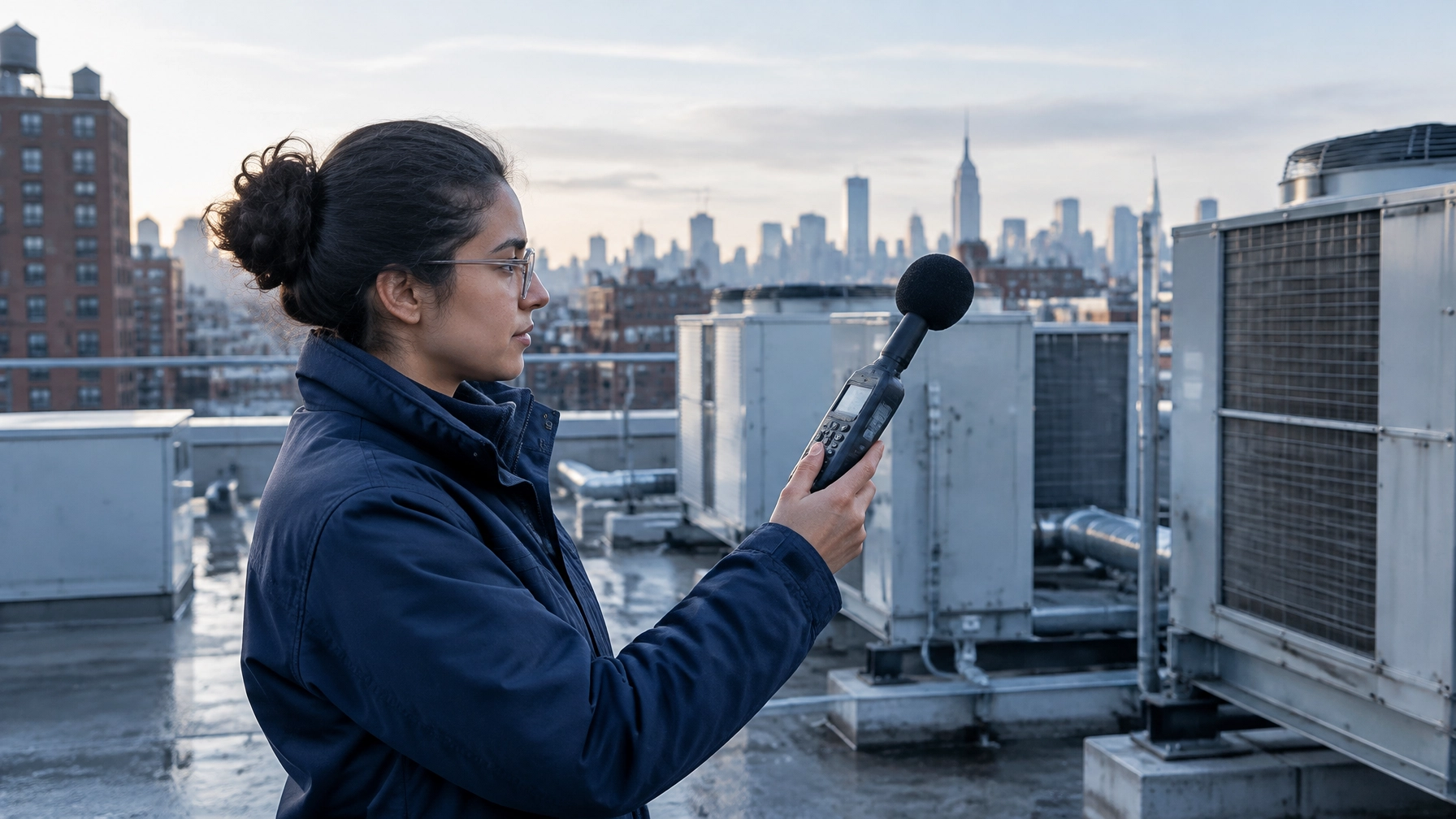
A noise chapter can determine whether a development moves forward cleanly or carries a mitigation obligation into building design, permitting, and certificate of occupancy.
Under New York City’s City Environmental Quality Review (CEQR) process, noise analysis evaluates two questions:
- Will the proposed action increase noise at existing sensitive receptors?
- Will the project introduce new receptors into an area with unacceptable ambient noise?
The same technical logic often supports a broader Environmental Impact Statement (EIS) under CEQR or the State Environmental Quality Review Act (SEQRA). The exact scope depends on the lead agency, project type, funding source, surrounding land uses, and agency comments.
For projects in Queens, New York, Newark, New Jersey, and Monmouth County, New Jersey, the key issue is not simply measuring decibels. The analysis must connect field data, source modeling, building design, mechanical systems, and final construction documentation.
“The source is the equipment or process directly responsible for the sound generation. The path is the medium of sound propagation. The receptor is the final destination of concern.”
NYC CEQR Technical Manual, Chapter 19
CEQR, SEQR, and EIS Noise Review
CEQR is New York City’s environmental review framework. SEQR is New York State’s broader environmental review process. An EIS is the detailed document used when a proposed action may create significant adverse environmental impacts.
In New York City, a noise chapter typically follows the CEQR Technical Manual. In New Jersey, a project may involve municipal, county, state, or federal review requirements rather than CEQR specifically. The technical principles remain familiar, but the applicable standards and reviewing agencies can differ.
A defensible noise EIS should document:
- Existing noise conditions
- No-Action conditions, meaning the future without the project
- With-Action conditions, meaning the future with the project
- Noise-sensitive receptors
- Mobile, stationary, and construction sources
- Modeling assumptions and measurement procedures
- Impact significance
- Mitigation commitments
- Construction and closeout documentation
Noise analysis should begin early. If the mechanical engineer selects rooftop units, exhaust fans, generators, cooling towers, or loading dock equipment after the EIS is complete, the project may discover that the approved mitigation no longer matches the actual design.
Mobile Source Noise Versus Stationary Source Noise
Mobile source noise
Mobile sources move in relation to the receptor. Common examples include:
- Passenger vehicles
- Trucks and buses
- Trains and subway operations
- Aircraft
- Traffic generated or rerouted by the project
For vehicular traffic, CEQR generally uses Leq(1) and L10(1). The peak hour is important because traffic volumes and vehicle classifications may create the highest exposure during a specific one-hour period.
CEQR references the Federal Highway Administration (FHWA) Traffic Noise Model, or FHWA TNM, when roadway geometry, traffic conditions, shielding, or multiple noise sources require detailed modeling. FHWA guidance and current federal regulations are available through the FHWA noise regulations and guidance page.
The analysis should account for:
- Vehicle counts by type
- Heavy trucks and buses
- Vehicle speed
- Roadway geometry
- Receiver distance and elevation
- Building shielding
- Barriers and terrain
- Existing and future traffic patterns
Stationary source noise
Stationary sources remain fixed in relation to the receptor. Examples include:
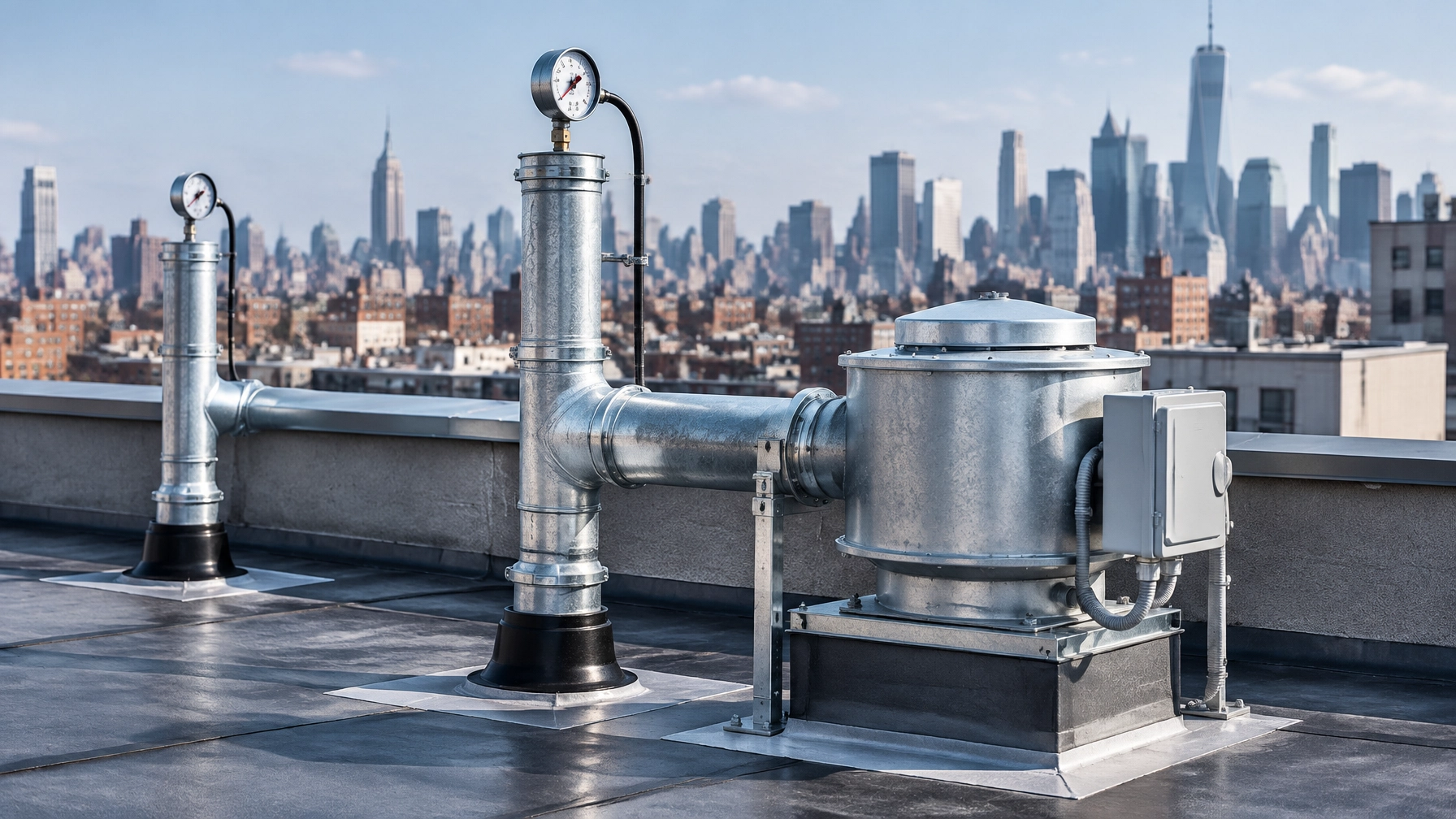
- Rooftop HVAC units
- Cooling towers
- Emergency generators
- Exhaust fans
- Mechanical ventilation equipment
- Loading docks
- Industrial machinery
- Amplified sound systems
- Fixed transit facilities
CEQR generally evaluates stationary source noise using Leq(1). Detailed source analysis should also consider octave-band data, particularly when the equipment may produce low-frequency noise or tonal characteristics.
The practical mistake is to treat the equipment schedule as a mechanical design issue only. It is not. Equipment sound power, location, orientation, screening, enclosure design, silencers, vibration isolation, and operating hours can change the EIS conclusion.

The Noise Metrics That Matter
Leq(1)
Leq(1) is the one-hour equivalent continuous sound level. It represents the single steady sound level containing the same acoustic energy as the fluctuating noise measured during one hour.
CEQR uses Leq(1) as a primary metric for:
- Peak-hour mobile source analysis
- Combined mobile and stationary source evaluation
- Stationary source analysis
- Impact comparisons between No-Action and With-Action conditions
Leq(8)
An 8-hour Leq summarizes sound energy across an eight-hour period. It can be useful for extended operational periods, construction assessments, workplace-style exposure characterization, and supplemental analysis.
It is not a replacement for the CEQR one-hour impact metric when CEQR requires Leq(1). A report should identify exactly why an 8-hour value is being used and how it relates to the applicable agency criteria.
L10
L10 is the sound level exceeded 10 percent of the measurement period. For example, L10(1) is the sound level exceeded during 10 percent of a one-hour period.
CEQR commonly uses L10(1) to characterize traffic-related exposure and determine building attenuation. It captures the higher portion of fluctuating traffic noise without representing only the single loudest event.
L90
L90 is the sound level exceeded 90 percent of the measurement period. It is commonly used as an indicator of residual or background noise.
L90 can help explain the existing sound environment, especially where traffic, mechanical equipment, or intermittent events create large variations. It is usually supplemental. It does not replace the CEQR impact comparison based on the applicable Leq, L10, or other required descriptor.
Ldn and FTA methodology
The Federal Transit Administration commonly uses Leq(h) for nonresidential land uses and Ldn for residential land uses in transit noise assessments. Ldn is a 24-hour metric that applies a 10 dB nighttime penalty between 10 p.m. and 7 a.m.
For rail, subway, and transit projects, the FTA Transit Noise and Vibration Impact Assessment Manual provides screening, general assessment, and detailed analysis procedures.
How CEQR Determines a Significant Noise Impact
CEQR generally evaluates both incremental change and absolute noise exposure.
For daytime mobile or stationary source impacts, the commonly applied CEQR framework considers:
- A No-Action level of 60 dBA Leq(1) or less, with a 5 dBA or greater increase generally considered significant
- A No-Action level of 61 dBA Leq(1), with the allowable increase limited to 4 dBA
- A No-Action level of 62 dBA Leq(1) or greater, with a 3 dBA or greater increase generally considered significant
- A resulting level above approximately 65 dBA Leq(1) as a significant concern
During nighttime hours, a 3 dBA Leq increase is typically treated as significant because background levels are lower and sensitivity is higher.
For a new residential or community facility receptor, the analysis also compares exterior exposure to the CEQR Noise Exposure Guidelines. Where exterior conditions are marginally unacceptable or clearly unacceptable, the project must provide sufficient composite building attenuation to achieve acceptable interior conditions.
The CEQR Technical Manual identifies an interior target of approximately 45 dBA for residential vehicular noise. Train and aircraft applications may use a lower interior target, depending on the applicable source and analysis.
The exact conclusion must come from the current technical manual, project scoping document, lead agency direction, and any applicable federal or state requirements.
From EIS Finding to NYC Noise E-Designation
A noise E-Designation is an institutional control placed on a New York City tax lot when environmental review identifies measures that must be implemented during future development.
The E-Designation may require:
- A closed-window condition
- Minimum window and wall attenuation
- Specific façade performance
- Alternate means of ventilation
- Mechanical design measures
- OER review before DOB permits or certificates of occupancy
The NYC Office of Environmental Remediation E-Designation rules state that a Noise E-Designation must be addressed through an OER-reviewed Remedial Action Plan.
This is where many projects lose time. The EIS may say “provide 35 dBA of window/wall attenuation,” but the construction team still needs to prove that the actual window assemblies, wall construction, ventilation equipment, and room layouts meet that requirement.
What an Acoustical Compliance Plan Must Include
For NYC purposes, the compliance plan is generally submitted as a Noise Remedial Action Plan, or Noise RAP. The OER Air Quality and Noise RAP template identifies the core documentation.
Window and wall attenuation
The plan should identify:
- Required attenuation by façade and floor range
- Window manufacturer and model
- Glazing composition
- OITC ratings
- Wall assemblies and calculated performance
- Composite window/wall attenuation
- Worst-case room or façade condition
- Stamped architectural and engineering drawings
- Laboratory test reports
OITC, or Outdoor-Indoor Transmission Class, is especially important for exterior transportation noise. A generic STC rating is not always enough to demonstrate compliance with an E-Designation.
Alternate means of ventilation
A closed-window requirement creates a mechanical design obligation. The project must provide fresh air without relying on open windows.
Acceptable systems may include:
- Central ventilation
- Dedicated outdoor air systems
- PTAC units with documented outdoor-air capability
- Trickle vents where accepted
- Combined HVAC and fresh-air systems
The RAP should include equipment cut sheets, mechanical plans, air distribution details, manufacturer information, and a letter from the mechanical engineer describing how fresh air reaches living spaces.

Construction Documentation and E-Designation Closeout
OER approval does not end when the RAP receives a Notice to Proceed. The installation must match the approved plan.
The closeout package typically includes:
- A PE or RA certification
- As-built stamped elevations
- As-built plans showing window types and locations
- Window manufacturer, model, and glazing information
- Alternate ventilation manufacturer and model
- Photographs of installed windows
- Photographs of ventilation components
- Installation records
- Any required laboratory documentation
- A completed Installation Report
OER reviews the Installation Report. If the work satisfies the approved Noise RAP and E-Designation, OER can issue a Notice of Satisfaction or, where applicable, a notice supporting a temporary certificate of occupancy.

A Better Workflow for Queens, Newark, and Monmouth County Projects
The most reliable approach is to connect environmental review and design from the beginning.
For a project in Queens, start with the CEQR record, identified receptors, airport or transit exposure, and any existing E-Designation language. For Newark, evaluate roadway, rail, industrial, and mixed-use stationary sources while coordinating the analysis with the project’s permitting path. In Monmouth County, consider roadway traffic, rail corridors, commercial equipment, and the requirements of the applicable New Jersey lead agency.
Your project team should:
- Confirm whether CEQR, SEQR, NEPA, or another review framework applies
- Identify sensitive receptors before finalizing site plans
- Coordinate traffic projections with noise monitoring
- Obtain manufacturer sound power data for mechanical equipment
- Model rooftop units, generators, loading docks, and exhaust systems
- Include attenuation and ventilation in the architectural and mechanical plans
- Track every mitigation commitment through construction
- Photograph and document installed components before closeout
- Resolve agency comments before they affect permits or occupancy
Envicon works across environmental assessment, compliance and permitting, mechanical coordination, construction oversight, and agency-facing documentation. Our team does not hand you a noise chapter and leave you to interpret it. We connect the EIS conclusion to the drawings, field installation, and closeout package.
The Takeaway
A CEQR or SEQRA noise chapter is not an isolated technical report. It is the first step in a chain that runs through traffic analysis, equipment selection, façade design, ventilation, permitting, construction, and occupancy.
In Queens, Newark, and Monmouth County, the projects that move cleanly are the ones that treat noise compliance as a design and documentation issue from day one.
If your project has a noise EIS requirement, a potential NYC OER E-Designation, or a mechanical design that may affect compliance, review Envicon’s compliance and permitting services, contact our Newark office, or use our project risk screener.
Call Envicon Group at 917-764-2171 to discuss the next step.