For condo boards in Hoboken, Jersey City, Newark, and Bayonne, the question is no longer whether structural conditions should be documented. The question is what the inspection will cost, what the report must cover, and whether the scope will satisfy New Jersey’s Structural Integrity Law.
Under P.L. 2023, c.214, commonly associated with Senate Bill S2760, certain New Jersey condominium and cooperative buildings must receive periodic structural integrity inspections by a qualified New Jersey engineer. The law took effect on January 8, 2024.
A realistic structural integrity inspection cost in NJ may range from approximately $3,500 to $8,000 for a straightforward single-building visual inspection. More complex buildings with multiple structures, parking podiums, balconies, difficult access, visible deterioration, or destructive follow-up can exceed $10,000 to $25,000 before repair design or construction work begins.
Those are planning ranges, not quotes. The building determines the scope.
“The cost of an inspection and structural report is a common expense to be shared by all association unit owners.”
New Jersey Department of Community Affairs Structural Integrity and Capital Reserve FAQ
What the NJ Structural Integrity Law Requires
A covered building generally means a residential condominium or cooperative building with a primary load-bearing system made of:
- Concrete
- Masonry
- Steel
- Hybrid construction
- Heavy timber
- A podium deck supporting residential construction
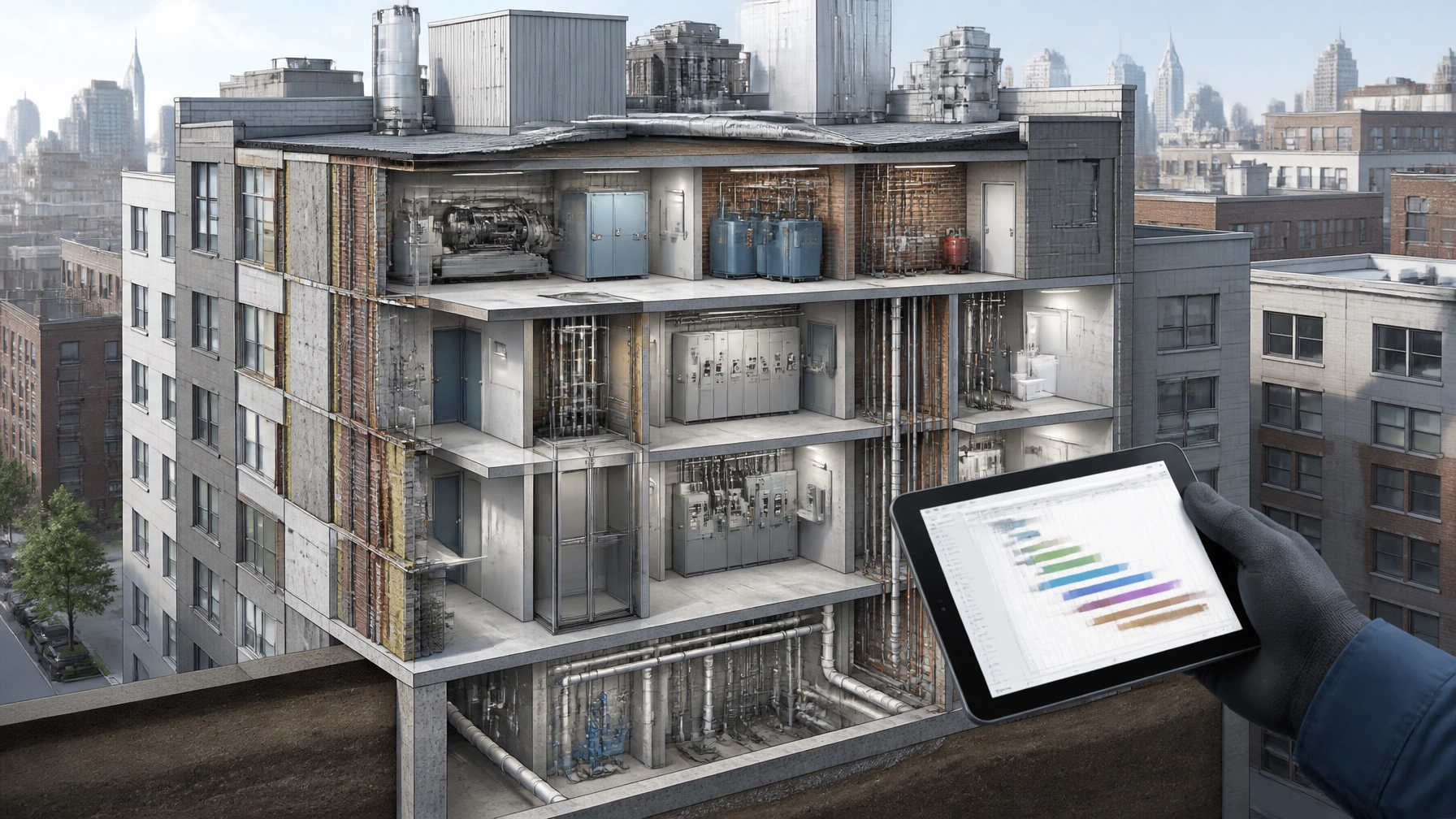
The inspection evaluates the structural path that transfers loads to the foundation. That includes relevant columns, beams, bracing, foundations, and attached balconies.
Traditional wood-frame condominium buildings may fall outside the structural inspection requirement. However, that does not automatically exempt the association from New Jersey’s separate capital reserve study requirements.
The law requires a written report that:
- Describes the condition of the primary load-bearing system
- Identifies required maintenance or repairs
- Establishes the timing of the next inspection
- Follows an ASCE-based structural condition assessment protocol or a similar nationally recognized protocol
- Is provided to the municipal appointing authority, construction official, and enforcing agency
- Is made available to residents upon request
Boards should review the current NJDCA guidance and consult association counsel about building-specific deadlines, filing practices, and any subsequent statutory updates.

The Structural Inspection Deadline for a Hudson County Condo
The certificate of occupancy date is one of the first facts a board should confirm.
For covered buildings that received a CO before January 8, 2024:
- Buildings with a CO issued 15 or more years before January 8, 2024 generally had an initial inspection deadline within two years of the law’s effective date.
- Buildings with a CO issued between January 9, 2009 and January 7, 2024 generally follow a deadline tied to the building’s 15-year anniversary.
- Newer covered buildings generally require an initial inspection within 15 years of the CO date, or within 60 days after observable damage to the primary load-bearing system, whichever occurs first.
For a building with a CO issued on or before January 8, 2009, the two-year transition period ended on January 8, 2026. A covered condominium in Hoboken, Jersey City, Newark, or Bayonne that has not completed its required inspection should not assume that the deadline is flexible. The board should promptly confirm its status with a licensed engineer, municipal officials, and association counsel.
The law also requires follow-up inspections. The timing depends on the preceding report and the condition of the building. The statute includes an outer limit of five years for subsequent inspections under its follow-up provisions, while the initial report addresses the next inspection timing and observable damage triggers. This is one reason boards should rely on the actual statute and current NJDCA guidance instead of a generic inspection calendar.
What Drives Condo Structural Inspection Cost in Jersey City and Hoboken?
A simple building walk-through is not priced the same as a multi-building waterfront condominium with garages, podium slabs, balconies, and limited access.
| Cost driver | Why it affects the fee |
|---|---|
| Building age and CO date | Older buildings often require more records review, more detailed condition mapping, and closer evaluation of past repairs. |
| Height and structural system | Height does not determine whether a building is covered, but it affects access, facade exposure, structural complexity, and field time. |
| Number of buildings | A condominium association with several buildings needs separate component inventories and additional site coverage. |
| Balconies and podiums | Attached balconies and podium decks are important structural components. Their inspection may require elevated access, probes, or specialized testing. |
| Parking garages | Garages add columns, beams, slabs, ramps, drainage areas, joints, and waterproofing transitions to the inspection scope. |
| Site access | Occupied units, locked rooms, tenant notices, roof access, garage restrictions, and limited observation points can increase coordination time. |
| Existing records | Original drawings, prior reports, repair records, permits, and maintenance logs help the engineer understand the structure and reduce uncertainty. |
| Visible deterioration | Spalling, exposed rebar, cracking, corrosion, settlement, water intrusion, or deflection may require expanded documentation and immediate recommendations. |
| Destructive follow-up | Probes, concrete cores, masonry openings, cover-meter testing, or other non-destructive and invasive testing add direct field and laboratory costs. |
| Repair recommendations | A report that identifies corrective maintenance requires more detail than a basic condition summary. |
| Report and submission requirements | Signed and sealed reporting, photo logs, component schedules, municipal delivery, and board presentations all affect production time. |
The most important pricing distinction is whether the engineer is providing a baseline visual inspection or a more developed investigation with testing and repair guidance.
Typical Planning Levels for a New Jersey Condo Board
Baseline visual inspection
A single, accessible building with clear records and no known critical conditions may fall in the range of $3,500 to $8,000.
This scope may include:
- Records review
- Board or property manager kickoff call
- Site walk-through
- Primary structural component inventory
- Photo documentation
- Condition ratings
- Written recommendations
- Signed and sealed report
- Coordination regarding municipal submission
Enhanced inspection with probes or testing
A building over 30 years old, a waterfront building in Hudson County, a post-tensioned parking deck, or a property with prior repair history may require an enhanced scope. Planning costs commonly move into the $8,000 to $20,000 or higher range.
Additional work may include:
- Targeted masonry openings
- Concrete probes or cores
- Rebar cover measurements
- Corrosion evaluation
- Post-tensioned deck review
- Waterproofing and flashing investigation
- Expanded repair recommendations
- Contractor-ready repair narratives
Multi-building or critical-condition inspection
Associations with multiple buildings, extensive balconies, podium construction, garage structures, or visible distress may exceed $20,000. If the inspection identifies a safety concern, the board may also need temporary protection, shoring recommendations, emergency monitoring, or immediate coordination with the municipality.
The inspection fee is only one part of the budget. Corrective maintenance, permit drawings, repair design, bidding, and construction oversight are separate scopes.

What This Inspection Is Not
Boards often receive proposals that use similar language for different services. The distinction matters.
Structural integrity inspection
This is the statutory inspection required for qualifying covered buildings under P.L. 2023, c.214. It focuses on the primary load-bearing system and produces a report with required maintenance recommendations and inspection timing.
Reserve study
A reserve study creates a long-term financial plan for common-area capital assets. Under New Jersey law, the study includes a 30-year funding plan and should account for structural inspections and corrective maintenance.
A reserve study does not replace the statutory structural integrity inspection.
See Envicon’s reserve study services for New Jersey condo and HOA boards.
Property Condition Assessment
A PCA, often prepared under ASTM E2018, supports a real estate acquisition, refinancing, lender review, or portfolio assessment. It evaluates building systems and anticipated capital needs.
A PCA does not automatically satisfy the S2760 structural inspection requirement.
Facade inspection
A facade inspection focuses on exterior walls, cladding, masonry, windows, attachments, and related conditions. It may identify structural concerns, but it is not necessarily a complete evaluation of the primary load-bearing system.
Structural repair design
Repair design begins after the inspection identifies a condition that requires corrective work. It may include sealed drawings, specifications, calculations, permit support, bidding assistance, and construction oversight.
A board should not accept a low inspection fee if the report simply identifies problems without explaining the next step.
How Boards Can Control the Inspection Budget
Before requesting proposals, assemble:
- The building certificate of occupancy
- Site plans and structural drawings
- Prior inspection reports
- Balcony, facade, garage, or roof repair records
- Permit and violation history
- Maintenance logs
- Information about leaks, cracks, corrosion, or resident complaints
- A list of all buildings, garages, podiums, balconies, and common structures
- Access restrictions and preferred inspection dates
Then ask each engineer to state clearly:
- Which buildings and components are included?
- Is the inspection visual only?
- Are probes or testing included or treated as an allowance?
- Is the report signed and sealed by a New Jersey-licensed engineer?
- Will the engineer coordinate municipal delivery?
- Are repair recommendations included?
- What happens if the inspection identifies a critical condition?
- Can the findings feed directly into the association’s reserve study?
A clear scope prevents change orders and gives the board a defensible number for its budget.
Why Boards Choose Envicon
Envicon provides NJ-licensed engineering oversight for condo and cooperative boards across Hoboken, Jersey City, Newark, Bayonne, Hudson County, Bergen County, and Essex County.
We do not treat a statutory inspection as a document-production exercise. We connect the field condition to the board’s actual decision:
- Is corrective maintenance required?
- How urgent is it?
- What should the association budget?
- Does the reserve study need to be updated?
- Will repair design or permitting follow?
- What does the municipality need to receive?
- Who owns the next step?
Our NJ structural inspection service provides a direct path from scoping to field review, signed reporting, repair recommendations, and construction support when needed.
From our Jersey City office, we work throughout Hudson, Bergen, and Essex counties. You get direct access to the engineer leading the work, not a national intake queue.
The Takeaway
The right answer to “What is the structural integrity inspection cost in NJ?” depends on the building, not a generic price sheet.
Budget more for:
- Older or poorly documented buildings
- Multiple structures
- Balconies, podiums, and parking garages
- Difficult access
- Visible deterioration
- Destructive follow-up
- Detailed repair recommendations
- Municipal submission and board presentation requirements
The statutory inspection, reserve study, PCA, facade inspection, and repair design serve different purposes. A responsible board should coordinate them without treating one as a substitute for another.
Request a Board Engineering Scope Review
Envicon can review your building’s CO date, construction type, number of structures, prior reports, and known conditions before recommending a scope.
- Request a consultation
- Call Envicon at (917) 764-2171
- Review NJ structural inspection services
- See reserve study services
Precision matters. So does knowing what happens after the inspection. We help boards move from uncertainty to a clear, defensible plan.