In the high-stakes world of New Jersey and New York real estate, speed and margins are everything. When you’re looking at a potential acquisition in Jersey City or an infill project in Newark, the "Environmental Due Diligence" line item on your pro forma can feel like a nuisance: a box to be checked so the bank stays happy.
It’s tempting to go with the lowest bidder. You get a quote for $1,800 and another for $4,500. It’s just a Phase I Environmental Site Assessment (ESA), right? They all look the same. They all follow the same rules. Why not save the $2,700 and put it toward the architectural renderings?
Because that "cheap" report is often the most expensive mistake a developer can make.
In our world at Envicon Strategic Solutions, we’ve seen the fallout. We’ve seen $20 million deals stall at the closing table because a cut-rate consultant missed a historical gas station on a 1920s map. We’ve seen lenders reject reports three days before a deadline because the "Environmental Professional" didn’t meet the latest ASTM E1527-21 standards.
Saving a few thousand dollars on the front end can easily cost you millions in delays, lost financing, and unforeseen remediation. Here is why the "bargain" Phase I is actually a liability in disguise.
The Lender Rejection: A Fast Track to Financing Limbo
The primary purpose of a Phase I ESA for most investors is to satisfy a lender. But here’s the reality: banks are getting smarter, and their risk departments are getting tighter.
Many low-cost firms survive on volume. They use "report mills": junior staff or overseas data-entry teams: who copy and paste from old templates. They might miss the fact that the EPA or NJDEP updated their requirements, or they might fail to include the mandatory "User Questionnaire."
If your report doesn't strictly adhere to the ASTM E1527-21 standards, it’s essentially a paperweight. According to industry research, inadequate documentation or missing data can invalidate a report for lenders, forcing you to pay for a second assessment entirely.
Imagine being 45 days into your 60-day due diligence period. Your lender’s environmental reviewer flags the report as "deficient." Now, you have to hire a firm like ours to redo the work, but because you're in a panic, you’re paying rush fees. The "cheap" report just doubled in price: and that’s the best-case scenario.

The Phase II Avalanche: When "Clean" Becomes a Money Pit
The job of a Phase I is to identify Recognized Environmental Conditions (RECs). A good consultant uses a mix of data, history, and a "sixth sense" developed from years of walking NJ construction sites.
A cheap consultant has one goal: get off the site as fast as possible.
When a consultant is under-qualified or rushing, they often do one of two things:
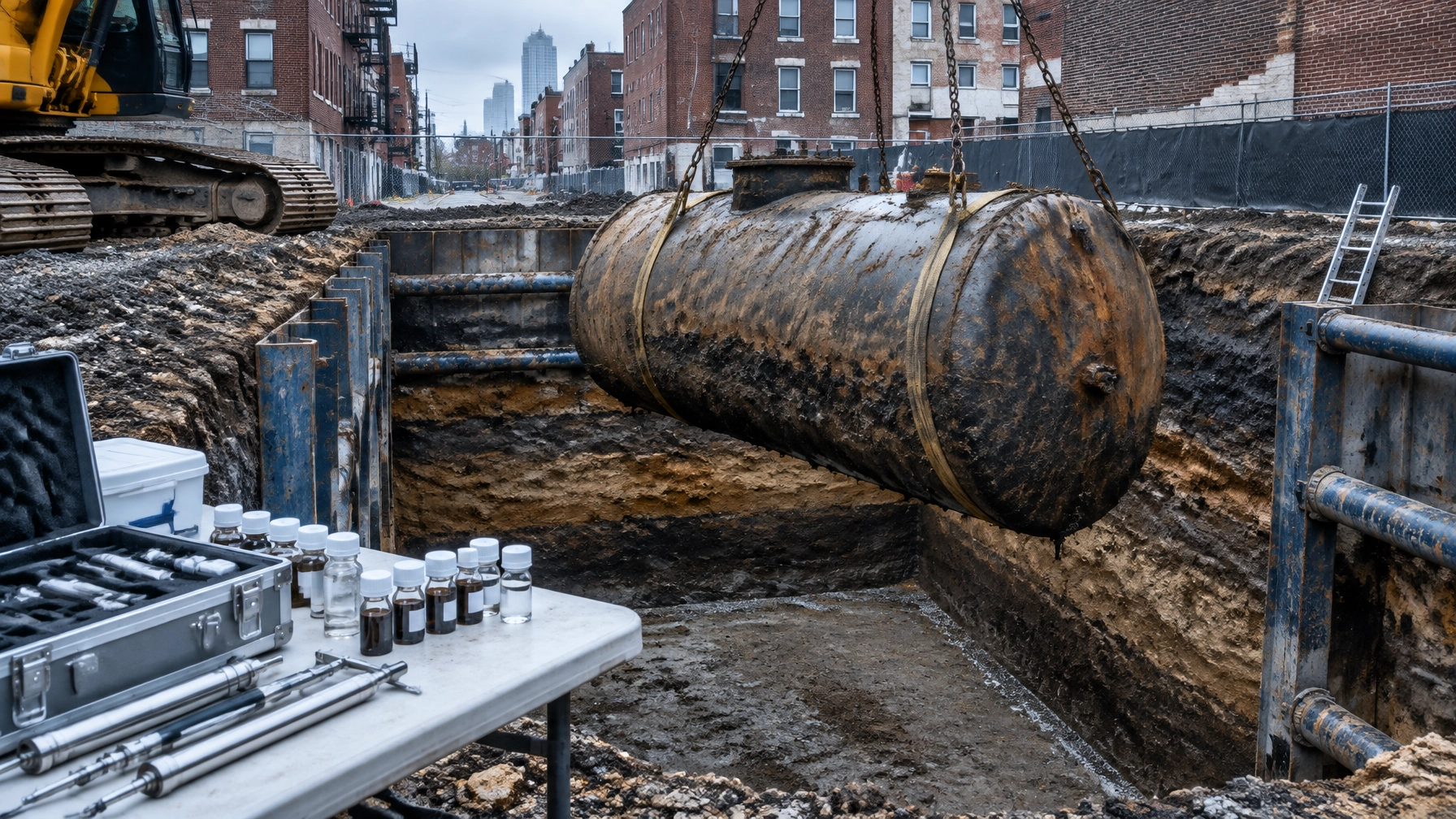
- They miss a REC. They miss the evidence of an old underground storage tank (UST) or a historical dry cleaner. You buy the property thinking it's "clean." Six months later, during excavation for your foundation, you hit a plume of PERC or a leaking tank. Now, you’re looking at hundreds of thousands in remediation costs that weren't in your budget.
- They call everything a REC. To cover their own liability because they didn't do the deep research, they'll flag non-issues as major risks. This triggers a Phase II Investigation involving soil and groundwater sampling.
Research shows that while a Phase I might cost a few thousand, a Phase II can range from $5,000 to well over $100,000. We’ve seen cases where a $1,000 "budget" Phase I failed to properly vet a site, leading to $20,000 in unnecessary sampling just to prove the site was actually fine. That’s a $21,000 bill for a "bargain."
The Local Intelligence Gap: Why NY/NJ Knowledge is Your Shield
You can’t evaluate a site in Hudson County from an office in another state. New Jersey is home to some of the most complex environmental regulations in the country. From the Site Remediation Reform Act (SRRA) to the nuances of the Licensed Site Remediation Professional (LSRP) program, you need a partner who speaks the local language.
At Envicon, we don't just read the records; we understand the history of the neighborhood. We know which industrial zones in Brooklyn or Queens have specific "E-Designations" that require OER oversight. A national firm selling cheap reports won't have that "boots on the ground" intuition.

When we walk a site, we aren't just looking for oil stains. We’re looking at the topography, the surrounding land use, and the regulatory "vibe" of the municipality. That authority: that deep-seated local knowledge: is what de-risks your acquisition.
"Engineering is about math, but development is about trust. You need to know that the person signing your report cares as much about your ROI as you do." : Jason Pancoast, CEO, Envicon Strategic Solutions
Efficiency vs. Cutting Corners: The Envicon Advantage
We get it. You need to move fast. But there is a massive difference between efficiency and cutting corners.
Our approach at Envicon Strategic Solutions is built on being your Visionary Partner, not just a vendor. We use high-end technology to streamline our data collection, which allows us to provide fast turnarounds without sacrificing the integrity of the report.
When you work with us, you’re getting:
- Lender-Ready Accuracy: We know what the big banks and local credit unions need to see. Our reports move through review boards like a hot knife through butter.
- Strategic Vision: If we find a REC, we don't just drop a problem in your lap. We provide a roadmap for how to handle it, what it might cost, and how it impacts your development timeline.
- A Safety Net for Your Legacy: We believe in building communities. A project built on a "cheap" foundation (literally or figuratively) is a project at risk. We protect your name by ensuring your site is truly compliant.

The Bottom Line: Buy Authority, Not Just a Report
If you’re a developer in the NJ/NY corridor, you aren't just buying a PDF. You are buying the ability to sleep at night. You are buying the confidence to tell your investors that the dirt beneath their feet is a solid investment.
A "cheap" Phase I is a gamble where the house always wins. The few thousand you save today could be the reason you’re dealing with a lawsuit or a stalled project five years from now.
At Envicon, we don't compete on being the "cheapest." We compete on being the most authoritative, responsive, and visionary firm in the market. We’re the firm you call when you want the job done right the first time so you can get back to the business of building the future.
Key Takeaways for Your Next Acquisition:
- Check the Credentials: Is the person signing the report a qualified Environmental Professional (EP) with local NJ/NY experience?
- Verify the Standard: Ensure the report strictly follows ASTM E1527-21 to avoid lender rejection.
- Look Beyond the Price: If the quote is significantly lower than the market average, ask what they are not doing (e.g., historical city directory searches or local agency file reviews).
- Think Long-Term: The cost of an undetected environmental issue always outweighs the cost of a high-quality Phase I ESA.
Ready to de-risk your next project with a team that knows the soil of NJ and NY inside and out? Contact us today and let’s build something that lasts.
Envicon Strategic Solutions provides expert environmental consulting, geotechnical engineering, and strategic due diligence for developers and investors across New Jersey and New York.